![PortStrategy[GreenPort]](https://www.portstrategy.com/wp-content/uploads/2026/09/PortStrategyGreenPort.svg)


Charting West-Med port congestion
The Red-Sea attacks are approaching their first anniversary in early November and the maritime world has become used to the new situation of structural re-routings around Cape Good Hope. JP Verschuure, Director at Rebel, asks if the problems are reducing or whether supply chains are just as congested as in the Spring of this year?
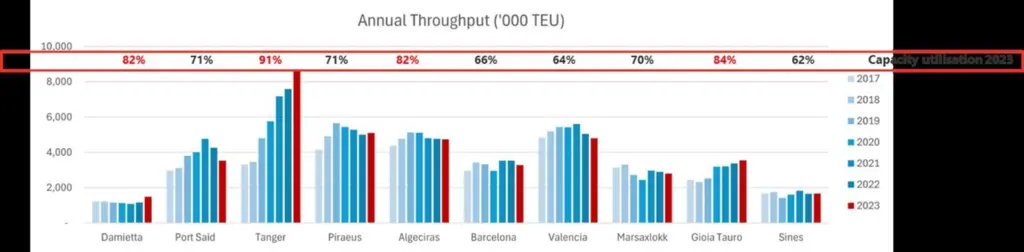
From January onwards – and in April-June in particular – ports in the Mediterranean saw a wave of container vessels and containers shifting to the West Med ports, causing massive port congestions and liners seeking solutions to ship the containers back into the East and Central Mediterranean ports. In the first half of 2024 there was a high container demand with this especially notable at Chinese ports.
The question at this time was whether this was the structural and much hoped for recovery in container demand or did this have to do with a combination of the frontloading of demand, because of the anticipated congestion, and the preempting of tariffs being imposed on imports of Chinese goods in the Americas and Europe? At the same time, port congestion in the West Med saw supply side issues aggravating logistics chain problems.
At Rebel, we presented our analysis of AIS port call data at TOC Europe provided for the MEDports Association in order to understand the shifts in activity across Med ports.
So, what has happened across the Med ports in the seemingly quiet months of July and August?
PORT CAPACITY UTILISATION 2023
The port demand-supply situation in the Med was quite diverse for the key ports across the Med. Container demand growth in 2023 did not impress except in the port of Tanger Med. Equally, there were very few signs at the start of 2024 of a pick up in macro-economic conditions driving new throughput growth.
However, at the the start of the Red-Sea disruptions, capacity utilisation levels in key transshipment hubs in the West Med were already very high. Given that most terminals in these hubs are operated by liner owned terminals, the remaining available capacity in terms of available berthing slots was even more limited. Ports with a higher gateway share like Barcelona, Valencia and Sines were operating at lower utilisation levels going into the disruptive market conditions.
DEMAND REVERSAL: SPRING 2023
From end-January the shipping networks adjusted to the new reality. Containers destined for the Med were rerouted to West-Med hubs instead of the East-Med hubs located directly after the Suez Canal. In particular, the largest container vessels (of over 8000 TEU capacity) were all rerouted away from the Suez canal. Vessels of <8000 TEU mostly kept transiting the canal. Volume growth at Algeciras and Tanger Med has been just above global container demand growth (reported to be around seven per cent in H1 2024) despite already operating at a high capacity utilisation.
The largest impact of the disruptions was on the ports with capacity available at the start of the year such as Barcelona (24.9% y-o-y Jan-May), Valencia (13.0% y-o-y Jan-May) and Sines (28.3% y-o-y Jan-May). Ports in the West-Med were, however, not the only ones to absorb the volumes to the Med. Also, Zeebrugge, Antwerp and Rotterdam handled transshipment volumes. Volumes at the Northwest European ports were subsequently rerouted back into the Med as no additional capacity was available in the West-Med terminals. Liners without major stakes in the West Med container terminals such as Hapag Lloyd, ONE group and Cosco were obliged to use more costly shipping alternatives.
PORT CONGESTION IN Q3?
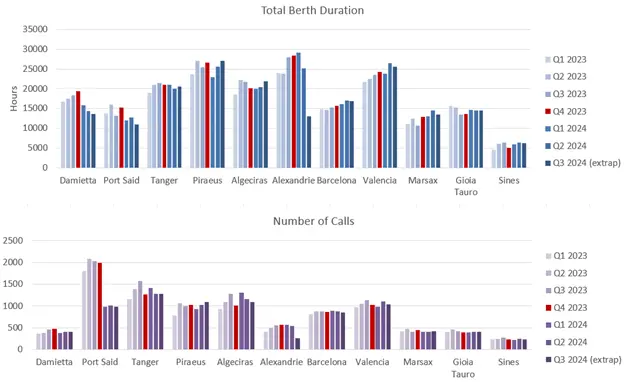
So, after the first shock in spring, where are we with the port congestion in the Med? Port congestion in West-Med ports seem to have marginally improved but ports are still under quite some pressure. Figure 2 below shows the total berth hours and vessel calls per port for the last seven quarters based on Alphaliner’s AIS data.
Berth occupancy in Tanger Med and Algeciras has inched up overall. With the reported increase in volumes throughout 2024 it suggests more consolidation of volumes on vessels and larger parcel sizes on the same services.
In Valencia, Barcelona and Sines, the situation has improved only marginally in comparison to Q2 (in terms of total berth hours and vessel calls). The same trend was witnessed in the reported container throughput volumes over the last few months, still showing extreme growth rates YTD versus last year. Barcelona reported 23.7% y-o-y Jan-August (versus +24.9% y-o-y Jan-May), Valencia 13.0% y-o-y Jan-August (versus 13.0% y-o-y Jan-May) and Sines 22.2% y-o-y Jan-July (versus 28.3% y-o-y Jan-April).
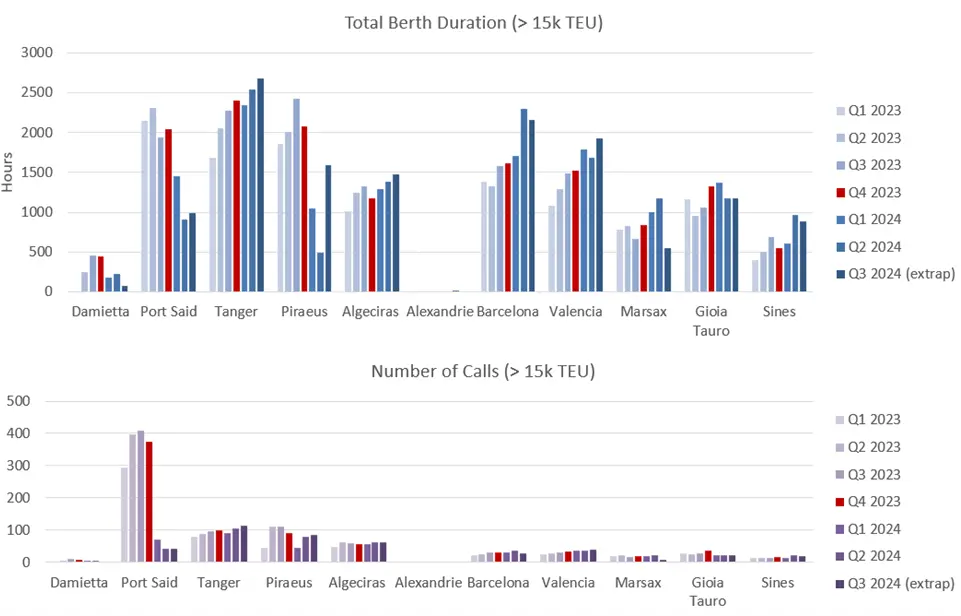
When analysing the vessel segment of over 15,000 TEU capacity in the Med, the different call patterns across the region jump out more clearly. The increase in berth hours for the largest vessel class in Barcelona, Valencia and Sines shows that these vessels are putting pressure on terminal operations with the large parcel sizes required to be handled. On the other hand, such ports are somewhat compensated by the declining berth hours and number of calls from smaller vessel classes. Most notable, however, is that in the case of both Algeciras and Tanger Med the berth hours of the largest container vessels increased while the number of vessel calls was stable. This is a further indication of the consolidation of larger parcel sizes on the largest vessels.
The situation in the East Med ports stayed quite stable as well, bar one exception: = saw an in increase in large container vessel calls with Cosco sailing back into the Med with large vessels. The drop in Piraeus container volumes was still -11.7% in July y-o-y but improved from the worst y-o-y growth rate levels in May 2024 (Figure 3):
STRATEGIC REACTIONS
Despite seemingly less media attention, port congestion in the West Med is here to stay. There is no indication of a drop in volumes in the region. The continued challenging situation has a couple of key strategic considerations affecting the route to a solution.
- Since adding port capacity is a lengthy process, the easiest fix is taking out volumes from the West Med. Transshipment to the Americas can be reshuffled. Likewise Asian cargo will be routed via the Panama Canal into the Americas. This should free up capacity for European transshipment cargoes.
- The Red Sea disruptions have affected global supply chains for much longer than anticipated in the early days of the attacks in November 2023. Projecting this into the future suggests it may be wise that port infrastructure is expanded to deal with the new status quo. But this investment comes at a risk. A solution in the Red Sea may equally turn back the supply chains as quickly as the re-routings started. External financiers will price in this risk when making greenfield investments and externally financed plans may prove difficult despite the clear need for capacity.
- The re-routings further underline the incentive for liners to own terminals at key junctions and bottlenecks in the Med but also globally. Also, liners who typically do not target owning container terminals will further realise the need for it in the current geopolitical environment. Port authorities developing port infrastructure could seek to leverage the interest also from smaller liners in addition to the typical larger players. This should make it even a better basis for projects like Nador West Med. However, most likely the fragmented capacity will result in more expensive facilities on a per TEU basis than in the case of a multi-user facility. However, liners will probably gladly pay the premium.
Overall, it is clear that a fairly fine balance between supply and demand for terminals on the key east-west trade lanes remains. There are some signs of improvement after a year. And as political uncertainties mount, the need for reserve capacity at key strategic hubs becomes ever more apparent. The key questions are: how much will be needed; who will provide it and, especially challenging, how will this be paid for?
Related Articles
 EQUIPMENT
 OPERATIONS
 OPERATIONS