![PortStrategy[GreenPort]](https://www.portstrategy.com/wp-content/uploads/2026/09/PortStrategyGreenPort.svg)





China factor to the fore
From its block on US soybean imports to reducing its dependence on Australian iron ore, China’s trade policies continue to dominate dry bulk shipping. Felicity Landon reports
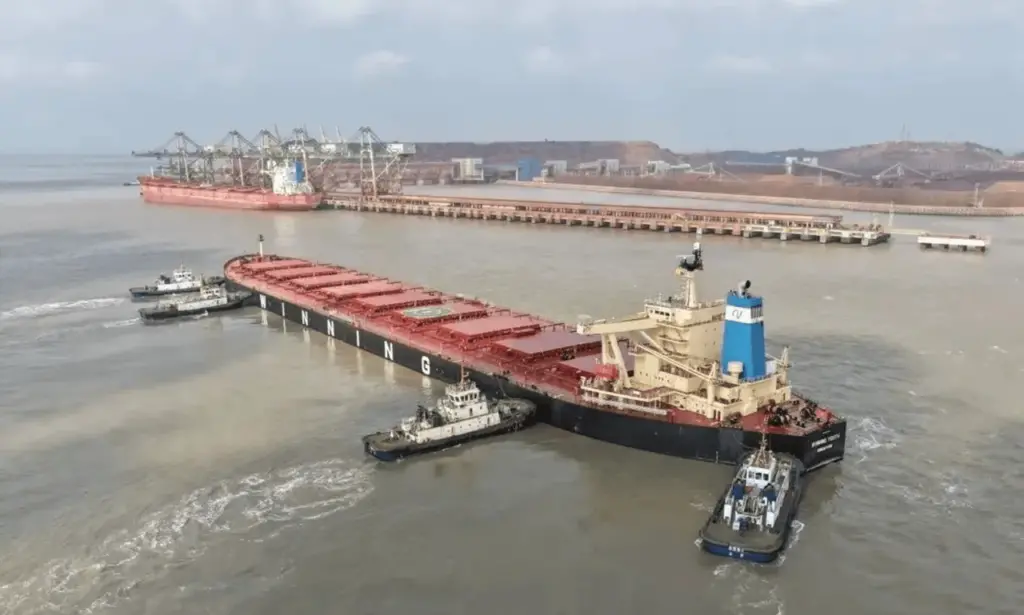
The intricacies of the dry bulk sector were laid out during Drewry’s recent Dry Bulk Shipping Market Outlook webinar, which opened with a bleak observation: the Global Economic Policy Uncertainty Index reached its highest level in 2025, surpassing even the peak of the pandemic, and the sharp rise in uncertainty coincided with the introduction of trade restrictions by the US administration and reciprocal actions from several trading partners.
However, the index started to decline towards the end of 2025, suggesting that global sentiment is gradually stabilising, said Rahul Sharan, Director in Drewry’s bulk research team. “The uncertainty has started go down and there’s clarity on the trade front, so we believe the demand side is going to be stronger next year. Meanwhile, the supply side will be a little bit tight, mostly because the new orders were very low in 2025, meaning that in 2026-27, [newbuilding] deliveries will be very low.”
In 2013-14, the orderbook stood at more than 60% of the dry bulk fleet, he said. “Today, it’s come down to 10%.”
Breaking down bulk performances, he said that grains, which represent 8% of dry bulk volumes, look stronger in terms of the EU’s wheat outlook but corn is weakening, while the coal trade (27% of dry bulk volumes) hinges between climate goals and the drive for energy security.
Sharan predicted that a major driver for dry bulk demand in 2026 and beyond will be the ‘green push’ and tightening of carbon emissions, with increasing demand for EV batteries as EV sales rise, and the energy transition to cleaner resources. “Manganese ore, nickel ore and lithium ore will increase and the share of minor bulks in total dry bulks might go up to 30% in 2030 [compared to 28%],” he said.
MAJOR DEVELOPMENTS
Iron ore accounts for 36% of dry bulks – and in this sector, there are major developments ahead. Brazil is expanding its iron ore mining and export capacity. But more even more significant is the Simandou project, in southeast Guinea, which has one of the world’s biggest and highest-grade iron ore deposits. As mining gathers pace there, it’s set to transform trade patterns.
The first shipment of iron ore from Simandou left in November 2025, transported from the SimFer mine via the newly built Trans-Guinea Railway to the port of Morébaya, where it was loaded on to a bulk carrier bound for China.
Although Rio Tinto is a major partner in the southern blocks of the project, Chinese entities run the other blocks and collectively have the largest strategic influence across the entire project, through mine ownership and shared control of the rail-port infrastructure, said Drewry.
With this huge investment in the Guinean project, China, which takes more than 70% of global seaborne iron ore imports, is naturally expected to take almost all of the Simandou output.
Australia and Brazil are the major suppliers of iron ore to China, accounting for 64% and 22% respectively. Vale, which supplies more than 80% of Brazil’s iron ore, already has shipping arrangements with COSCO and others, so a decline in trade on the Brazil-China route is seen as unlikely.
But China’s political relations with Australia have been strained, “and it is more probable that a rise in Guinea’s iron ore supply will prompt Chinese importers to shift away from Australia to Guinea, which will add to dry bulk shipping demand.”
An added factor is that the Guinean iron ore is very high grade, and the cost of mining is lower than in Australia; the landed cost in China of the Simandou iron ore will therefore be lower and should become even cheaper once operations are at full scale, said Sharan.
Soybeans also caused upheavals in the dry bulk trades in 2025. China suspended purchases of US soybeans as a retaliatory measure against Trump’s tariffs on Chinese imports, and as a result there was almost no US soybean trade between the US and China in May through to September, said Sharan. Typically, around 13m tonnes would have arrived in September-November alone. However, China’s decision to resume purchases following trade discussions will change things around again in 2026.
POSITIVE OUTLOOK
Drewry says that compared to 2025, there is a positive outlook for 2026 across all vessel segments – handysize, supramax, panamax and capsize.
“We are predicting a high chartering rate in 2026,” said Sharan. However, he warned, if more geopolitical issues emerge in 2026, and the economy grows at a slower rate, rates might even contract.
Santosh Gupta, Deputy Director, Drewry Financial Research Services, said there had been downward pressure on the earnings of dry bulk shipping companies due to persistent weakness in the market. With charter rates perceived as lower but asset prices remaining stronger, some players increased vessel sales in 2025, he said.
Related Articles
 EQUIPMENT
 OPERATIONS
 OPERATIONS