![PortStrategy[GreenPort]](https://www.portstrategy.com/wp-content/uploads/2026/09/PortStrategyGreenPort.svg)





Demand to head south?
China is at the centre of world dry bulk demand and plays a dominant role in the coal and iron ore trades. Both the steam coal and coking coal sectors are facing major uncertainties. Andrew Penfold takes a look…
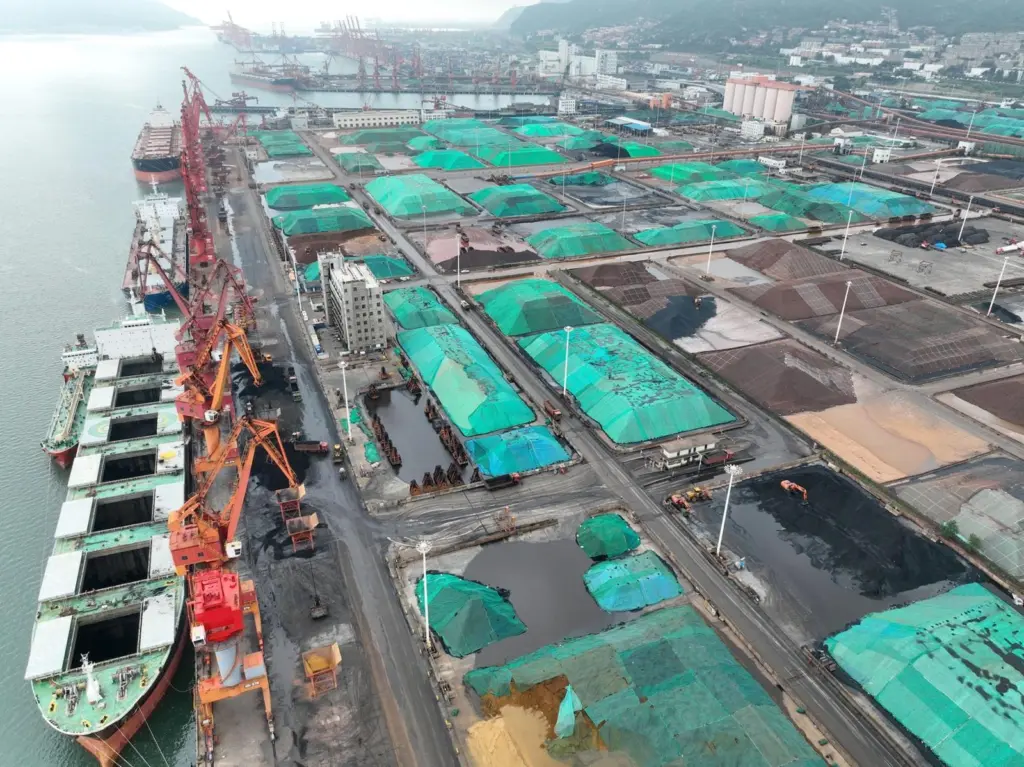
World coal trade reached a staggering 1,466m tonnes in 2023 – a record level. Within this total it is estimated that Chinese imports hit a record level of 474.5m tonnes in 2023, this representing a growth of around 62 per cent over 2022 levels and also ranking as the highest coal import total recorded since 2013. Early data indicates that steam coal volumes will stay high in 2024, with this attributed to slowing domestic production and the price advantage of higher quality imported coal. Demand has been driven by both steam coal for power generation and also coking coal imports for the Chinese steel industry.
Indonesia is the largest supplier of coal to the Chinese markets with this primarily comprising steam coal for power generation. Other major suppliers include Australia and Russia. Indeed, one of the major trends noted since 2021 has been the increased role of Russian coal, with this comprising mainly coking coal for steel production. These supplies – together with those from Mongolia – are overland shipments facilitated by improving rail links. This has clearly been driven by the geopolitical pressures and sanctions that have forced the redirection of Russian coal to their Chinese partners.
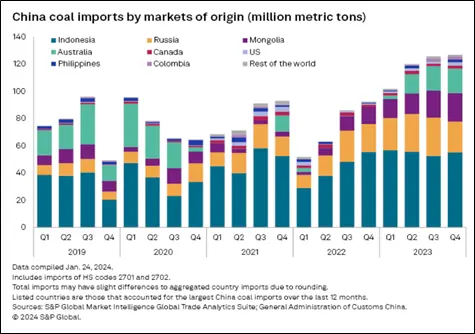
Figure 1 summarises the development of total Chinese coal imports by source since 2019 and highlights the changing structure of the trades.
The outlook for 2024 is highly uncertain with constrained economic growth and a recovery in the nation’s hydro-electric output resulting in an anticipated overall decline in demand of between five and seven per cent. A steeper economic contraction could see volumes fall much more rapidly. With raw material import volumes remaining unchanged this can only mean a switch to higher – politically risky – exports of steel or further stock increases with even weaker pricing.
STEAM COAL DEMAND
China’s energy profile remains dependent upon thermal coal, with coal contributing around 62 per cent of the country’s power generation in 2023, this represents an increase of 7.3 per cent over 2022. With domestic coal production issues focused on pricing and safety concerns at the mines it seems certain that coal’s leading role will remain in the next few years with only slow progress made on developing other power sources.
Figure 2 puts these trends into some perspective. There has been a decline in the proportional significance of coal as a primary energy source, but the sheer scale of the demand increases as the Chinese economy has expanded means that coal use has continued to show significant demand development, with the role of imports central to meeting this demand.
With new coal-fired stations coming on stream absolute demand for coal will continue to expand and, given the location of mines, the costs of domestic production and inland transport capacity constraints this demand will continue to be fed by imports.
| Figure 2: China Electricity Production and the Role of Coal | |||
|---|---|---|---|
|
GwH |
|||
|
Total |
Coal |
% |
|
|
2013 |
5398 |
4200 |
77.8% |
|
2014 |
5583 |
4354 |
78.0% |
|
2015 |
5666 |
4115 |
72.6% |
|
2016 |
5920 |
3906 |
66.0% |
|
2017 |
6453 |
4178 |
64.7% |
|
2018 |
6995 |
4483 |
64.1% |
|
2019 |
7327 |
4554 |
62.2% |
|
2020 |
7623 |
4926 |
64.6% |
|
2021 |
8395 |
5042 |
60.1% |
|
2022 |
8849 |
5486 |
62.0% |
|
2023 |
9456 |
5886 |
62.2% |
|
Source: IEA and various |
|||
Within these totals the major steam coal suppliers are Indonesia, Colombia, and Australia.
The question remains, what will happen to coal consumption (and imports) should a severe economic slowdown be manifested in China? There was some stagnation over 2020-2021 as the Covid crisis locked down large parts of the Chinese economy, but a stagnation (or even contraction) in the Chinese economy would have a immediate and far-reaching impact on Chinese coal import volumes.
THE COKING COAL SECTOR
In 2023, China produced 1.019bn tonnes of steel, with this representing a marginal increase of around 0.6 per cent over 2022 output. The downward trend in the country’s steel industry has apparently been arrested after two consecutive years of declining production. This increase has also been recorded over the first quarter of 2024.
Despite increased interest in DRI and electric arc production this is the key driver of coking coal imports. However, the underlying position for Chinese steel is far from positive. Weakening economic growth and major uncertainties in the construction industry have curbed basic steel demand with this process increasingly manifested over the past two years. The various Chinese steel industry associations are now calling for restrictions in steel production to curb the rapid fall in steel prices that has occurred due to weakening demand and very high steel inventory levels.
The sharp drop in profits of more than 200 steel companies saw capacity-utilisation fall to just 75.6 per cent in March – economic production requires a sustained 90 per cent utilisation rate. This is unsustainable.
With steel production maintained at high levels and a severe weakening in domestic demand it seems certain that China will seek to step-up exports. In 2023, Chinese steel companies increased their exports of steel products by 36.2 per cent over 2022 to reach 90.3 million tons and it seems that this will exceed 100m tonnes in 2024. This increase has partly been driven by surplus output and very low export pricing. There are already mounting trade pressures on Chinese exports, and it seems certain that any further ‘dumping’ of steel on the world market will provoke adverse political responses. The export solution may well have passed its prime.
The downward trend is confirmed by the announcement that steel mills in Yunnan province plan to reduce steel output by around 40 per cent and those in Guangdong province could contract production by 20-50 per cent, with these programmes commenced in March.
It is clear that coking coal demand faces structural downside risks tied to any easing of steel demand and emission reduction objectives. In the medium term this will see coal demand contract and increased requirements for scrap in electric arc furnaces.
IRON ORE IMPLICATIONS
Uncertainties in the steel sector will also have implications for the iron ore trades. World total iron ore trade increased by around seven per cent in 2023 to reach some 1.59bn tonnes. China accounted for around 70 per cent of this total in 2023 (1.18bn tonnes), with this also driven by declining domestic production. In 2024, the global ore trade will directly depend on China and to date the major iron ore exporting companies are maintaining production at high levels.
Any reduction in blast furnace steel production will be directly felt in lower iron ore demand. Given the sheer scale of Chinese demand even a limited contraction – say five per cent – would see a decline in seaborne ore volumes of at least 59m tonnes. This will make a major dent in both bulk carrier earnings and port volumes.
ECONOMIC STAGNATION: CONSEQUENCES
The Chinese economy accounts for over 40 per cent of global seaborne dry bulk trades. China continues to flash red light warnings and the IMF expects total GDP growth of 4.6 per cent in 2024 (down from 5.2 per cent). The lower growth rate is primarily the result of the still emerging crisis in the construction sector and a general slowdown in retail consumption. It should be noted that some independent analysts view the potential downside for the Chinese economy in a much more pessimistic manner.
The weak property sector in China lowered real estate investments in 2023 by over 20 per cent compared to peak levels recorded in 2021. The impact of these issues has yet to be recorded in steel production given the central government’s policy of maintaining output.
What is certain is that iron ore and coal will both eventually be adversely impacted – especially if the export of surplus steel products brings in further tariffs and restrictions. Indeed, the scope for adverse geopolitical issues with China indicates the potential for much more severe volume reductions. Inventory build-up and increased exports are not a sustainable policy this can only result in a decline in volumes of around 5-7 per cent per annum in the next few years.
PORT AND SHIPPING IMPACT
At least since the early 2010s the world economy has been largely sustained by the increasingly important role of China. The dry bulk shipping market is entirely dependent upon demand from China with this being focused on the largest sizes of ore and dry bulk carriers. A sudden decline in demand here will be felt across the entire dry bulk sector as larger vessels cut size to compete for other commodities typically shipped in Panamax and smaller vessels. This process will be felt across the entire fleet and place pressure on earnings for all vessels, with the impact on freight rates being entirely negative. Scrapping of older vessels will increase and the pace of newbuild orders will slow to a crawl.
At the same time, volumes handled at the major iron or coal import terminals will see dramatic downturns as China seeks to balance the books by increasing the role of domestically sourced commodities in a declining demand environment. This will slow any further planned developments of new capacity for import terminals and will also be manifested in delays for the large export terminals currently operating and scheduling expansion in Australia, Indonesia, and other major suppliers.
Such a structural step change development will radically modify port investment programmes and slow expansion. Increased Chinese risk in this sector is just one manifestation of the broader geopolitical issues facing the port industry as the development model established pre-Covid is radically modified.
Related Articles
 EQUIPMENT
 OPERATIONS
 OPERATIONS