![PortStrategy[GreenPort]](https://www.portstrategy.com/wp-content/uploads/2026/09/PortStrategyGreenPort.svg)




FLORIDA’S MILLIONAIRES CLUB
Florida is home to three large container ports that each handle over one million TEU annually. AJ Keyes assesses how these ports are keeping pace with demand
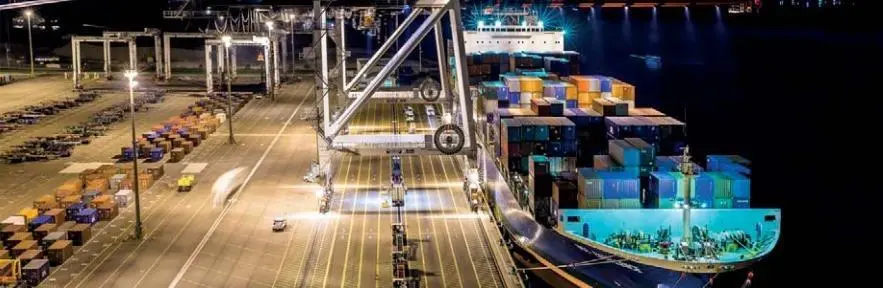
The economy in Florida has been more dynamic in the recent past than in the US as a whole. It has been less impacted by COVID-19 and maintained stronger GDP and employment. This has benefitted major container ports in the state, notably Port Everglades and Miami, while Jacksonville has taken advantage of general port congestion and supply chain disruption in the US South Atlantic area by its ability to reach markets such as Atlanta through intermodal rail connectivity.
These three ports are now each handling over one million TEU per annum and collectively around 3.6 million TEU in 2021 – an increase of 2.7 per cent per annum since 2010.
So, what is driving demand for each port and what is being done to accommodate growth and enhance efficiency?
JACKSONVILLE OFFERS BANDWIDTH
In its last fiscal year, which runs from October 1 through to September 30, the Jacksonville Port Authority (JAXPORT) reported that container volumes were 1.4 million TEU, equal to an annual increase of around 9.6 per cent. The first six months of the new fiscal year has also started positively, with almost 638,000TEU handled, with the stronger US peak season still to come.
Volumes in the port’s two key trade lanes were the driving force, with Puerto Rico activity up by 19 per cent and Asia rising by 18 per cent, factors not lost on Eric Green, CEO, JAXPORT, who comments: “Achieving a container record and strong vehicle volumes while maintaining our efficiencies — all in the middle of a pandemic — speaks to the resiliency and capability of Jacksonville’s maritime community.” He goes on to claim how: “JAXPORT is a solution to the nation’s port congestion problem” pointing out that throughout the pandemic it has had no vessels waiting at anchorage to enter the Jacksonville harbour. Further that, “the port offers available berth and terminal capacity to easily accommodate vessels displaced by congestion at other US ports.”
With JAXPORT seeing Federal support to deepen the Jacksonville shipping channel from 40ft to 47ft, due for completion by Q3 2022 and US$200 million of berth enhancements ongoing at Blount Island, the port will be able to simultaneously handle two new post-Panamax container vessels. This will make JAXPORT a more viable option to compete for all-water services from Asia via the Panama Canal.
In a separate move, Ceres Terminals has commenced operating the TraPac container terminal at the port, signing a 20-year deal to take over from Mitsui OSK Lines of Japan. The Dames Point Marine Terminal has two 1200ft berths and six post-Panamax cranes and in the Q4 2021-Q1 2022 period secured calls from Hapag-Lloyd’s AL3 European service due to congestion at other regional ports. JAXPORT will be hoping that the new operator is able to entice new liner services moving forward.
Ceres Terminals represents a logical choice here because it already operates the intermodal rail yard in Jacksonville that services both Dames Point and the Blount Island Marine Terminal.
BREAD-AND-BUTTER FOR PORT EVERGLADES
Port Everglades also handled 1 million TEU during its fiscal year period ending September 30, 2021, returning the port back to its pre-COVID-19 level. For the first half of its 2022 fiscal year, the port handled 555,315TEU, up by 7.9 per cent on the H1 2021 fiscal year, with demand driven by the Central America/Caribbean region, which provides 74 per cent of all containers handled.
Jonathan Daniels, Chief Executive and Port Director, Port Everglades, comments: “Our bread-and-butter trade partners, Latin America and the Caribbean, are rebounding as they return to manufacturing and open their borders for trade and tourism….Florida ports, including Port Everglades, are poised to handle larger container volumes and may be able to help alleviate congestion that other ports are experiencing,” he concludes.
MIAMI MAGIC
The Port of Miami handled 1.25 million TEU in its fiscal year period ending September 30, 2021, reflecting a strong increase of 17.6 per cent over the comparable 12-month period. The calendar year was described by the port as its “busiest in history” with expectations for the trend to continue in 2022.
Trade with the Caribbean and Latin America is dominant for Miami, accounting for 52 per cent of container traffic.
Based on the port’s geographic location, this is not going to change and its location in Miami-Dade county, which generates almost 15 per cent of total Florida state GDP, confirms a solid local market to serve.
The Port of Miami said it continues to operate without delays to vessels, with all cargo flowing in spite of the wider disruptions to the supply-chain across North America and the rebound from the COVID-19 pandemic.
Related Articles
 EQUIPMENT
 OPERATIONS
 OPERATIONS