![PortStrategy[GreenPort]](https://www.portstrategy.com/wp-content/uploads/2026/09/PortStrategyGreenPort.svg)



GOING GREAT GUNS
Container ports on the US Gulf Coast are outperforming national growth and their peers on the eastern and western seaboards. AJ Keyes assesses the plans and strategies of ports in the region
Serving the US, and especially the large discretionary markets of the US Midwest, continues to be undertaken by ports located in each of the “four corners” of the US (Northeast, US South Atlantic, Southern California and Pacific Northwest),” explains Craig Anderson, Managing Partner at specialist maritime business intelligence company, Data and, before adding, “but looking at the data, the US Gulf Coast ports are going great guns, driven by the pace of local economic growth in Texas and declining efficiencies in San Pedro on the US West Coast. Yet serving the US Midwest by waterway is still yet to be developed.”
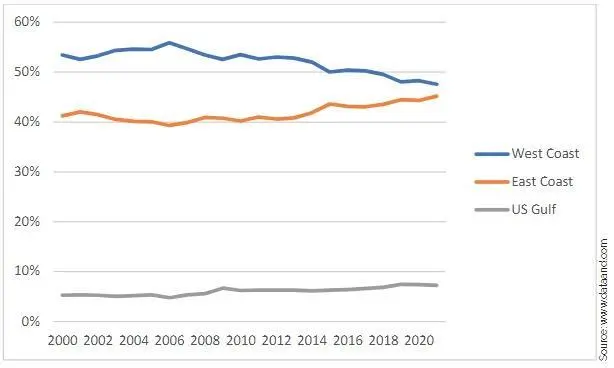
For the period 2000 to 2021, container ports on the US Gulf Coast recorded average annual growth of 5.4 per cent. By comparison, total North American port demand grew by 3.9 per cent per annum, with East Coast ports generating 4.4 per cent per annum and West Coast ports seeing increases of 3.3 per cent per annum.
As a result, the US Gulf Coast has seen its share of total North American container port traffic increase from an estimated 5.4 per cent to 7.2 per cent over this assessment period, with total port volumes rising from 1.6 million TEU per annum to almost 4.9 million TEU per annum.
Figure 1 provides a summary of this position as it has developed and while the gap between the West and East coasts can be seen, the steady and continuing increase by the US Gulf Coast is evident.
USGC: ALTERNATIVE GATEWAY ROLE?
To maintain growth levels and handle increasing volumes the ports on the US Gulf Coast must continue to increase productivity and improve efficiencies. A central question in this respect is with transport logistics congestion hitting the West Coast hard and now occurring more frequently at East Coast ports, are US Gulf Coast ports capable of keeping pace with projected future growth, while also acting as an alternate gateway to frustrated shippers and cargo owners?
A round up of developments at the ports of Houston, New Orleans and Mobile will answer this question.
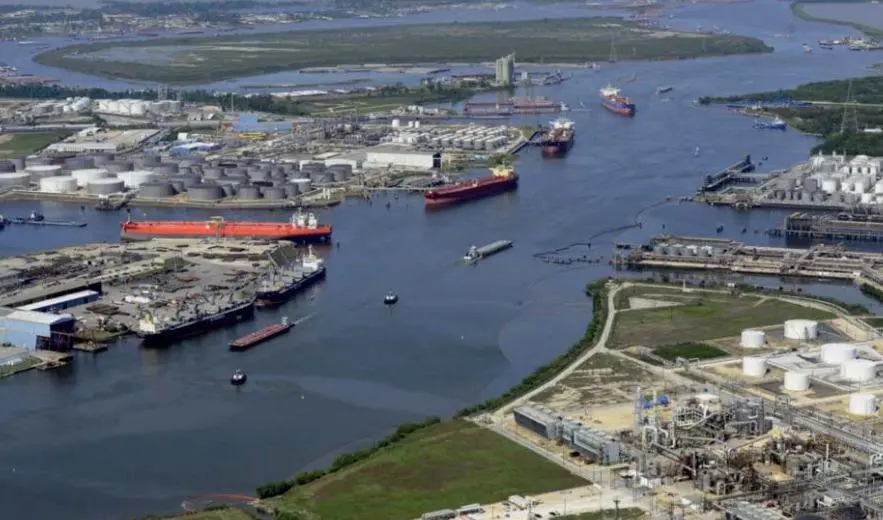
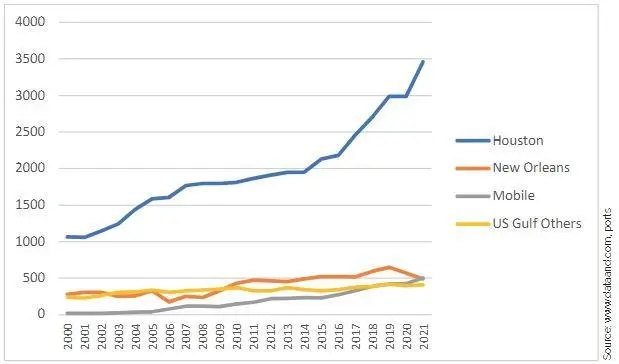
Houston is by far the dominant gateway in terms of volumes, as Figure 2 shows, and unsurprisingly the port has also been the recipient of the strongest growth in recent years. In 2014 Houston’s total volumes were 1.95 million TEU, but by the end of 2021 this figure had risen to almost 3.46 million TEU, supported by the oil & gas economic boom and industry relocating from California.
HOUSTON: BIGGER, DEEPER, SAFER
Subject to strong demand, Houston has continued to improve its infrastructure and access. The project to widen and deepen the 52-mile Houston Ship Channel commenced in 2021 and is expected to be finished by 2025.
The Houston Ship Channel expansion, also known as Project 11, will widen the channel by 170ft along its Galveston Bay reach, from 530ft to 700ft. It will also deepen some upstream segments to 46.5ft, further ensuring safety and efficiency improvements for shipping, while also reducing NOx emissions by 38 per cent.
The port’s container terminals currently handle about 24 ship calls a day, with an additional three to six ships usually waiting to get into the facilities, says Jeff Davis, the port’s Operations Officer, and there has certainly been an increase in the sizes of vessels calling.
However, the role of container operations in Houston needs perspective. Container ships only account for 20 per cent of total shipping activity in the channel, with liquid bulk clearly dominant, representing 70 per cent of the overall number of ships calling. Put that into context with Houston being the largest US port in terms of foreign waterborne tonnage (of 193.9 million short tons in 2021), and the need for Project 11 is easy to see.
Of course, expansion of container facilities continues too. Houston recently added 100 acres of terminal space, in July 2021, for new container yards at the Bayport Container Terminal, explains Roger Guenther, Executive Director, Port of Houston. He also points out that in February 2022 three cranes were installed on a new berth at the Bayport complex, while the Barbours Cut Terminal has seen new truck gates increasing inbound lane capacity from 15 to 29.
Despite this investment, however, the port remains dependent on the access canal and it will still not be adequate for the largest new Panamax vessels. Potentially this could impact Houston’s ‘must-call’ status, especially if another truly deepwater facility is developed elsewhere on the US Gulf.
NOLA: OVERCOMING HEIGHT LIMITS
The Port of New Orleans (Port NOLA) had a tough 2021, with its 2020 total container volumes of 572,853 TEU falling to 488,199 TEU, representing a drop of 14.8 per cent.
The US Gulf continues to suffer from a shortage of access to containers caused by global supply chain issues. Janine M. Mansour, Commercial Director, Port NOLA, cites this as an influential factor on the port’s 2021 performance. “On the container export side, we were down 12 per cent,” she points out.
Nevertheless, NOLA has big plans for future container activities and to be better placed to respond to changing market dynamics. Brandy D. Christian, President and CEO, Port New Orleans explains: “We continue to position ourselves as an alternative gateway during supply chain disruptions.” As carriers and shippers continue to look to Port NOLA as the US Gulf gateway of choice, we are committed to investing in our state’s existing maritime assets, while also making progress on a second container facility that will serve vessels of all sizes, and create more jobs and opportunity for Louisiana.”
The existing Napoleon Avenue Container Terminal recently received four new gantry cranes as part of a US$100 million investment, but the port’s major future investment focus involves the 1100 acres of land acquired in Violet, LA, where it plans to develop the Louisiana International Terminal (LIT) at St. Bernard Parish. A new terminal taking up 400 acres is planned, supported by adjacent logistics activities. This new location means ships do not have to pass under the Crescent City Connection Bridge, with its height restriction of 170ft, meaning the largest ships that can pass under it are 6200 TEU, whereas the Violet option can receive new Panamax size tonnage of 15,000 TEU.
However, the potential new facility at Plaquemines Parish will receive larger ships in deeper water and with its largescale planned capacity it is a clear rival to the LIT scheme and will be up and running before it.
MOBILE BARRELS ON
Despite the global pandemic, the Port of Mobile handled record container volumes in 2021. A total of 502,623TEU passed through the facility, which the Alabama Port Authority says represents an increase of almost 19 per cent over 2020. This trend has continued into 2022, with the port authority confirming that April 2022 was a 39.7 per cent year-on-year increase, as container activity rose for the eighth continuous month.
There has also been confirmation of terminal expansion. As part of a US$100 million project, an additional 32 acres is being added to APM’s existing 115-acre site at Choctaw Marine Terminal. The project is due to commence during 2022, with the first 19 acres ready by 2024 and the remaining 13 by 2025.
As part of the process, APM Terminals is expected to add two more ship-to-shore gantries to complement the existing four super-post-Panamax units. Overall the current 650,000 TEU/yr capacity will be raised in phases to an eventual level of 1.5 million TEU per annum.
CLEAR DEMAND
There is a clear demand for cargo owners and shipping lines to utilise the existing ports on the US Gulf, with each facility responding in kind with various plans to keep pace with demand. While Houston, NOLA and Mobile continue to focus on their respective hinterlands, the new Louisiana Gulf Gateway Terminal (LGGT) at Plaquemines Parish looks to be a game changer. It too will service the local hinterland but it also has a major focus on exploiting the Mississippi river system to serve key markets such as St Louis, Memphis etc. Its plans encompass partnering with a specialist vessel provider to achieve this to provide access at a highly competitive cost.
Related Articles
 EQUIPMENT
 OPERATIONS
 OPERATIONS