![PortStrategy[GreenPort]](https://www.portstrategy.com/wp-content/uploads/2026/09/PortStrategyGreenPort.svg)


Heavyweight hurdles
Jacques Vandermeiren, CEO of the port of Antwerp-Bruges, was recently quoted as saying that the container segment of its business portfolio “continues to pose significant challenges.”
This is a view endorsed, and expanded upon, along the North Continent coast at Rotterdam. Rob Bagchus, President, Rotterdam Terminal Operators’ Association, explains that the facilities in the port are “too full” before outlining the challenges it brings. “Containers staying longer in the terminals take up capacity, this not only applies to the deep-sea terminals, but also to the inland terminals,” he says.
To some extent, demand for terminals at these two ports is nothing new. Both are mainstays in all liner shipping schedules, which is reflected by the container volumes handled and infrastructure available.
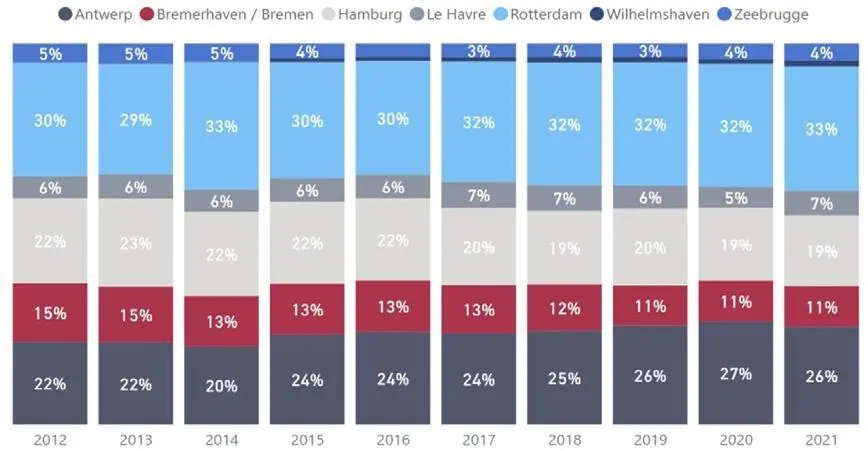
In 2021, Rotterdam handled 15.3 million TEU and Antwerp recorded just over 12.0 million TEU, representing estimated shares of the regional market of 33 per cent and 26 per cent, respectively.
As Figure 1 shows, both of these ports have successfully increased their shares of the Hamburg – Le Havre port range, with Rotterdam’s up from 30 per cent in 2012 and Antwerp gaining a four per cent share on the 22 per cent figure of 2012.
These improvements have been secured largely at the expense of ports in Germany over the period, with Bremerhaven seeing a drop from 15 per cent in 2012 to 11 per cent by the end of 2021 and Hamburg losing three per cent on its 2012 share of 22 per cent.
CHALLENGES REMAIN
While the longer-term position of Rotterdam and Antwerp remains strong and demand for access to terminals is not expected to change much, a number of challenges in 2022 remain.
For the first half of 2022, Rotterdam saw a drop of 6.2 per cent on H1 2021, to 7.3 million TEU, while for Antwerp-Bruges a 4.4 per cent decrease in the six months to June 2022 resulted in 6.8 million TEU handled.
Rotterdam has attributed this decline in overall volumes primarily due to a loss of traffic to and from Russia, as well as “the ongoing disruption of container logistics”.
In a statement, the Port Authority explained that container vessels were “no longer able to comply with their sailing schedules” and as a result in order to seek to make-up the missing time were omitting scheduled calls and then discharging/loading more boxes in other ports of call.
This trend was proven with Rotterdam seeing 5.5 per cent fewer calls in the first half of this year compared to H1 2021, although the ships that did call recorded an average 6.1 per cent rise in overall container exchanges, albeit this is also a feature of larger vessels in service.
The port explained the impact of this trend: “This results in peaks of activity at the terminals, which are already very busy, since containers are left for longer periods because ship arrival times are more unreliable.”
A similar position is occurring at the recently merged port of Antwerp-Bruges, with the port authority outlining that its container terminals are “under constant pressure.” The organisation adds: “With globally disrupted container liner shipping, vessel delays and high volumes of import cargo, the container trade continues to face operational challenges.” The port hopes that the merger of the two complementary facilities will “reconcile economy, people and climate.” Additionally, the development of Saeftinghe dock in Antwerp will add 1400m of quay and 5.1 million TEU of capacity. This is a key part of the port’s plans to eventually add up to 7.2 million TEU of capacity – a plan formulated with the new merged entity in mind. This capacity is being matched at Rotterdam with the new 7m TEU Hutchison Ports-TiL terminal due from 2027 – see p6.
MATCHING MARKET DYNAMICS
Pressure on both ports to keep pace with ever-challenging market dynamics remains and there has been little relief from congestion through the European summer after the two-month Shanghai lockdown and move into peak season during Q2 2022.
This is making the remainder of 2022 challenging, despite the rapidly deteriorating economic position across Europe due to cost-of-living and energy issues, along with the negative impact of Russian attacks on Ukraine. For the time being at least, it appears congestion is set to continue.
A major concern is that it brings more stock to already high inventory levels.
Dean Davison, Head of Maritime Advisory, Infrata, elaborates: “It is reasonable to expect greater volumes to have commenced flowing after the China lockdowns with these adding to the usual peak season demand. With inventory levels already high anyway, where shippers had built up stock, then late-arriving vessels, congestion to access berths, worker strikes and inland logistics challenges, will all serve to further disrupt cargo flows to end-users.”
Liner schedule reliability is a thorny issue. Specialist information provider, Data&, confirms that in 2019 before the COVID-19 pandemic transit time was, on average, in the Asia- Europe trades between 47-49 days, but now the figure is considerably higher, sometimes in excess of 120 days. This clearly makes planning a supply chain or managing inventory considerably more difficult, if not near impossible.
Lennart Verstappen, spokesperson for the Port of Antwerp- Bruges, has stated that in the current disrupted container shipping environment, it is no longer possible to accurately make the same predictions regarding terminal operations.
He lists a growing number of (clearly relevant) factors: “Congestion and disrupted shipping have been going on for months, starting with the pandemic, then intensified by the mv Ever Given Suez Canal incident, geopolitical disruptions such as the war in Ukraine, lockdowns in China, high peaks in import volumes, and delayed ships.”
These challenges, or a selection of them, look set to continue for the remainder of 2022, regardless. From the perspective of Antwerp and Rotterdam, the respective port terminals will see strong volume growth and, potentially, higher revenues from storage, but the smoother flow of cargo from ships arriving on time and on shorter transit times would certainly be regarded as a preferable alternative.
Related Articles
 EQUIPMENT
 OPERATIONS
 OPERATIONS