![PortStrategy[GreenPort]](https://www.portstrategy.com/wp-content/uploads/2026/09/PortStrategyGreenPort.svg)

Market Expectations
Talking to major container ports in the North Europe region offers an insight into strategies and plans to remain competitive and continuing to support cargo flows. Dean Davison outlines a range of key port investments
“Our port is well known for its productivity and flexibility,” states Tineke van Ginneken, Key Account Manager Consumer Goods, Beverages and Forwarders, Port of Antwerp-Bruges, when asked what makes the port successful, before adding: “When we look into the portfolio of our maritime connectivity, we see a well-diversified portfolio. Looking at the current geo-political tensions, it’s always good to be less depending on one particular region.”
Kris Danaradjou, Deputy Director of Development at HAROPA PORT offers another perspective. “HAROPA PORT is benefiting from growth dynamics that exceed the average of the Northern European range. This growth is supported by a comprehensive and competitive maritime offering. HAROPA PORT is connected to nearly 650 ports worldwide and remains both the first port of call on imports and the last on exports within the Northern European rotation—providing a decisive logistical advantage,” he confirms.
Further insight from Axel Mattern, CEO, Port of Hamburg Marketing, outlines the importance of inland reach to a port’s success: “Hamburg’s role as a gateway port is reinforced by its extensive hinterland network. The port is closely integrated with European rail, road, and inland waterway systems, allowing cargo to move efficiently into key industrial and consumer markets across Central and Eastern Europe.”
VOLUME POWERHOUSE – HAMBURG-LE HAVRE
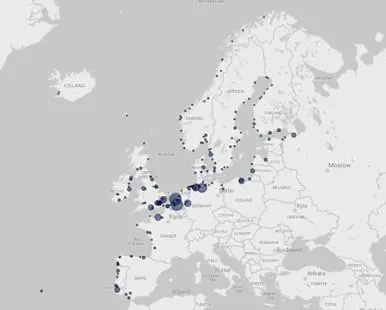
As Figure 1 shows, the geographic range of North Europe includes the UK and Scandinavia, but in terms of container ports, it is the Hamburg-Le Havre range that remains the volume powerhouse, currently seeing more than 45.2 million TEU (if Polish ports are also included).
Figure 1: Container Ports in North Europe
So, how are container volumes developing at major ports in this key region?
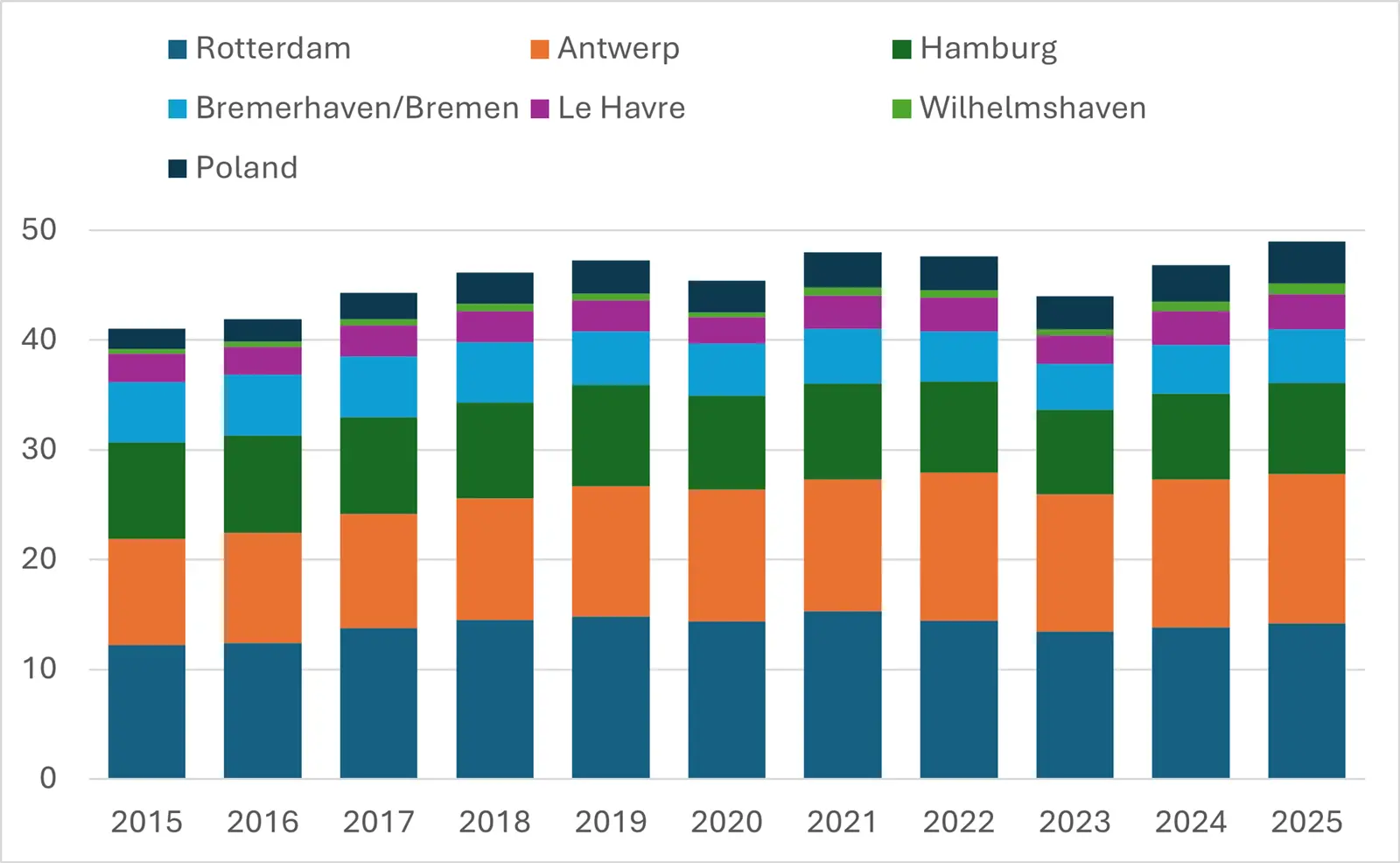
In 2025, an estimated 45.2 million TEU passed through the major ports (including Poland). This represents the highest recorded total since 2015 and a return to annual year-on-year growth following 41.0 million TEU in 2023 and 43.5 million TEU in 2024. After the impact of COVID-19 and the subsequent rebound and rebalancing, a return to continued growth appears to be happening. Unsurprisingly, Rotterdam and Antwerp remain the largest volume container ports, although all facilities in this range recorded growth for 2025 over 2024.
Figure 2: Development of Container Volumes at Major Ports in Hamburg-Le Havre Range Since 2015, in Million TEU
SIGNIFICANT RAMP-UP
With continued long-term growth occurring across the region, it is imperative that ports each continue to invest in infrastructure and capacity – and they all are clearly doing so, none more so than at Antwerp.
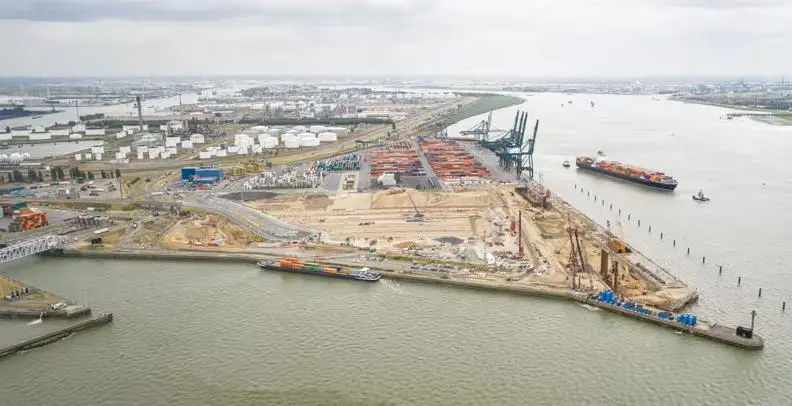
“The biggest project/investment for our port will be the new container dock that will be built. In 2026 we will start with the tendering procedure for the new container dock. Construction is to start in 2027 and we hope to welcome the first containers by 2032,” explains van Ginneken, although she adds that this project is just one part of the wider project of redevelopment and expansion dubbed ECA (Extra Container Capacity Antwerp): “In the past years we have started, together with our port community, to make adjustments to the current infrastructure in our port area. The whole ECA project, from start to finish, will result in an extra capacity of 7.1 million TEU in the port.”
This port is also seeing automatisation at DP World Antwerp Gateway, with yard capacity up 30% to help generate an annual capacity of 3.7 million TEU. With a record throughput of just under 2.5 million TEU in 2025, the facility has an estimated utilisation of 71%, so the extra capacity is needed.
Further investment is also ongoing at PSA’s Europa Terminal. “Not only is the quay-wall being re-built (to create deeper draft for the containerships), but the whole terminal is also being renewed. The project, called Project Emerald, will be finished by 2033, and comprises three phases. The main goal is to become a climate neutral terminal, to increase operational safety, and to optimise the capacity of the terminal (semi-automated cranes with a reach of 26 containers and ASC’s ) up to 2.4 million TEU (+41%),” explains van Ginneken.
To relieve the pressure on terminals, significant investments are being made in Rotterdam to expand terminal capacity, including at APMT2, Euromax and RWG. ‘Rotterdam is the only Northwest European port with room for substantial growth — up to eight million additional TEU per year. This will enable us to continue facilitating the expected consumption growth and economic development in Northwest Europe,’ says Frank van der Laan, Senior Business Intelligence Advisor at the Port of Rotterdam Authority.
Van der Laan is upbeat moving forward, expecting growth to outpace the market: “This year will still be quite challenging, but from 2027 capacity will increase and waiting times are expected to decline.”
HAROPA ports, including Le Havre, point to its significant ramp-up in investments. “The 2020–2025 strategic plan saw €190 million committed in 2025, totalising more than €1 billion in five years. The next strategic plan (2026–2030) will continue this momentum, with a new ambitious €1 billion investment program over five years,” confirms Danaradjou.
He explains that there are major structuring projects underway along the Seine axis: “The “chatière” project in Le Havre will create a direct river connection between Port 2000 and the Seine, removing a major break in the logistics chain and strengthening the competitiveness of massified transport. HAROPA PORT will keep developing multimodal platforms along the Seine axis, particularly in the Paris region, as well as industrial developments, with more than 60ha allocated over the past two years and a land reserve of 700 to 800ha available by 2030.”
With capacity optimisation continuing at Port 2000 and a shore power electrification programme, Danaradjou states that HAROPA’s modernisation initiatives are continuing.
Hamburg is not to be left out in terms of investment and expansion as well, as Mattern confirms: “A comprehensive package of measures is currently being implemented at the Container Terminal Burchardkai (CTB) to significantly increase annual handling capacity through extensive automation. In addition, the ‘Transformation Waltershofer Hafen’ project will further strengthen this key container handling area by expanding the turning basin from 420m to 600m thereby enabling safer and faster manoeuvring of large vessels and by extending and largely automating the Eurogate Container Terminal Hamburg (CTH), thereby creating additional capacity.
MARKET EXPECTATIONS

Kris Danaradjou, Deputy Director of Development, HAROPA PORT
Danaradjou at HAROPA explains why current projects are being undertaken and the rationale involved. “These initiatives directly address market expectations and target key competitiveness factors at the European level, particularly in the context of logistics decarbonisation. The “chatière” project, for example, will eliminate a historic break in the supply chain and enable a significant increase in river transport, resulting in both improved competitiveness and reduced emissions. In parallel, our hinterland market has been extended by efficient railway connections to the main cities in France and neighbouring countries. The container traffic transported by railway from and to Le Havre has doubled since 2021 and it will go on with the opening of new multimodal connection platforms in France main economic regions,” he states.
He also offers a good summary supporting a need for investment, something that all ports will be able to relate to and agree with: “Terminal developments scheduled in the coming years with additional land for extension will strengthen our ability to handle growing volumes, improve reliability and productivity—key criteria for operators—and support the growth of transshipment and inland flows.”
Hamburg’s Mattern concurs when summarising the benefits of the port’s investment projects. “Our initiatives will further strengthen the Port of Hamburg’s competitive position by directly enhancing efficiency, capacity, and reliability across the logistics chain. The modernisation and automation of container terminals will significantly increase handling productivity while making better use of existing space. This allows the port to accommodate growing cargo volumes without requiring extensive additional land use. At the same time, the expansion of the turning basin and improvements in nautical infrastructure will enable safer and faster vessel movements, reducing turnaround times and increasing schedule reliability,” he concludes.
POLISH PROWESS
“Poland’s ports, and notably the Baltic Hub Container Terminal (BHCT) at Gdansk, is helping the country transition from a regional player to a core North Europe node,” explains Craig Anderson, Technology & Digital Lead at Data&.
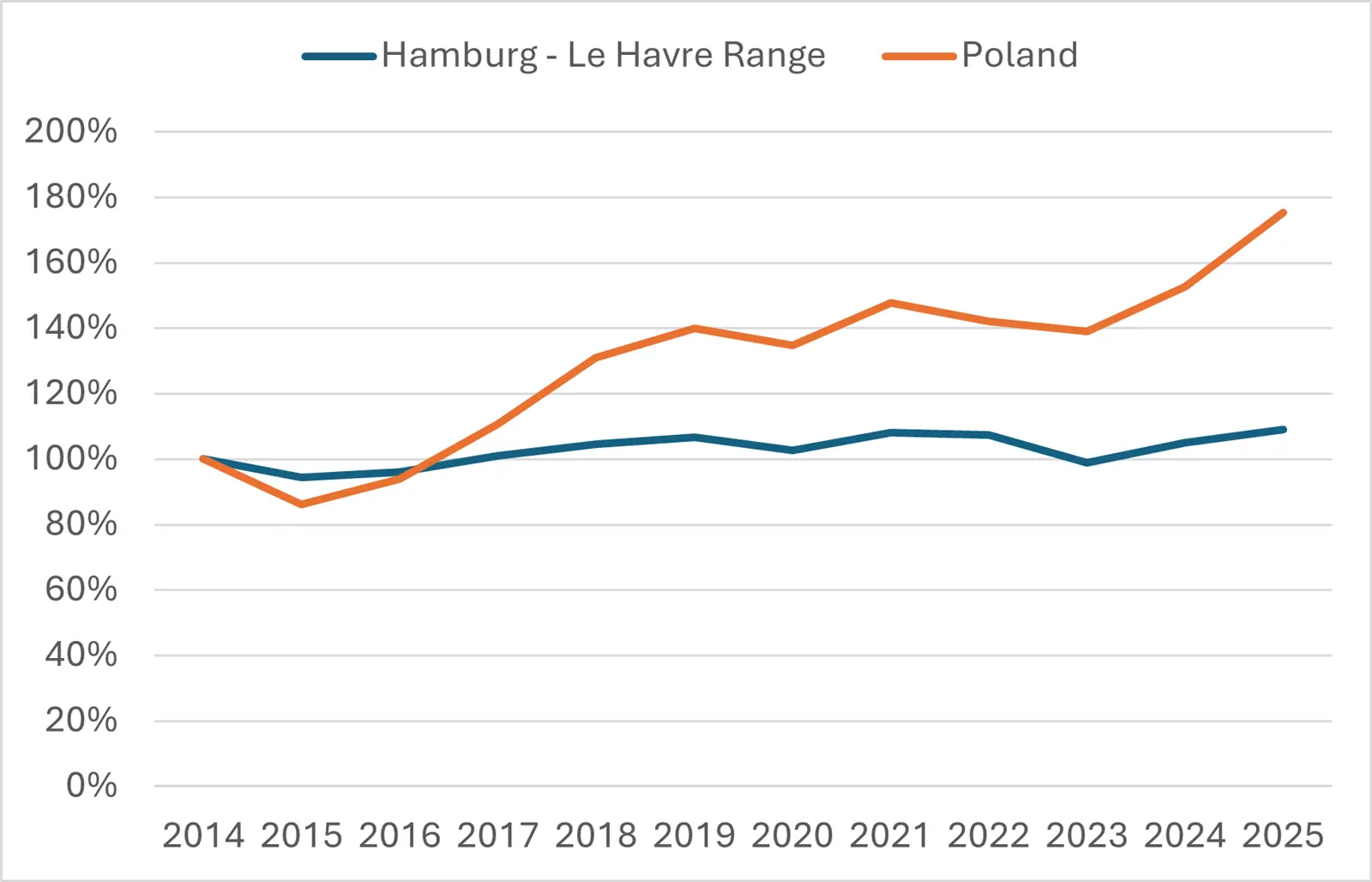
He adds that a growth divergence has emerged with Gdansk delivering high single-digit CAGR, versus lower / flat growth across core range ports: “Poland’s ports have been increasing share year-on-year across the past decade, with gains largely coming at the expense of Hamburg and secondary core ports. It is important to note that this share growth has persisted despite macro volatility throughout the wider North European region, thereby indicating structural competitiveness for the country’s ports.”
Figure 3 clearly supports Anderson’s explanation, with comparative growth in Poland outperforming the collective region. The core ports remain dominant in terms of absolute TEU, but relative growth momentum has seen some shift to the east.
Source: Data&
To keep pace with demand, BHCT is building a new T3 terminal, increasing capacity by 1.5 million TEU to 4.5 million TEU per annum. The E470 million investment is seeing a new 717m deep-water quay with 18m water depth being built across 36 ha. In addition, eight new sip-to-shore quay cranes and 28 semi-automatic RMG units (operated remotely) are being added. Construction of the new terminal began in October 2022 and is scheduled for full commissioning in the second half of 2025.
Related Articles
 EQUIPMENT
 OPERATIONS
 OPERATIONS