![PortStrategy[GreenPort]](https://www.portstrategy.com/wp-content/uploads/2026/09/PortStrategyGreenPort.svg)




Mict Powers On
Adding major new capacity, deploying new near zero emission container handling equipment and implementing a major digital systems upgrade Manila International Container Terminal (MICT) continues to advance at pace.
The Manila International Container Terminal (MICT) is the primary container gateway in the Philippines, astutely staying ahead of user demand and handling growing import and export cargo flows.
‘User demand’ is multi-faceted comprising steadily increasing container volume, a challenging mix of liner services and a steady upturn in average vessel size.
In 2025 MICT broke the 3mTEU barrier for the first time following a 5.4% increase in volume in 2024 and a 4.5% rise in 2025. Against this background and as per past proactive practice, ICTSI is now raising the terminal’s capacity to 3.5mTEU/yr via its phased Berth 8 development. This is designed to accommodate ultra-large container vessels of up to 18,000TEU. Completion will be in 2027 and will provide 300m of quay with a draught of -15m alongside and a supporting yard area of 12ha.
The ability to handle larger classes of vessel also features in MICT’s Berths 6 and 7. They are designed to accept up to the neo-Panamax class of vessel and jointly feature six quay cranes, with a twin lift capability, on 600m of quay.
The container services and vessel types calling at MICT are diverse presenting operational challenges. “Our liner customer base comprises direct calls, feeder services and others operating in both capacities,” explains Christian Lozano, CEO, MICT. “There are regular scheduled calls and ad hoc vessels calling, and over the larger part of 2024 – 2025 we have achieved ‘on window’ berthing slots of above 70%. Given the nuances of our operational situation and the volatility in the marketplace over the period – liners bypassing the Suez Canal due to Houthi attacks, the Panama Canal drought, US East/Gulf Coast labour strike etc – we see this as a good result and one which despite continuing market volatility we are endeavouring to build on.”
Statistics show that currently MICT handles 18 regular direct liner services, 15 direct services that also accommodate feeder cargo and 12 feeder services.
On Berth 8, Lozano adds: “The expansion consolidates the Port of Manila’s role in regional and global trade corridors. For exporters and shipping lines, the project will provide increased berth availability, improved vessel turnaround times, and a more dependable environment for long distance cargo planning.”
MICT, International Container Terminal Services Inc’s (ICTSI) flagship container terminal, currently handles approximately 70% of the total container volume moving through the Port of Manila, the Philippines largest port.\
PERFORMANCE PUSH
MICT, along with the other 32 ICTSI terminals worldwide, is committed to continuous improvement. This spans multiple dimensions: capacity expansion as per Berth 8, new equipment acquisition, a strong emphasis on decarbonisation and harnessing the powers of the digital world including AI.
There are several notable developments on the container handling systems front.
The four new ship-to-shore cranes for Berth 8 are designed for remote operation – a first at MICT but of course ICTSI already has extensive experience of this and notably at its fully automated Victoria International Container Terminal (VICT) in Melbourne, Australia. The emphasis on training at MICT is also manifest in this context with the designated remote operators visiting VICT, Busan and Evergreen’s advanced Terminal 7 in Kaohsiung to learn about and experience this type of operation first-hand. The full portfolio of training at MICT spans training for new job roles, competency, upskilling and safety and efficiency training with this carried out via all key modes: classroom, on-the-job and simulator-based.
There has also recently been significant investment in equipment deployed on the landside with reduced or near zero emission (NZE) equipment prominent.
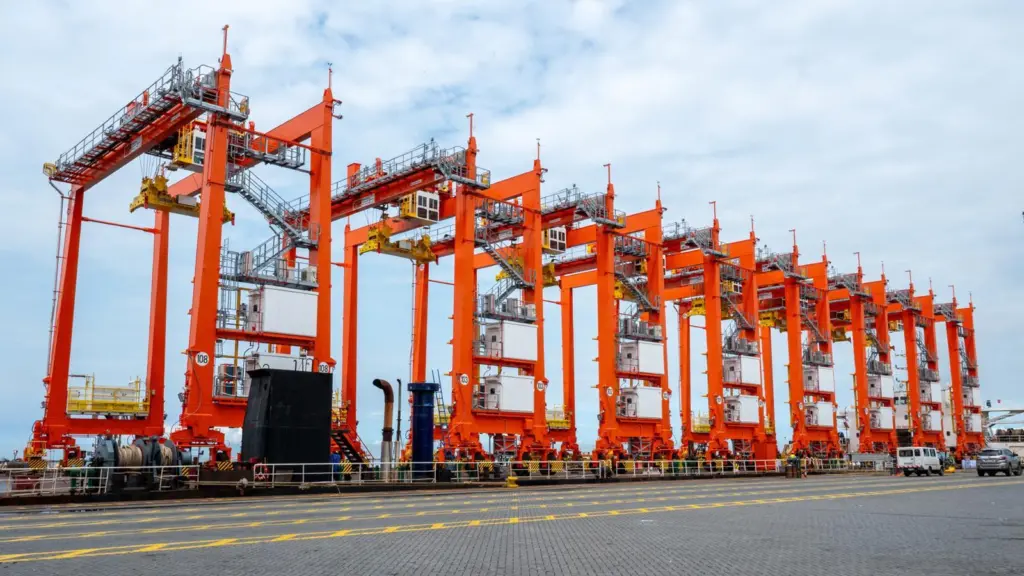
MICT has added eight NZE rubber-tyred gantries, complementing a fleet that is now over 80% hybrid and comprises xx units. Sourced from Mitsui Engineering and Shipbuilding Co. Ltd, the RTGs feature an 80kW lithium-ion power pack paired with a 100kW engine-generator set. The smaller genset, compared to the 220kW units used in conventional Mitsui hybrid RTGs significantly reduces fuel consumption while cutting emissions.
Electric trucks and establishing EV charging infrastructure are also on the agenda.
ICTSI is actively pursuing the goals of cutting greenhouse gas emissions per container move by 26% and achieving net zero emissions by 2050.
Other new equipment deliveries include 43 terminal trailers, 17 skeletal trailers and 11 tractors as well as an initial assessment of electric terminal tractors under MICT’s modernisation programme.
These latest investments follow on from earlier work focused on the upgrade of MICT’s Berths 1 – 5 and their respective yard areas. This included the addition of reefer racks to accommodate 300TEU of reefer cargo.
DIGITALLY BUSY
The exploitation of new generation digital technology is also a mainstream area of activity for MICT in its continuous pursuit of higher levels of performance.
The MICT gate system has been enlarged with additional automated inbound lanes employing Camco Technologies Optical Character Recognition (OCR) portals and automated gate kiosks. The technology, which automatically identifies container data, truck and trailer, interfaces with the Terminal Appointment Booking System (TABS) and works to streamline traffic flow and reduce queuing.
“Average truck dwell time has been cut to 47 minutes and pre-truck manifesting gate transaction reduced to just 48 seconds,” underlines Lozano.
The gate system upgrade also represents part of an overall digital systems upgrade which includes a new yard management system that delivers optimised container stacking, enhanced visibility and improves resource allocation to ease bottlenecks.
Additionally, MICT has introduced the ICTSI App, which provides real-time vessel, container and truck tracking, along with billing computation and electronic interchange receipts. Further, E-wallet payments enable automated fee deductions, expediting import clearance and gate-out processing. SMS notifications also now work to alert truck drivers on container hold releases and truck instructions on gate-in. There are also two specialist apps – “Radar” for cargo tracking and “Naviagte” which delivers gate appointments and online payments as well as coordinates transactions between multiple parties.
At a wider level, MICT has been chosen to participate in the Bureau of Customs pilot programme focused on achieving a digitally-based Customs Processing System. This is intended to streamline import/export workflows, enhance data integrity, and reduce corruption vulnerabilities. Full system implementation is targeted for the first quarter of 2027.
FURTHER AHEAD
The future prospects for MICT are reflected in ICTSI’s confidence in making initial preparations for Berths 9 and 10, although no firm dates have ben set as yet for their implementation. This will no doubt be influenced by the development of ICTSI’s new deepwater container terminal development, The South Luzon Container Terminal (SLCT), at Bauan, Batangas, approximately 110-120km south of Manila.
SLCT will offer the dual assets of taking the pressure off MICT and serving the fast-growing manufacturing and export hub of South Luzon and surrounding areas, as well as linked metropolitan centres – see Port Strategy, Quarter 1, p29. It comprises the largest new deepwater port development in the Philippines and will be wholly financed by ICTSI to the tune of USD800 million.
At full development, the terminal will feature an 800-meter quay, 38 hectares of yard space, and an 18-meter berth depth. The Phase 1 Development comprises the construction of a 425m quay, with equipment installation planned for August 2027.
Underpinning ICTSI’s MICT and SLCT major capacity ramp up are the overall container trade prospects for the Philippines.
Key catalysts to trade growth are seen as the Philippines positioning itself as a leading manufacturing hub with a special focus on four product segments: retail; industrial manufacturing and automotive, high tech and health care. This objective is strongly supported by the government’s stated goal of boosting export growth and facilitating the infrastructure development required to achieve it. SLCT, for example, is a key project which complements President Ferdinand R. Marcos Jr.’s “Build Better More” programme, which features comprehensive infrastructure projects and goals.
Intra-Asian container trade is highlighted as a dynamic growth area with key drivers including manufacturing shifts, supply chain diversification, rising consumer demand and key trade agreements that lower obstacles to free trade. Projections foresee the value of intra-Asian trade rising from USD113 billion in 2020 to USD393 billion by 20230.
MICT and SLCT sit at the heart of this dynamic environment aligned with the Philippines’ trade, economic and national port system goals.
Related Articles
 EQUIPMENT
 OPERATIONS
 OPERATIONS