![PortStrategy[GreenPort]](https://www.portstrategy.com/wp-content/uploads/2026/09/PortStrategyGreenPort.svg)


Russia’s plan B
Russia has turned to Plan B to secure dry freight shipping capacity – the enlargement of its merchant fleet through domestic construction and acquisition. Oleksandr Gavrylyuk reports
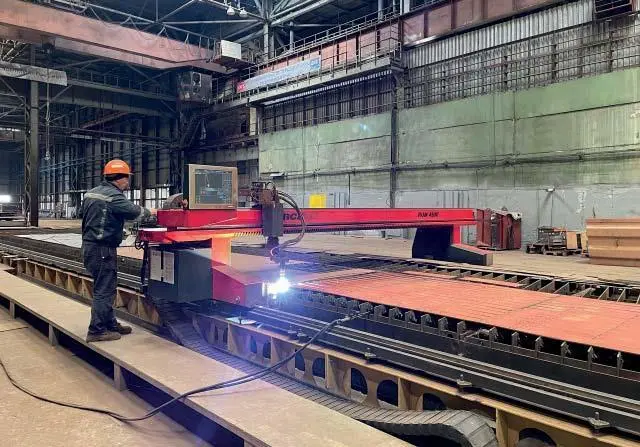
In late March this year, Lotos shipyard, based near the Russian Volga River’s delta/Caspian Sea port of Astrakhan, started cutting metal for a multipurpose (container/dry bulk) river-sea going ship of the 00108 project, developed by Nizhny Novgorod-based Vympel design office. It is planned to lay its keel in May this year and deliver the vessel in 2024.
Both Lotos and Vympel are parts of the state-owned United Shipbuilding Corporation (OSK to give it its Russian acronym), Russia’s largest shipbuilder comprising around 40 enterprises active in the sector scattered all over the country. In December last year, the State Transport Leasing Company (GTLK), another government-controlled giant, contracted OSK for the construction of four ships of the 00108 project with cost estimated at RUB 1.74 billion (about US$22.5 million) each.
The 141 meter-long and 16.9-meter-wide vessels will be the largest ones capable of navigating down the Volga River (with their individual deadweight of 5000 tonnes and draught of 3.6 meters) into the Caspian Sea.
The vessel design features two cargo holds with an aggregate capacity of 12,000 cubic meters which enables the carriage of 429TEU (when sailing along the river) and up to 531TEU (in the sea), as well as grain, timber, sawn wood, general and oversized cargoes.
In February this year, the Kremlin approved a preferential leasing programme for the country’s shipbuilding industry. Given the shortage of Russia’s merchant fleet in the Caspian basin, OSK is, according to Aleksey Rakhmanov, Director- General, OSK, expecting to construct up to 21 vessels of the 00108 project by 2027.
“It may take us around a year to build the first ship, but then we will be able to deliver a new hull every three or four months,” he believes. Taking into account Lotos’s favourable geographical location and the privileges it enjoys as an anchor resident of the Astrakhan Special Economic Zone, it is likely to receive OSK’s new orders.
Coupled with the deepening of the Volga-Caspian fairway, the planned construction of the new vessels will allow Moscow to launch a regular shipping line through the International North-South Transport Corridor (INSTC). Intended to connect Saint Petersburg on the country’s Baltic coast with Iran and India via a network of Russia’s internal waterways and the Caspian Sea, INSTC has significantly grown in importance since the Kremlin’s invasion of Ukraine and its increasing international isolation.
Following the application of western economic sanctions and withdrawal of global shipping operators from Russia last year, Moscow declared its ‘great turn’ to the East. However, to be able to supply its export commodities to increasingly distant (mainly Asian) markets via the INSTC, Northern Sea Route (Russia’s part of the Northeast Passage) and other routes and corridors, the nation needs to have a powerful and modern merchant marine.
Viktor Yevtukhov, Russia’s Deputy Minister of Industry and Trade, has assessed the country’s demand for new commercial ships at around 1500 by 2035. From 2023 to 2027, Moscow is going to earmark RUB 231 billion (around US$2.96 billion) for the building of 260 new sea and river vessels, including 119 cargo, 73 passenger, 27 dredging, 10 fishing and five heavy-tonnage ships, as well as one floating dock, five tugs and 20 barges.
DIFFICULTIES FORECAST
In the opinion of local observers, domestic shipbuilders are likely to experience big difficulties, when trying to cope with this ambitious task. Already now, they are overloaded with orders – there were 291 hulls under construction at the Russian yards as of December 2022, according to GTLK’s data. This year alone, they are supposed to deliver 70 vessels, up 27 per cent on 2022.
Furthermore, sourcing foreign-made components, ship machinery and equipment has become an increasingly serious problem for the sanction-hit country. As a result, the Kremlin is reportedly also working out a dedicated programme for the acquisition of 85 used and partially built ships of various types (including 60 bulkers, 15 tankers, several container carriers and multipurpose vessels) by 2034.
With RUB 150 billion to be loaned by commercial banks for purchasing these vessels, Moscow will allegedly be prepared to allocate RUB 70 billion to subsidise the loan rates under the scheme.
The prevailing political and economic realities have prompted Russia to start rejuvenating its aging fleet. As with so many things associated with Russia, however, there is no certainty that its ambitions in this arena will be matched by the ultimate reality.
Related Articles
 EQUIPMENT
 OPERATIONS
 OPERATIONS