![PortStrategy[GreenPort]](https://www.portstrategy.com/wp-content/uploads/2026/09/PortStrategyGreenPort.svg)




Strength & Resilience
The US Pacific North West and Canadian Pacific Gateway is a major container gateway for North American imports and exports. Dean Davison looks at trade developments for ports in this region and the road ahead
The US Pacific North West and Canadian Pacific Gateway is a major container gateway for North American imports and exports. Dean Davison looks at trade developments for ports in this region and the road ahead
The Pacific North West (PNW) region, (which includes the US ports of Seattle-Tacoma (North West Seaport Alliance (NWSA), Portland (OR) and the Canadian Pacific Gateway area comprising both Vancouver (BC) and Port of Prince Rupert), is one of the major gateways for Asian imports to North America and loaded exports from Canada and the US back to Asia.
Between 2000 and 2024, the PNW region saw total container volumes increase from almost 4.8 million TEU to just over 8.2 million TEU, reflecting a CAGR of 2.3% per annum. In 2024, this figure reflected a share of total North American container port traffic of 12.6%.
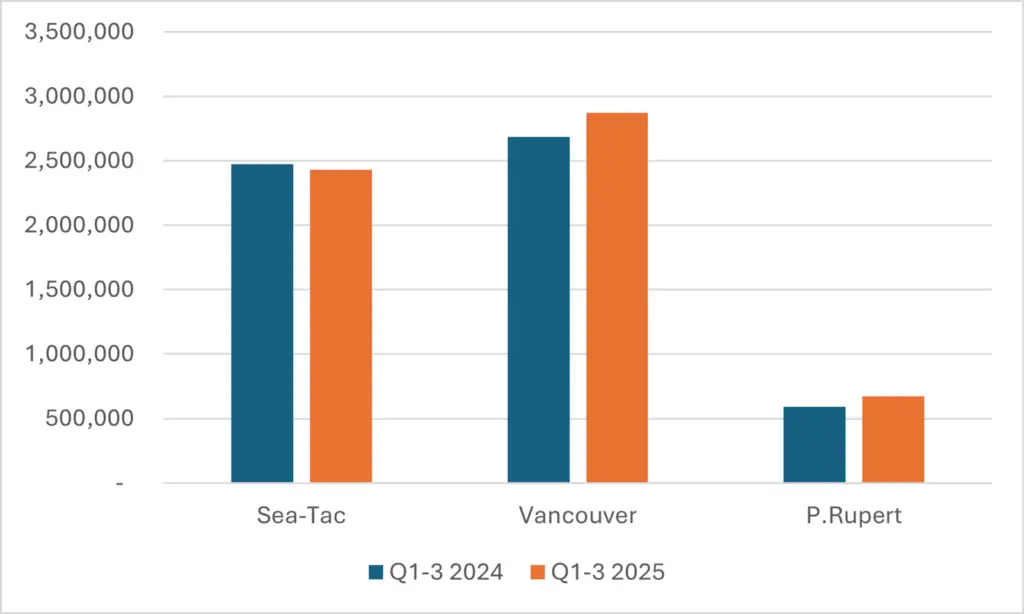
In terms of individual ports in the PNW region, a comparison of the position for the first three quarters in 2024 and 2025 is shown for all three facilities in Figure 2, with the following conclusions drawn:
- Total Sea-Tac volumes are down by 1.7% year-to-date for the first three quarters of 2025, and the NWSA facilities saw a share of total regional container traffic drop from 43% to 41%.
- Vancouver saw total containers handled rise from almost 2.7 million TEU for the 2024 period to 2.9 million TEU for YTD end of September 2025, enabling the port to increase its share of the regional market from 47% to 48%.
- Prince Rupert generated an increase from 593,666TEU to 673,032TEU over the same comparable periods, which also meant that its share of the PNW market was up from 10% to 11%.
“TARIFFS WEIGH ON VOLUMES”
NWSA confirmed that for YTD 2025 container throughout against the comparable nine months of 2024 saw full box imports decline by 5.7%, with loaded exports falling 2.9%. The port authority confirms that “tariffs continue to weigh on container volumes, and negative year-over-year comparisons reflect volumes from Canada due to labour disruptions in September 2024.”
With the actual drop for the 2025 period being just over 40,000 TEU, potential remains for Seattle-Tacoma to target a stronger Q4 and claw back this deficit, though container demand for these two ports is currently more challenging compared to nearby Pacific Gateway facilities in Canada which are performing better in 2025 based on their results.
Continued increases in Q3 2025 for Vancouver followed a strong first half of the year, with the port authority suggesting what is driving container trade through the port’s terminals. “Containerised trade—like the Canadian economy—has shown remarkable strength and resilience so far this year in the face of US tariffs and global uncertainty. More and more, we are seeing Canadian businesses turn to containers to securely trade goods with world markets,” explains Peter Xotta, President and CEO of the Vancouver Fraser Port Authority.
John-Paul Verschuure, Director, Rebel Group, offered further insight: “Container trade through Vancouver has returned to pre-COVID-19 growth levels and has overcome the pandemic-era surge in consumer demand and numerous supply chain disruptions. For full year 2025, it is reasonable to expect Vancouver to see double-digit improvements on 2024, helped by some Asian cargo diverted to the West Coast of North America away from the eastern seaboard due to the ongoing Red Sea crisis.”
Prince Rupert’s container volumes are increasing in 2025 too, with the recovery due to the port overcoming realignment of ocean carriers’ transpacific trade routes, two labour disruptions, and a brief suspension of rail service due to wildfire that paused terminal operations. As a result, the port will be targeting a return to calendar year volumes that surpassed one million TEU per annum between 2018 and 2022 (which peaked at 1.2 million TEU in 2019).
LOOKING ELSEWHERE
The PNW region continues to benefit from a strong geographic proximity to Asia and Indo Pacific locations, which endorses the ongoing potential for loaded inbound cargo. With Prince Rupert being 11 days sailing from Shanghai, Vancouver 12 days of ship time and Seattle-Tacoma being 13 days, all of these ports offer a saving on the 14 days to reach Los Angeles/Long Beach
For Canadian ports, while China is a major trading partner (i.e. accounting for over 60% of Vancouver’s import cargo tonnage), Canada’s wide range of free trade agreements across 16 Pacific Rim countries, including Japan, South Korea, Vietnam, Malaysia, Australia/New Zealand, and, soon to be signed, Indonesia, helps support potential cargo demand for both imports and exports.
Timing of trade diversification for Canada may be relevant. In late October 2025, US President Trump announced he was ending “all trade negotiations” with Canada, citing what he described as “egregious behaviour” linked to recent television advertisements protesting US tariffs. “A desire to look elsewhere to lower the current strong reliance on trade with the US seems a sensible policy,” states Verschuure.
Related Articles
 EQUIPMENT
 OPERATIONS
 OPERATIONS