![PortStrategy[GreenPort]](https://www.portstrategy.com/wp-content/uploads/2026/09/PortStrategyGreenPort.svg)



Taiwan: at a crossroads
Andrew Penfold examines the twists and turns of Taiwan linked container trade and identifies the key influencers to the shape of things to come
Taiwan has moved to the centre stage of world risks. After a long period of mutual coexistence (and increased economic integration) renewed political tensions from China, spurred at least in part by a partial loss of confidence in the mainland’s economic progress, attention has been turned to the future of the island nation. What has happened to container trade and what are the implications for any large- scale upset for the port sector?
VOLUME DEVELOPMENT
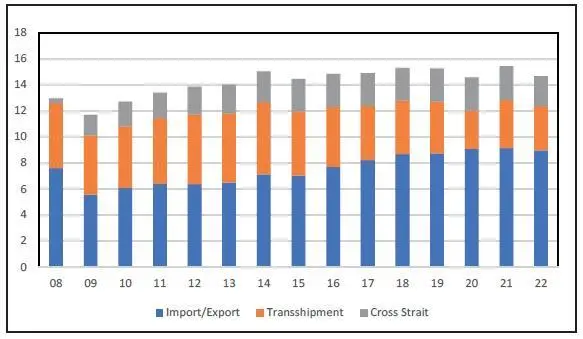
In 2022, total container volumes at Taiwan’s four ports reached 14.7m TEU. No significant growth has been noted since 2015, with this reflecting the uncertainties of the Covid period but also a shift in the pattern of demand. In the early part of the 2010s demand was spurred to a large degree by transshipment activity at the key ports with this accounting for 38.6 per cent of moves across the quays in 2012. This has declined sharply as port development in many of the previous feeder zones in China and ASEAN markets has progressed and expanding demand has seen direct calls move to centre stage.
Another shift has been the changing importance of ‘Cross Strait’ container flows – i.e. direct links between China and Taiwan. Although permitted from 2008, this was formalised in the Economic Co-operation Framework Agreement between Taiwan and China in 2010. This arrangement also eliminated most tariffs on trade between the two parts of China. Direct shipping links were also permitted with this replacing the previous system of goods transfer via third-party ports.
The primary aim of these developments (at least from a Taiwanese perspective) was to stimulate growth that had been severely impacted by the global economic downturn of 2008. This, together with a Free Trade Zone policy at the major ports, was successful and stimulated domestic volumes.
Figure 1 summarises the development of Taiwanese container port volumes by category since 2008. The major trends noted are the recent stagnation in Cross Strait flows (following earlier rapid growth) and the decline in the proportion of transshipment volumes. Local cargoes have continued to expand but have suffered as a result of Covid disruption since 2020. There has been an increased contribution of FTZ cargoes within this sector. Since 2015 the value of goods generated from the FTZs has increased by some 14.8 per cent to reach a total value of 3.71bn Taiwan Dollars in 2021– with indications of some further increases in 2022.
So, the switch is away from a regional transshipment role towards a reliance on import/export flow. Indeed, the underlying pace of growth for local cargoes is in line with what would be anticipated in other developed economies.
PORT DEVELOPMENT
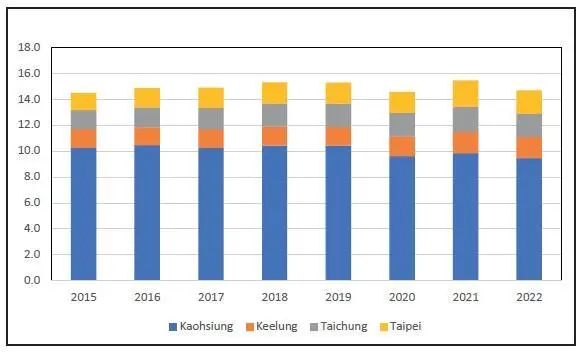
Container trade is dominated by the major terminals in Kaohsiung, although market share has fallen back from 71 per cent in 2015 to 64.5 per cent last year. Total Kaohsiung volumes peaked at 10.43m TEU in 2018 and have since followed a typical Covid-led profile.
Much stronger growth has been noted at each of the three smaller ports, with Taichung and Taipei (and neighbouring Keelung) seeing increases in both absolute volumes and market share across the period. This diversification away from Kaohsiung reflects the broader domestically-led basis of Taiwanese container trade growth over recent years.
CHANGING REALITIES
It is clear that recent years have been quite stable, but the current outlook is much more problematic. The deterioration of relations between China and the US from 2018 has upended the status quo. Although not yet a full on ‘trade war’ pressure on high tech Taiwanese companies to scale back their reliance on China has moved to centre stage and this has driven Taiwan to increasingly focus on trade with ASEAN markets – the so-called ‘New Southbound Policy’ to expand and diversify its trading relations with other countries in the region. With this, of course, actively resisted by China using its economic influence to isolate Taiwan.
The pressures increased in the middle of 2022 with the visit of US House Speaker Nancy Pelosi to Taipei which precipitated a flourish of military activity and ‘live fire’ activity in the Taiwan Strait. The degree to which these developments are signs of a forthcoming escalation in rhetoric or – indeed – a full scale attempt to invade remains one of the great unknowns in the world economy.
If push really does come to shove, then the specific situation for the individual Taiwanese ports is likely to be the least of our problems with global sanctions on China seeing a virtual shutdown in Asian trade. The implications are impossible to quantify but a continued playing out of the current situation seems certain to result in even greater focus on domestic demand with a decline in Cross Strait traffic as the current level of relations with China deteriorate further.
PORT IMPLICATIONS
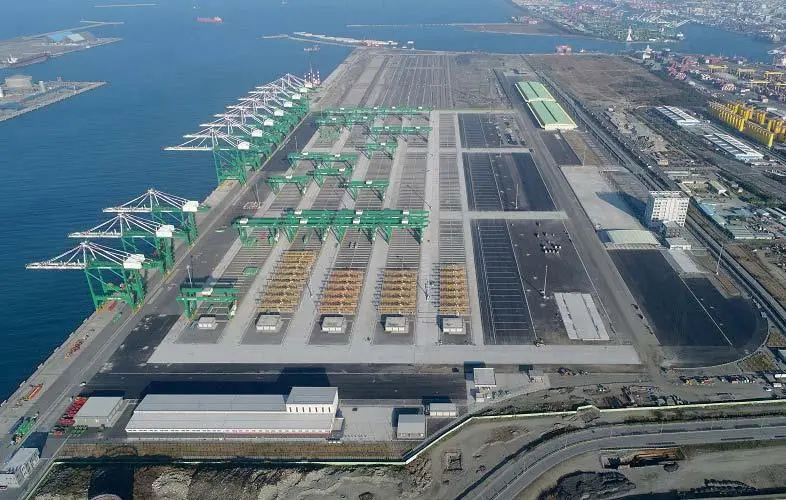
Within this (to date) stable profile, the emphasis in Taiwanese ports has been on upgrading facilities to handle the largest classes of container vessels that are increasingly dominating the country’s trade. At the centre of this has been Kaohsiung’s move to lease Wharf Nos. S1 & S5 in the 7th Container Terminal to Evergreen Marine on a long-term basis. The driving force here is the need to berth the Megaships (24,000TEU+) that are being delivered to the line. This forms part of the current ‘Comprehensive Commercial Port Development Plan’ which will run through to 2026 and has a capital value of some US$1.37bn. It will increase national container capacity to around 18.6m TEU per annum.
This has been a rapid development, with the first phase of the expansion due to commence operations at the end of April following delivery of cargo handling equipment at the turn of the year. Once the expansion (which was initiated in 2011) is completed this year the 7th Container Terminal will offer five 18m deep container berths with a total length of 2415m and a terminal area of 149 hectares.
Evergreen Marine, the port’s largest container shipping client, handled over three million TEUs at the port in 2022. The company’s order for new vessels has been the primary catalyst for terminal expansion. To complete this investment Evergreen has ordered 19 remotely operated ship-to-shore (STS) container cranes and 56 automated gantry cranes, which are currently being installed. The intention is to move towards full yard automation.
Although containers are central to the programme, investments will also include a new cruise terminal and various green improvements and capacity expansion at the nation’s other major gateways.
WHAT NEXT?
The overall situation is very difficult to assess, if things stay as they are the emphasis in each of the ports will be towards further investment to handle the largest vessels with increasing ties to local demand and to ASEAN trading partners. Taiwan reached ‘Developed’ status many years ago and is now a very good example of an efficient and highly integrated container port operation.
The danger is outside the control of any of the ports. One can only hope that a steady further development of recent trends is recorded, rather than any Ukraine-style upheaval. The latter alternative would be far more disruptive at the global level than anything seen in many years with container trade forced to a screeching halt. Unfortunately, recent experience does not suggest the sensible course of action is guaranteed.
| 2015 | 2016 | 2017 | 2018 | 2019 | 2020 | 2021 | 2022 | |
|---|---|---|---|---|---|---|---|---|
| Kaohsiung | 10.26 | 10.46 | 10.27 | 10.45 | 10.43 | 9.62 | 9.86 | 9.48 |
| Keelung | 1.45 | 1.39 | 1.42 | 1.47 | 1.46 | 1.53 | 1.60 | 1.62 |
| Taichung | 1.45 | 1.54 | 1.66 | 1.74 | 1.79 | 1.82 | 1.98 | 1.78 |
| Taipei | 1.33 | 1.48 | 1.56 | 1.66 | 1.62 | 1.62 | 2.01 | 1.81 |
| Total | 14.49 | 14.87 | 14.91 | 15.32 | 15.30 | 14.59 | 15.45 | 14.69 |
| Cross Strait – % | 17.3% | 17.1% | 16.8% | 16.3% | 16.8% | 17.6% | 16.8% | 15.8% |
Related Articles
 EQUIPMENT
 OPERATIONS
 OPERATIONS