![PortStrategy[GreenPort]](https://www.portstrategy.com/wp-content/uploads/2026/09/PortStrategyGreenPort.svg)


The pillars of Hercules
The Straits of Gibraltar major ports of Algeciras and Tanger Med sit at the heart of Western Mediterranean transshipment activity. AJ Keyes looks at the influential liner strategies driving their evolution
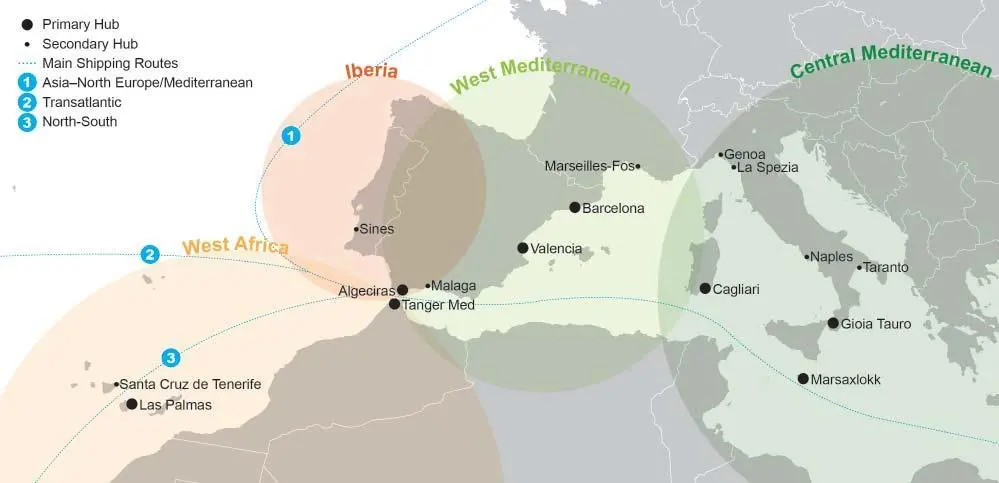
The Straits of Gibraltar are spanned by the mythical Pillars of Hercules, in reference to the Greek mythical hero- Hercules, who smashed through Mount Atlas to create the Straits. This may be a myth but the Straits of Gibraltar still represent the closest maritime link between the African and European continents at just 13km at the narrowest point. It is almost possible for the two major container ports on these two diff erent continents (just 30 nautical miles apart) of Algeciras, Spain, and Tanger-Med, Morocco, to see which ships are working in each other’s port.
From a geographical standpoint, access to the important trade areas along the Mediterranean Sea and interior European and Asian nations is through the Straits and the West Mediterranean port zone comprises an integral part of the wider region, as Figure 1 identifies.
Container shipping service networks have become increasingly complex over time. Inter-regional services typically operate on a multi-port rotation, providing direct connectivity between numbers of key ports, often in different markets.
While the introduction of larger vessels has enabled carriers to realise significant cost savings in terms of vessel operating costs, the need to consolidate cargo onto these bigger ships has led to increased demand for transshipment services at strategically located ports throughout the entire Mediterranean. There are basically two types of transshipment activity undertaken in the region, namely:
- Hub & spoke transshipment which allows ocean carriers to link a wide range of ports into a main service network, but also enables smaller feeder services to provide short/ shuttle-style links between regional “hub” ports and smaller “spoke” ports.
- Relay transshipment is where a shipping line transfers containers between discrete deepsea, mainline services.
The central and eastern Mediterranean hub ports are focused on the hub and spoke model, whilst the location of the west Med hubs also allows the relay of Asia-Europe and African deepsea cargoes.
Transshipment traffic is a notoriously flexible (or ‘footloose’) cargo because it is theoretically able to move between different regional ports within the same area. As such, it is often highly price sensitive and is not considered captive in the same way as a gateway container market where port demand, for example, is driven by the import demand relating to consuming population centres, and on the export side typically, by proximity to production hubs.
TRANSITING THE STRAITS
To put the importance of the Straits of Gibraltar into perspective, the Gibraltar Port Authority states that approximately 60,000 vessels transit the straits per annum. In terms of container activity, specialist information provider, Data& confirms that container ships represent around 20 per cent of all ships passing through the Gibraltar Straits, so there are clearly a high number of potential callers for the two regional ports, one located on either continent.
It is this key location that makes ports in the Gibraltar Straits region unique. So, how have liner strategies changed and what does it mean for regional ports? Well, fundamentally, the role of these ports remains constant, but the make-up of the protagonists involved has seen considerable change.
The most noticeable development has been the increase in ship sizes. For example, according to Data&, the largest vessel on the Asia-Europe trades at the end of 2010 was around 9000TEU, whereas now the ships are approaching 24,000TEU, an increase of 267 per cent or a consistent 8.5 per cent per annum over the 12-year period. Moreover, with the ship cascading process continuing, there has been an increase in ships on other trade lanes too calling to ports both within the region and in related deepsea markets.
Increase in ship sizes is not surprising, as this remains an ongoing and continuous trend over the past two decades. Yet looking at the services calling to the West Mediterranean region, and primarily Algeciras and Tanger-Med, the higher number of services and considerable increase in TEU slot space, whether measured by service string or in weekly vessel capacity, is at the centre of development.
THE NEW “NORMALS”
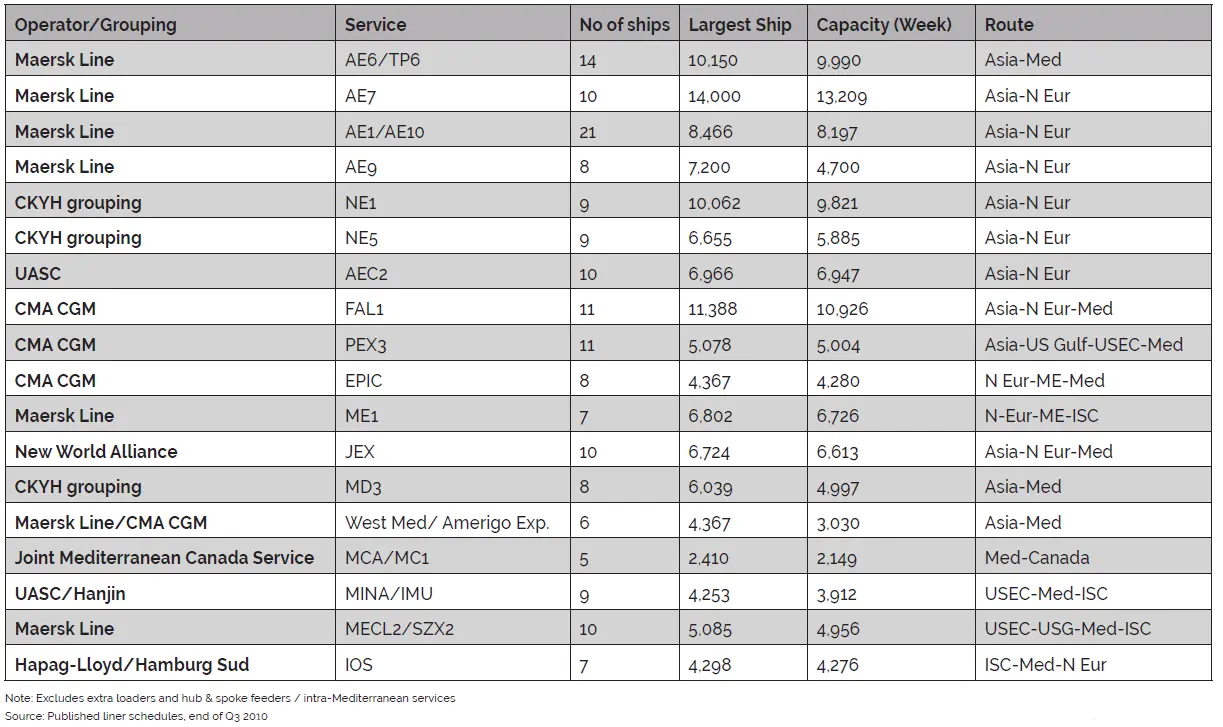
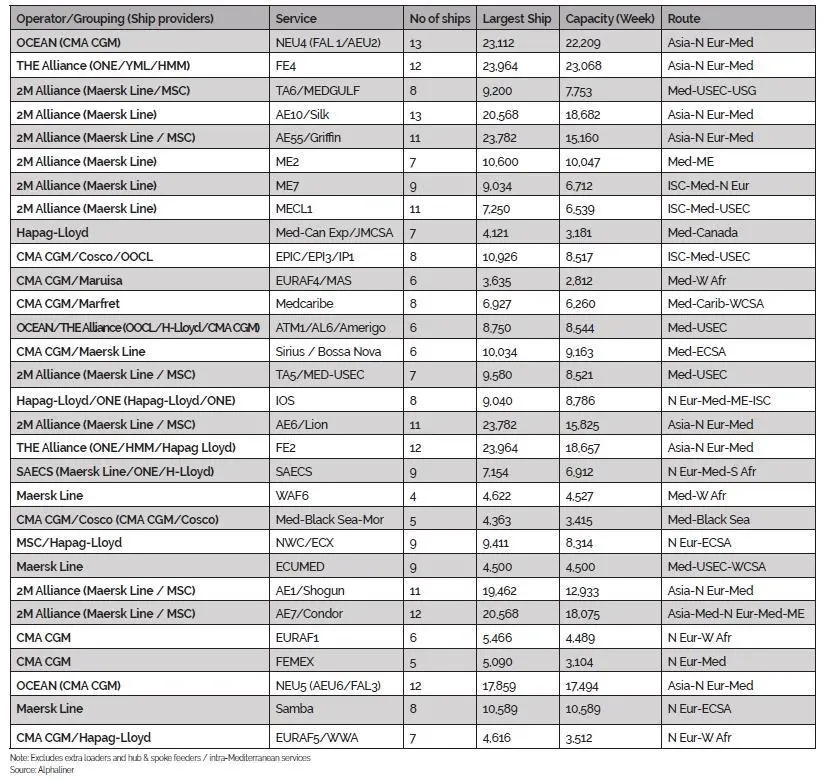
For this analysis, two specific periods have been selected. First, end of Q3 2010, which reflects the period after the Global Financial Crisis (GFC) of 2008-2009 and when the shipping industry had settled down into the new “normal” post GFC. Then, end of Q3 2022 is considered, again because it is after a tumultuous global event (COVID-19 pandemic) and the rebound has occurred, with a new state of “normal” beginning to appear. Table 1 and Table 2 offer a summary of the mainline services calling to Algeciras and Tanger Med.
There are a number of interesting conclusions that can be drawn. In Q4 2010, the total weekly capacity of the sample outlined was just over 115,600TEU, of which Maersk Line and CMA CGM were the major providers of capacity, with different services and several ships over 10,000TEU, although Maersk Line’s AE7 string offered the largest vessel, at 14,000TEU.
The CKYH grouping (Cosco, K Line, Yangming and the now defunct Hanjin Shipping) were also regular callers to Algeciras, where Hanjin Shipping had established a terminal facility.
There was limited relay transshipment ongoing, although it is known that hub & spoke activity was a common feature in serving markets in West Africa and the Canary Islands. Maersk Line was calling here with ships of up to 13,209TEU of weekly capacity and very little of this would have been for any Spanish hinterlands due to the very high transshipment incidence in Algeciras.
However, jump forward to the present day and the position sees much bigger ships, more operating alliances and complex liner strategies in play. Based on the sample of services in Table 2, the weekly “deepsea” capacity on offer is an estimated 298,300 TEU and a very strong position is held by the different shipping alliances, with each offering a number of weekly services.
The sizes of vessels deployed has also increased considerably, with some of the largest ships in service now calling. For example, THE Alliance has vessels up to 23,964 TEU from its FE4 service calling at Tanger Med on the westbound leg and Algeciras on the eastbound routing. Likewise, the OCEAN Alliance has ships of 23,112 TEU on its NEU4 string using Algeciras westbound and the 2M Alliance calling at Algeciras on its AE10/Silk option (largest ship of 20,568 TEU) and its AE55/Griffin (largest ship of 23,782 TEU).
DEFINED STRATEGIES
It is, however, not just about large ships calling in the Straits of Gibraltar, but also the differences in strategies of the ocean carriers. For example, CMA CGM has a defined strategy here. The operator markets its EURAF4 and EURAF5 strings as relay services. Both of these options link the company’s Tanger- Med terminal with West Africa, while offering potential for much wider geographic coverage via such services that sail to/from Asia (NEU4), the East Coast of North America (EPIC) or the Caribbean/West Coast of South America (Medcaribe).
Maersk Line is another proponent of the relay transshipment concept. As seen in Table 2, there are services from this ocean carrier that inter-connect between East- West and North-South services, or some combination of both. For example, the AE1 and AE7 services link Asia and North Europe, using some of the largest ships in service while offering an eastbound stop in Tanger Med to potentially connect with, for example, its ECUMED offering that links Tanger Med with such notable ports as New York/New Jersey, Manzanillo and Balboa at each side of the Panama Canal and onto Guayaquil and Puerto Bolivar.
The one noticeable absentee from this assessment thus far is MSC. In conjunction with 2M Alliance partner, Maersk Line, there are a lot of MSC services being sold in the region according to published schedules.
However, if the services in Table 2 are studied more closely, then it can be seen that there is more Maersk Line tonnage being provided in the majority of the jointly-operated services overall.
This position is not necessarily too surprising because it fits in with the Danish carrier’s use of Algeciras and Tanger Med in the Straits of Gibraltar, whereas MSC continues to utilise other regional ports, most notably Valencia in Spain (which is also the ocean carrier’s primary port of call for import-export gateway cargo into Spain) and the Canary Islands off of the West Coast of Africa.
Moving forward, MSC could look to utilise the expanding Sines facility in Portugal too, where its investment arm, Terminal Investment Ltd (TiL) retains a stake with PSA International.
The role of these major ports in the West Mediterranean, especially those located in the Straits of Gibraltar, is considered in more detail in Mix & Match Strategy. In summary, the regional hubs have seen a maturing of their crucial role, most notably the facilities located in the Straits of Gibraltar. Currently, there is a combination of the largest vessels on the Asia-Europe trades and other deepsea services calling and undertaking relay transshipment in more depth than was seen at any time in the past.
Consequently, this arrangement represents a unique global position and has directly driven the rate of port demand growth way ahead of the broader average. On this basis, the need for further expansion is required and is expected to occur, both in terms of maximising efficiencies at current sites and expanding where possible.
Related Articles
 EQUIPMENT
 OPERATIONS
 OPERATIONS