![PortStrategy[GreenPort]](https://www.portstrategy.com/wp-content/uploads/2026/09/PortStrategyGreenPort.svg)

TRANSSHIPMENT – EVOLVES
Transshipment is evolving as a tool via which to serve peripheral markets. Experience in the Indian Ocean confirms this and the ongoing requirement for port investment, as Andrew Penfold explains
The focus of attention has been on the major east-west trades in the past eighteen months, with freight rates reaching unprecedented levels. What is the knock-on impact in the secondary, lower volume, trades? Let’s take a look at the Indian Ocean insular markets.
HOW BIG ARE THESE MARKETS?
The Indian Ocean markets of Reunion, Mauritius, the Seychelles, and Madagascar are individually quite limited but together represent a significant market. However, the interests of these markets rank fairly low on the global radar of the major liner companies. They are consequently vulnerable to changes outside their direct control that make the involved economies susceptible to adverse shifts.
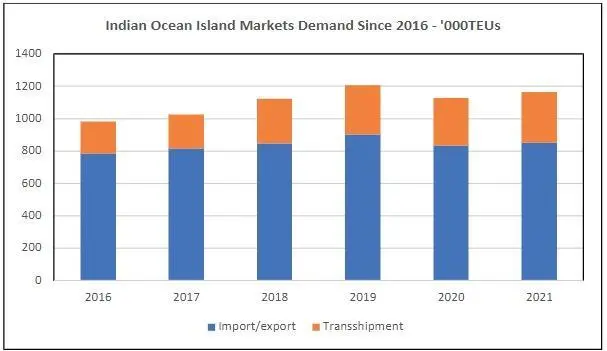
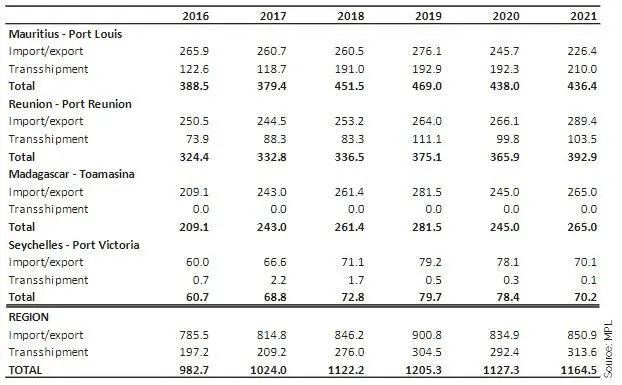
Considered together, these markets recorded a total of around 1.2m TEU in 2021. In common with all markets, these economies have been battered by COVID-19, with this especially impacting on demand generated by the tourism sector. There are only limited local industries, with Mauritius heavily dependent on clothing and tuna and the Seychelles also a major focus of the fisheries sector. Madagascar has seen volumes grow based directly on the broad prism of consumer demand. Reunion is an outlier as a département of France, with an economy dependent to a large degree on the needs of local retirees and the port dominated by French labour relations.
Despite these differences, they form a cohesive market for shipping lines.
As noted, overall volumes reached nearly 1.2m TEU in 2021 and the indications are that renewed growth is continuing with an estimated annualised increase of around 5-6 per cent in the first half of 2022. Within this total, transshipment demand has increased steadily from 20 per cent of port volumes in 2016 to some 27 per cent at present. Transshipment has long been the established strategy at Port Louis and Reunion has seen some success in this sector despite high stevedoring costs. Underlying import/export demand increased sharply by 15 per cent between 2016 and 2019 but fell back as Covid hit the region. Recovery is now underway.
HOW DOES TRANSSHIPMENT WORK?
These relatively small-scale markets were in the past served by multiport container and semi container services linking them with European markets and some feedering from East African ports such as Mombasa. However, as part of the broader reorientation of the trades in favour of the Far East – especially China – there has been a far-reaching revision in service structures. Initially this was focused on developing transshipment hubs within the region, with Port Louis a pioneer in this approach. As vessel sizes increased and demand volumes ran ahead of port capacity in various east Africa markets, feeder services were established from the Mauritius hub. Regional intra-island services were superimposed on this to provide a strong and stable demand structure based on a regional hub role, local demand and feedering to/from the other insular markets.
More recently, the focus has shifted. The emphasis is now increasingly driven by serving these markets as feeder destinations linked to major hub ports serving the Asia-Europe trades. This has seen increased reliance on Colombo and Salalah, with other regional hubs also playing a role. From the lines’ perspective, this makes good economic sense as overall costs of serving the region are much reduced and it also serves to lift load factors on the ultra large vessels deployed on the primary hauls.
However, for the regional economies the advantages are less clear. The loss of direct services has been accommodated well overall by the region and there has been some integration of regional calls – at Mauritius – into the rapidly expanding trades between East Asia and southern Africa. But, of course, this means much greater dependence on the major lines, with Maersk and CMA CGM effectively controlling much of the regional business. MSC plays a similar role in Toamasina. These can be uncomfortable bedfellows for small local markets. The economics are sound, but the risks are high.
SO, WHAT ARE THE RISKS?
The real risks here are that the markets will become increasingly dependent upon the major lines which will have little incentive to significantly improve operations.
For example, there has been no real development of the sub-3000TEU container fleet that is dominant on most of these trades. According to Clarksons, the fleet of these vessels has remained constant at around 3000 units since 2016 and a similar picture is noted for larger (old) Panamax tonnage. The orderbook for these two size ranges represents just 12 per cent and eight per cent of existing fleet capacity and scrapping of older units will more than offset new deliveries. Relying on these sizes and types of vessels means an increasing dependency on an ageing fleet, with little prospect of expansion and renewal – this can only push up charter rates and, therefore, costs for these economies. This is not a problem for the lines as these costs can be readily passed-on.
In some cases – notably, Port Victoria – the antiquated state of the existing quay prohibits the use of heavier shoreside equipment such as mobile cranes, with this leading to the continued use of ship’s gear for handling. This is an even more obsolete part of the container fleet with little or no investment directed to these units.
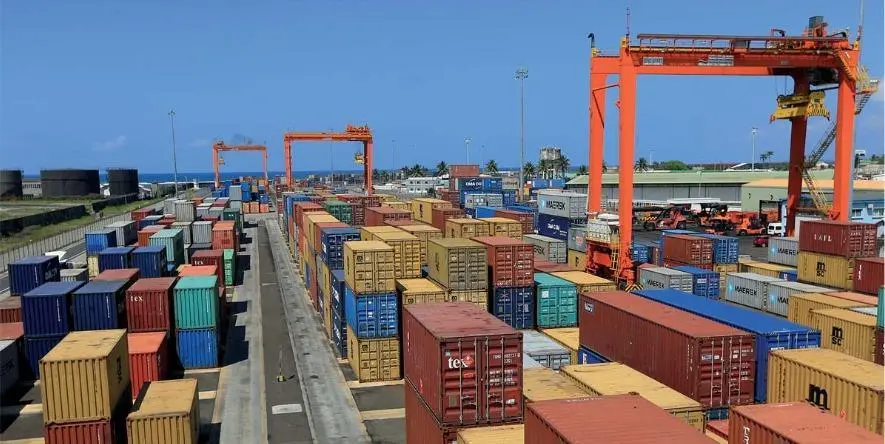
Port Louis and Reunion have kept ahead of these risks by developing port capacity to handle larger vessels and similar developments are underway at Toamasina. The presence of international investment in the form of International Container Terminal Services Inc. (ICTSI) at the latter port has transformed operations within a fairly limited overall investment profile.
Building on these developments the port is currently carrying out a US$639m expansion project. The Japan International Cooperation Agency (JICA) has provided US$411m to fund the project while US$227m has been provided by the Government of Madagascar. The expansion will comprise a 756m container berth with a draught of -16m and – importantly – the terminals will add ship-to-shore container gantries. The programme will enhance the port’s ability to handle ships with a capacity of up to 14,000TEU.
This represents a recognition of both increasing demand and the evolving requirements of lines serving these markets.
In Mauritius, to cater for container traffic beyond 2025, the Mauritius Port Authority has proposed the development of an island container terminal with a capacity of 1.5 million TEUs. The project would, in effect, require the building of a manmade island just off the current container terminal. The MPA also plans to construct a breakwater structure to create a tranquil basin at the container terminal. The aim is to work towards a public-private partnership deal for both projects, which combined are valued at $783 million.
The current container terminal was upgraded to offer an extended quay length of 800m and dredged depth of 16.5m in 2017, with annual capacity raised from 550,000TEU to one million TEU.
The situation in the Seychelles is still unresolved. The need to modernise Port Victoria is well known but the pace of realising required development has been very slow. It is agreed that a modern quay is needed to allow the use of larger mobile cranes and to berth the bigger vessels that will inevitably be introduced, but agreement on the inward investment strategy has not been prioritised.
The real risk for the Seychelles is that the island’s economy could become dependent on secondary transshipment. That is to say, Asian goods could be transshipped at major hubs for distribution to, for example, Port Louis and then transshipped again for final delivery in small – perhaps semi-container – vessels to the islands. A preliminary indication suggests that this could result in an increase in freight costs of between US$400-600 per container – a major penalty for the island economy.
LESSONS TO BE LEARNT
The changing structure of container shipping will see smaller regional markets further integrated into feeder networks linking to the largest east-west hubs. This does not obviate the need for modernisation, however. It will continue to be vital to provide facilities that are well suited to the needs of the shipping lines and to provide the flexibility to handle some direct calls at economic rates. Ports that do not rise to these challenges will be left behind and will remain fully in hock to the interests of the few major shipping lines dominating these markets.
Accommodating these developments will be the major challenge for regional ports and these issues will also be noted in other lower volume and fractured regional markets.
Related Articles
 EQUIPMENT
 OPERATIONS
 OPERATIONS