![PortStrategy[GreenPort]](https://www.portstrategy.com/wp-content/uploads/2026/09/PortStrategyGreenPort.svg)





Unlocking the potential
Mexico’s containerports are moving forward positively but can do even better with greater investment in connecting road and rail infrastructure. Rob Ward reports
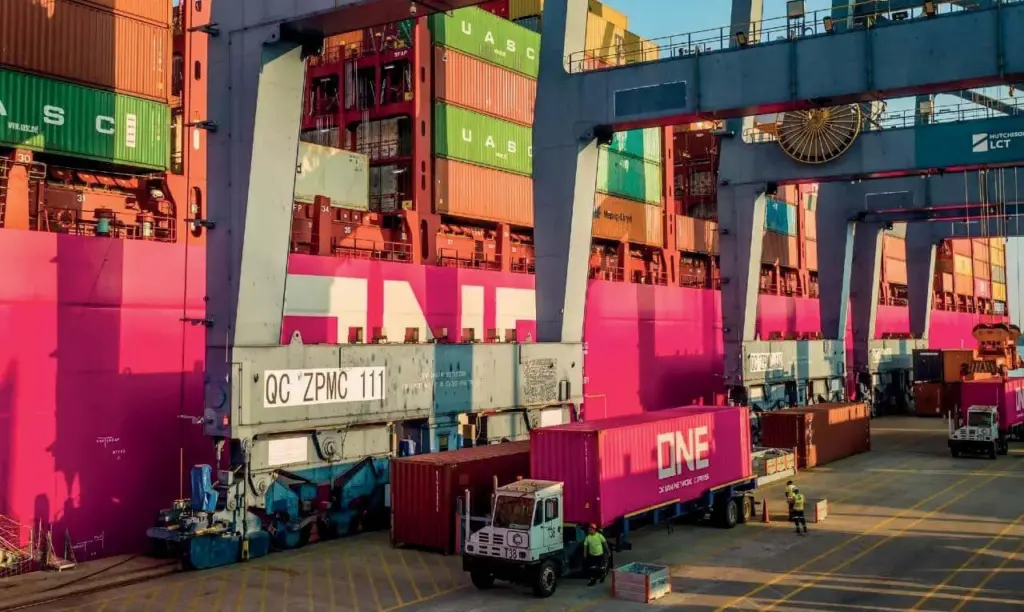
For a country the size of Mexico – 135 million people spread across 1.96 million sq km – which produces a variety of products for export, you would expect the port and general transport infrastructure to be strong and well developed in the 13th biggest country in the world…. And you would be wrong!
And now that its biggest trade partner, the United States, is going full throttle towards more near-shoring – creating closer to hand alternatives to reduce dependency on China and the Far East – Mexico is in a good position (and indeed location) to amplify considerably its share of any US trade… if only it can improve its, often, outmoded and moribund infrastructure.
In 2022 Mexican ports handled 8,297,950TEU (up 5.7 per cent from the 7,847,881TEU handled in 2021) according to the National Mexican Port Authority. Of those, some six million TEU were moved via the Pacific ports (up 8.5 per cent and including Manzanillo, Lazaro Cardenas and Ensenada) and just 2.3 million TEU via the Caribbean/Mexican Gulf ports (down 0.9 per cent overall in 2022, where Veracruz and Altamira lead the way).
The overall total (close to 8.3 million TEU, is 16.9 per cent more than the 7.1 million TEU handled during 2019, the last “normal” year before Covid, and that figure, in turn, was 1.7 per cent higher than 2018, which registered 6.98 million TEU. In terms of just the Pacific ports we can compare six million TEU with 4.8 million TEU in 2018 which is a hefty 25 per cent jump, while the Caribbean movement in 2022 went up a measly1.83 per cent to 2.23 million TEU from 2.19 million TEU in 2018, clearly showing how Pacific based ports are growing faster.
Mexico, the US and Canada signed up to the US-Mexico- Canada Agreement (USMCA) and it came into force on July 1, 2020, replacing the North America Free Trade Agreement (NAFTA) and the US Department of Commerce called it: “A21st-century, high standard trade agreement supporting mutually beneficial trade resulting in freer markets, fairer trade and more robust economic growth in North America.” Some call it the “New NAFTA”.
Moreover, the new agreement helps reduce the need for “outsourcing” to cheap labour destinations in the Far East, and especially to China, but transport infrastructure must be improved to aid this trend if it is to succeed long term.
“Mexico today spends only one per cent of its GDP on infrastructure when comparable economies are spending up to five per cent but the government doesn’t seem to understand how bad that is for the economy,” says one Lazaro Cardenas based shipping agent, who did not wish to be named. “This statistic has to change,” he elaborates, “if we are to capitalise on the fact that many US importers either no longer wish to do business with China, or at least desire to do less, to have more sourcing options. And that’s where Mexico fills the void, if only we can improve our transport infrastructure.
“Our government is aware of the problems but it is not acting quickly enough in my view. Clearly the US does not wish to depend so much on China, so there is a greatopportunity here for Mexico. We must not blow it.”
The veteran shipping agent says that the majority of the problems are not so much portside but more in terms of the road connections with the port, which are often congested and in a dilapidated state. The key box port of Manzanillo is some 12 hours (525 miles) by truck from Mexico City (urban population of 22 million) which is located 7250 feet above sea level in the high plateau of central Mexico.
NEAR SHORING
A couple of months ago an influential article in the New York Times highlighted the growing trend of “near-shoring” as American multinational companies – after decades of espousing the economic merits of production in China – decided to “recalibrate the risks of relying on Chinese factories to make their goods”. It was the rising ocean freight rates during 2021 and early 2022 and the “crazy congestion at Chinese ports” that lit the fuse towards major changes in the logistics supply chain but the momentum has continued even as freight rates have fallen back.
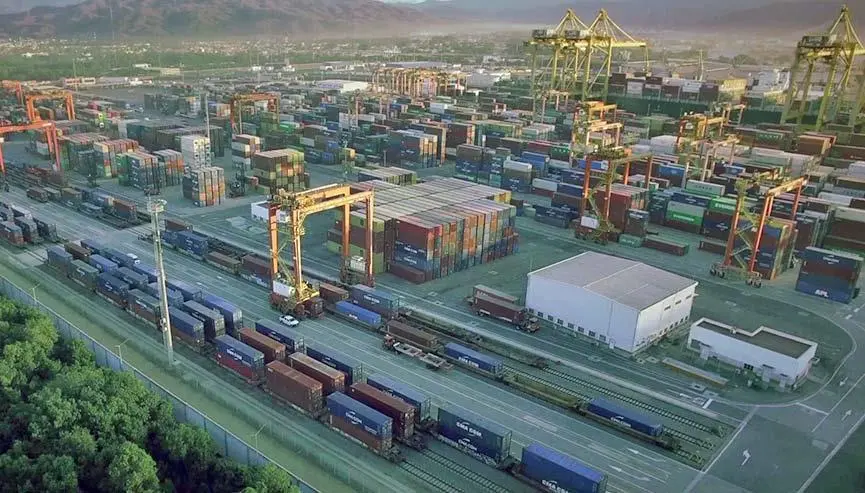
Mexico is also a member of the 21 member Asia-Pacific Economic Co-operation group (APEC) along with Chile, Peru, the US, Canada, Hong Kong, China, South Korea, Australia, China and others, and this might be leading to a swing to even more containers moving via its three main Pacific ports, which will need capacity increases in the near future to help prevent bottlenecks.
To some extent the “New NAFTA” and the growth of APEC can work together to Mexico’s advantage. Some industries, such as apparel, can import cloth and raw materials from China and then use the cheap labour in Mexico before re- exporting the finished products to the US. Walmart (headquartered in Arkansas) has been developing this system over the past two years. Tesla has also decided to build a giga factory in Nuevo Leon, which will benefit Mexico’s ports in several ways.
Several new US backed industrial parks are also in the offing. US Census data shows that since 2019 American imports of Mexican goods have increased by 25 per cent and that during the first 10 months of 2022 Mexico exported US$382 billion of goods, up 20 per cent over the 2021 figure.
UNDER CONTAINERISED?
Despite the “mostly strong” results from the country’s Top Five ports for boxes, many believe that Mexico is still, “Very much under-containerised” and that the volumes moved via boxes can further penetrate breakbulk and the use of sea freight, rather than trucks, can be improved if the political will was there.
There are also questions of “pollution and road congestion” to be answered as a high percentage of cargoes destined to/from the US transit via the highways and Mexico cargo analysts say that much of this could be transferred to the sea if the right incentives were in place.
One port operator which has grasped the nettle is Contecon Manzanillo which is located in the port handling the most containers in Mexico. 2022 saw Manzanillo handle 3.474 million TEU, up three per cent on the previous year. Stevedoring Services of America (SSA) also operates a major container terminal in Manzanillo.
Contecon, the International Container Terminal Services Inc (ICTSI) owned operator, is currently in the process of expanding its capacity from 1.2 million TEU up to two million TEU per annum, as it implements a US$230 million investment programme over five years.
Contecon’s expansion will see it build 400 more metres of extra berth – taking it up to 1.2km in length – and add two more Super post-Panamax Ship to Shore Gantry Cranes (SSGCs, taking the total up to 10) and six more RTGs (taking the fleet to 13).
“Manzanillo is the most important node of international logistics in the Pacific Coast of Mexico and it will continue to be so,” says Jose Antonio Contreras, CEO, Contecon. “We are convinced that this expansion, as well as the construction of land access to the northern zone of the terminal, will consolidate and strengthen the port’s competitive position.”
He adds that the expansion will create 600 new direct jobs to the existing 1200 and 11,600 indirect jobs.
Contecon’s rival in Manzanillo, SSA Mexico, will still be the largest box facility in the port, and indeed in all Mexico, with 14 Super post-Panamax SSGCs and four post-Panamax units, along with 52 RTGs.
Hutchison Ports also has a multi-purpose terminal in Manzanillo, TIMSA, but handles far fewer boxes there than its rivals.
Bernardo Varela, the Operations manager for Mexican shipping agency Transpac SA, tells Port Strategy that better infrastructure would be welcomed in the country especially in Manzanillo where the box terminals are hemmed in by the growing city.
“Moving trucks through the city is not ideal,” says Varela, who is based in Mexico City, “and many of the roads in and out are in need of repair. We definitely need improved road and rail networks, especially here on the Pacific Coast where the Pacific Alliance is improving trade with South America and China, and the rest of Asia.”
Also flourishing on the Pacific coast is the port of Lazaro Cardenas, which handled just over two million TEU in 2022 and registered the biggest rise, 20.2 per cent over 2021, of all the major ports in Mexico. It should be pointed out in this respect, however, that 51 per cent of Lazaro Cardenas’s volume in 2022 was transshipment plus, interestingly, in the first quarter of 2023 volume at the port fell 20 per cent compared to the same period in 2022. Manzanillo also experienced a drop but only two per cent.
The main box terminal in Lazaro Cardenas is operated by Hutchison Ports LCT, with a two million TEU per annum capacity. APM Terminals is also active in the port, operating a smaller 1.2 million TEU/yr capacity facility.
Ensenada, in Baja California, and the most northerly Mexican port, also did well last year, with a throughput of 436,019TEU, a healthy 10.4 per cent rise over the 394,911TEU of 2021, and some 40 per cent higher than the 272,587 TEU of 2019, the last full year before Covid hit. Hutchison is also the main operator here.
Back in 2019 the difference between the Pacific volumes and the Caribbean/Gulf volumes was not so stark, with the former responsible for 4.8 million TEU and the latter for 2.2 million TEU, so just under half, compared to the almost 3:1 ratio of today.
Related Articles
 EQUIPMENT
 OPERATIONS
 OPERATIONS