![PortStrategy[GreenPort]](https://www.portstrategy.com/wp-content/uploads/2026/09/PortStrategyGreenPort.svg)




Nigeria: expanding despite traffic setbacks
Nigeria, Africa’s most populous country with over 200 million inhabitants, is often cited as a land of great potential but as seen time and time again it has been slow to realise it and ,accordingly, port development has proceeded at a measured pace.
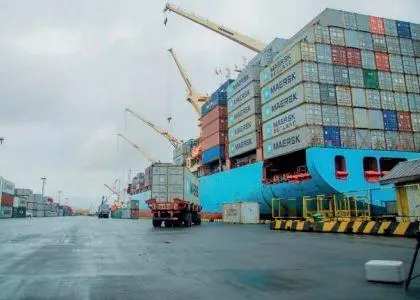
This remains the case today with port investment largely following forecast economic prospects, although after nearly a decade financing has at last been secured for the new port of Lekki in Lagos State.
In October 2019 agreements were signed with the China Development Bank including a USD$629 million financing facility that government officials said would accelerate the completion of the Lekki deep-sea port project. Completion was put at 30 months, which appears to be highly ambitious and will likely lengthen. This may also be appropriate given the reality that Nigeria’s overall non-oil related cargo volumes are still in recovery from previous highs with the container sector included in this. Further, while there is, generally, significant economic potential the actual economic forecasts are not yet that bright – Real GDP growth is projected to rise to 2.9% in 2020 and 3.3% in 2021. But this depends on implementing the Economic Recovery and Growth Plan (2017–20), which emphasises economic diversification.
The latter has, of course, traditionally proved problematic, one significant factor being foreign investors deterred by security problems. Also, as the African Development Bank poignantly notes, “The poverty rate in over half Nigeria’s 36 states is above the national average of 69%. High poverty reflects rising unemployment, estimated at 23.1% in 2018, up from 14.2% in 2016. Low skills limit opportunities for employment in the formal economy.”
In cargo throughput terms the challenge is also clear. For 2013, a total container volume in Nigeria was of over 1,700,000 TEU and the latest statistics available from the Nigerian Ports Authority (NPA) give a volume of 1,210,000 TEU for 2018. The situation with total cargo throughput excluding crude oil is even more dramatic, from a high of over 80 million tonnes in 2011 the volume had fallen to just under 36 million tonnes in 2018.
This overall situation clearly presents a challenge for new port developers. While the Lekki concession is for 45 years a good kick-start to a new development is most beneficial.
Building existing bases
Meanwhile two existing container terminal operators have just announced investment plans.
The SIFAX Group company Ports and Cargo Handling Services Limited, located on Tin Can Island, has introduced three new, high capacity, Liebherr mobile cranes for across the quay operations as well as two more second-hand units. These units are particularly intended to match the latest vessel types calling at the terminal. Also acquired as part of a comprehensive terminal upgrade package are nine reach stackers and 10 terminal tractors.
The company has just one year left to run on its concession period, it has submitted a bid for an extension and with the investment undertaken is clearly confident of getting it.
Similarly, the West Africa Container Terminal at Onne, offering a gateway to Eastern Nigeria and an alternative to the Lagos terminals, has announced what it describes as a Phase 2 upgrade scheduled to commence over the near term. Terminal operator APM Terminals states:
“The Phase 2 upgrade includes the acquisition of three additional mobile cranes bringing the total in operation to five; 20 rubber-tyred gantry cranes (RTGs), three reach stackers, 13 terminal trucks and trailers and an empty container handler.”
Related Articles
 INSIGHT & OPINION
 INSIGHT & OPINION
 INSIGHT & OPINION