![PortStrategy[GreenPort]](https://www.portstrategy.com/wp-content/uploads/2026/09/PortStrategyGreenPort.svg)




Shape of things to come
Shipping profits are being squeezed and the outlook is grim. This will have a far-reaching impact on the terminal sector. Andrew Penfold forecasts what happens next
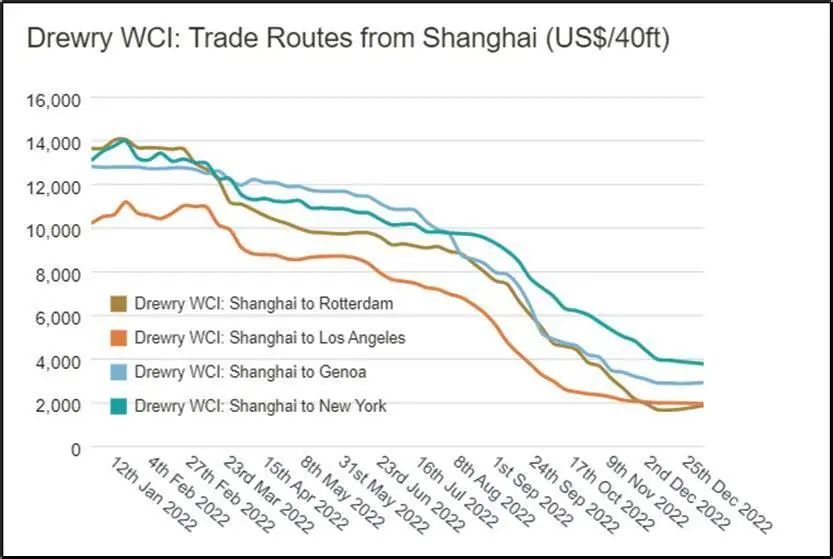
Following the Covid-led supply chain chaos of 2021 and 2022, container freight rates have collapsed and are pretty much at the same level as they reached in 2019.At the beginning of the year Drewry’s World Container Index was running at a level of around US$2,100 per 40’ container. At the peak of the market in January 2022 the corresponding rate was around US$9,700. The pattern of decline spread across the market, but the sharpest proportional drops were noted on the key Transpacific and Asia to Europe trades. This trend was also reflected in the other key indicator – the Shanghai Containerized Freight Index.
The massive profits recorded by the lines over the period represent a one-off gain. The ripples of this will spread out across the port market.
SPENDING THE CASH
The resulting windfall profits have distorted the market and the impact has yet to be fully realised. The responses of the lines to these unprecedented profits have been interesting and will have far reaching effects on the port and terminal sector. Their responses have focused either on rapid expansion of capacity by means of a surge in newbuildings or an upturn in the pace of related infrastructure and other supply line supporting investments.
The former seems likely to have far-reaching negative impacts, whilst the latter will shift the structure of the market. Both responses will impact sharply on the port sector.
The orderbook for cellular container vessels is now very high and, according to Maersk Broker stands at over 30 per cent of existing fleet capacity. This is a higher proportion than noted in the late 2000s when the first round of the size-based revolution in the sector was in full swing. This ordering is concentrated on the largest vessel classes, with around 2.9m TEU of capacity in the 15,000TEU+ size range slated to be delivered by 2025. Even with some cancellations and delays it looks like a case of ‘déjà vu all over again’.
Even with optimistic trade forecasts it seems certain that this capacity can’t be absorbed – and certainly not on the major east-west trades. Also, such optimism is thin on the ground. Despite some recovery in 2021, total container trade volumes remain marginally below 2019 totals and this weakness is most focused on the headhaul transpacific eastbound and westbound Asian to Europe trades. The world is currently heading into recession, with the World Bank reducing its global growth forecasts for 2023 from 3 per cent to 1.7 per cent in early January. The outlook for Europe is particularly poor, with most risks clearly on the downside.
So, we have a massive increase in supply and – at best – a stagnation in demand. The implications are clear, the shipping lines face a collapse in rates and profitability. The collapse in rates is well underway and the natural follow-on from this is a significant downturn in profitability. Short term moves to manage capacity – blank sailings, slow-steaming and rerouting – will not solve the problem.
The other approach to the windfall results of 2021 and 2022 has been to invest downstream in supporting infrastructure. This seems a more sensible strategy but will also cause some upheavals. Recent examples include MSC subsidiary TIL’s acquisition of Bolloré Africa Logistics, CMA CGM’s investment in the GCT terminals in New York and Evergreen’s completion of its 100 per cent stake in Colon Container Terminal. The logic of these purchases is clear: the integration of suppliers into the core shipping business. This has been a long-term trend, but it has accelerated sharply in the past two years with the sudden availability of cash.
The acceleration in this activity has also seen a new twist to it – the willingness on the part of key lines to bid very high numbers to secure terminal assets. The underlying thinking is that the terminal asset can be leveraged to generate greater volume for the core shipping business and allied other services as well. A good case in point is the recent 30- year concession for Jawaharlal Nehru Port Container Terminal, won by CMA CGM’s subsidiary CMA Terminals in partnership with J M Baxi Ports & Logistics with both parties taking a 50 per cent stake. Taking control of this facility, now known as Nhava Sheva Freeport Terminal, is integral to CMA CGM’s core stated objective of consolidating its end-to-end service offering and establishing greater control over the logistics chain to offer its customers “…higher quality, integrated, digital and more environmentally friendly services in a context that requires a comprehensive approach to the supply chain.”
It will be interesting to see if this approach – in a highly competitive climate – is one that ultimately pays off?
WHAT IS THE OUTLOOK?
Quantifying the level of future freight rates and liner profitability is always very difficult but past experience shows that the link between supply and demand cannot be overcome. The container shipping market is heading for the rocks and there is little that can be done to steer away. Freight rates will fall to levels seen in the period 2016 to 2018, orders will be delayed, and scrapping will accelerate. Its also possible that lay-up of modern tonnage may be enforced.
Demand seems certain to remain weak in western Europe, although the outlook for the USA is somewhat more positive. With political and macro-economic uncertainties running high and the conflict in the Ukraine and Covid ongoing, it is unlikely that demand will remain stable this year and in 2024 and there are considerable downside risks.
PORT IMPLICATIONS
Faced with these conditions the following pressures will be manifested on the port and terminal sector:
- There will be pressures to deploy very large vessels onto secondary trades for which they were not really designed. The ‘cascading’ process that has been a feature of the container market can only continue and accelerate. The limitation here will be the capacities of container terminals in the secondary ports in Latin America, Africa, Australasia and the Indian sub-continent. The issue will not just be one of draught. In diverse cases, vessels will be lightly loaded – but with handling longer vessels at the berth, turning circles and the availability of gantries with sufficient outreach there will be challenges. Managing these requirements will require investment and, as has been mentioned, investments from lines in the anticipated market will be scarce.
- There will be renewed downward pressure on stevedoring pricing. With lines increasingly focused on protecting profitability (or minimising losses?) all suppliers will come under pressure to ‘contribute’. In previous market cycles common-user terminal operators have been able to resist these pressures as often there were limited alternative deepwater facilities available. This position has changed. As has been noted in northern Europe most major ports have been able to handle the largest vessels and some port switching was possible during the congestion period. These lessons will not be quickly unlearnt.
- The competitive nexus between line-owned and common- user terminals will also be changed. Major shipping lines have increasingly focused on the provision of equity based dedicated capacity in major ports. The motive was initially to benefit from some of the perceived profitability in this sector with line-owned terminals seeking to market to third party customers. This was a largely unsuccessful effort. With lines under pressure the motive for focusing operations at owned/controlled terminals will intensify. This will place pressure on the common-user sector where there is direct competition between the two types of operation.
This is not a healthy situation – even in the short term.
SEEDS OF CHANGE
The container business has always been cyclical and managing peaks and troughs has been key to survival. The current outlook is pretty bad with the classic solution to this – demand growth – looking more uncertain on the current cycle. What is clear is that once the current difficulties are negotiated there is still a long way for containerisation to progress in global volume terms.
Some reshoring will be recorded, and the role of China may be reduced over time as alternative low-cost manufacturers come forward. These trends will continue to require heavy port investment in both new and established locations. With shipping lines under severe financial pressures and terminal operating companies also facing short term constraints. The seeds of change are here which promise to foster a change of emphasis in investment patterns plus there is the promise of opportunities emerging. History records that when the going gets tough lines dispose of terminal assets – is there any real reason to believe this won’t happen again?
An initial focus could be on partial investment into terminals owned by lines – perhaps on a distressed basis.
As interest rates rise, pressure will increase. This would offer an initial route into the sector for new capital to enter the market. Container terminals offer much higher potential returns for deep pocketed infrastructure funds than other sectors. Will the fallout from the short-term problems change the structure of terminal investment? Such a situation seems much more likely this time around.
Related Articles
 EQUIPMENT
 OPERATIONS
 OPERATIONS