![PortStrategy[GreenPort]](https://www.portstrategy.com/wp-content/uploads/2026/09/PortStrategyGreenPort.svg)



Upping the transshipment stakes
Southeast Asia is a crucial region supporting container transshipment activity. But is it in danger of overdeveloping and generating too much capacity? A J Keyes assesses the position
“Though there was a concerted push for economic recovery in many developed countries, the global economy remained fraught with turbulence in 2023 and the world continued to experience inflation, rising interest rates, tight labour markets, geopolitical tensions and ongoing wars, all of which destabilised the outlook for recovery and disrupted supply chains,” announced Tan Chong Meng, Group CEO of PSA when recently confirming how Singapore’s total container volumes handled in 2023 recorded 38.8 million TEU.
Despite these comments being echoed throughout the container industry, Singapore still recorded an improvement in container volumes handled of 4.8 per cent over 2022. Yet this executive is clearly remaining cautious. “Looking ahead to 2024, the outlook for recovery of the global economy remains unclear, and the world braces itself for further potential geopolitical volatility.”
TOO MUCH TOO SOON?
The Port of Singapore and the two Malaysian ports of Port Klang and Tanjung Pelepas are each adding to their existing substantial terminals, infrastructure and container handling capabilities. However, is there a danger of overcapacity?
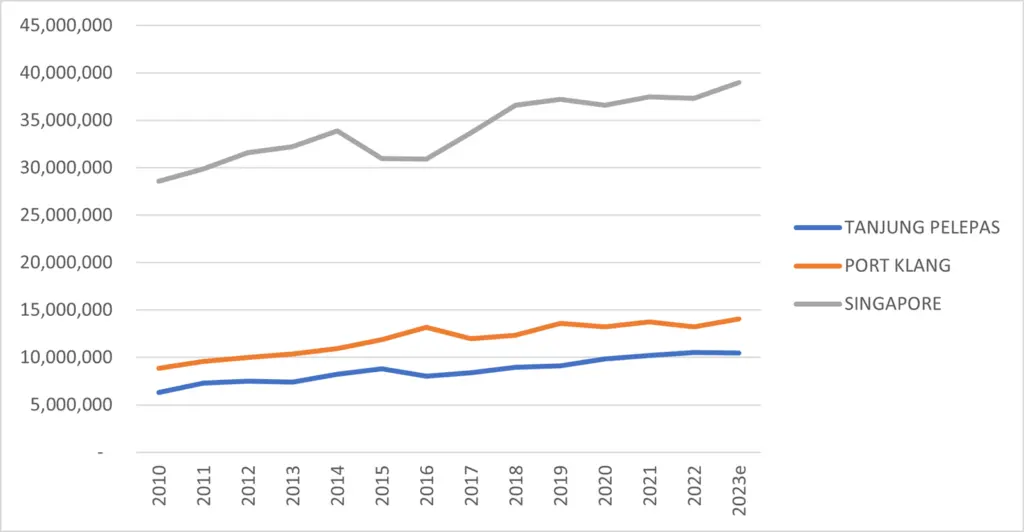
The development of Singapore’s container volumes since 2010 is shown in Figure 1, where it can be seen that the port suffered some volatility in the middle of the past decade, but overall activity has increased from 28.6 million TEU at the start of the period up to 38.8 million TEU in 2023 (reflecting 2.4 per cent per annum).
Both Port Klang and Tanjung Pelepas have seen increases over the same period, with Port Klang rising from almost 8.9 million TEU to just over 14.0 million TEU (3.6 per cent per annum) and Tanjung Pelepas up from 6.3 million TEU to almost 14.8 million TEU (four per cent per annum). Although Singapore’s annual growth total is the lowest, the port’s volumes are more than 30 per cent higher than the combined throughput total of the two facilities in Malaysia in 2023.
So, what level of infrastructure is currently responsible for handling these substantial container transshipment volumes? Table 1 provides a summary of the overall facilities at each of the three hub ports and, unsurprisingly, the numbers confirm the size and scale of the ports. There is a tremendous amount of quay, deep water, and a high number of large ship-to-ship cranes.
Generally, transshipment ports are able to operate at higher utilisation ratios than gateway (import-export) facilities, so these hub facilities regularly surpass the 85 per cent industry benchmark total after which terminal efficiency levels can be impacted. At an estimated 70.5 per cent at Port Klang and 78.0 per cent for PSA Singapore (which excludes Tuas port), both of these facilities have space and even Tanjung Pelepas at 84 per cent can rightly argue to have some existing capacity to use.
| Infrastructure | Port Klang | Port Tanjung Pelepas | PSA Singapore | PSA Tuas |
|---|---|---|---|---|
| Note: Includes estimates. Phase 1 of Tuas opened in 2022 Source: Ports listed, port authorities |
||||
|
Terminals / Ports |
Northport (Malaysia) / Westports Malaysia |
APM Terminals |
Tanjong Pagar, Keppel, Brani and Pasir Panjang |
Tuas Port |
|
Number of berths |
31 |
14 |
55 |
65 |
|
Amount of quay (m) |
8403 |
5040 |
15500+ |
26000 |
|
Water depth range (m) |
13.0-17.5 |
15.0-19.0 |
18.0 |
18.0+ |
|
Number of cranes |
99 |
66 SPPx |
190+ |
TBC |
|
Reefer points |
5332 |
4445 |
TBC |
|
|
Capacity in 2023 (million TEU) |
20.0 |
12.5 |
50.0 |
Capacity of 65 million TEU p.a. when completed |
|
Volumes in 2023 (million TEU) |
14.1 |
10.5 |
39.0 |
|
|
Estimated utilisation (%) |
70.5% |
84.0% |
78.0% |
|
A NEW CHAPTER
There are known, confirmed and ongoing expansion plans underway in each of these locations. In Singapore, the existing 55 berths at Tanjong Pagar, Keppel, Brani and Pasir Panjang container terminals generate total handling capacity of 50 million twenty-foot equivalent units (TEU) per annum, although all of the PSA Singapore container terminals are being consolidated at a single location – on Singapore’s western seaboard at Tuas. When completed in the 2040s, Tuas Port will be the largest automated container terminal in the world, with an annual handling capacity of 65 million TEU. By comparison, Pasir Panjang Terminal has 37 berths with a handling capacity of 34 million TEU annually.
Tuas Port will occupy about 1,337ha of land when completed, with 66 berths collectively offering 26km of quay. Port operations at Tuas Port Phase 1 commenced operations in Q3 2022 and will have 21 deep-water berths that can handle 20 million TEU annually when fully operational in 2027. PSA is expecting to move its operations at Tanjong Pagar, Keppel, and Brani Terminals to Tuas Port by 2027, with the Pasir Panjang Terminal activity fully consolidated at Tuas Port by the 2040s.
With a population of only 5.6 million, Singapore cannot rely on import-export activity, so its long history of being a primary hub for regional cargo, aggregating containers from ASEAN countries, such as Vietnam and Indonesia, will continue. This is proven by 85 per cent of the incoming cargo to the port being destined for other ports – a trend expected to continue.
EQUIPMENT & EXPANSION AT PTP
Tanjung Pelepas is planning to expand its current capacity, with investment in equipment. The current annual capacity of 12.5 million TEU will see a further 3.5 million TEU generated, as the port expands its footprint over five phases with more than 430ha added. In terms of the port’s development, Phase 3 of its expansion is expected to commence in 2025, with a target completion in 2028.
Investment in equipment is ongoing and constant. At the start of April 2024, PTP reached agreement with Shanghai Zhenhua Heavy Industries Co. Ltd (ZPMC) for the purchase of five Ultra Large Container Vessel (ULCV) Quay Cranes. This news followed a February 2024 agreement with Sany Marine Heavy Industry Co Ltd for six ultra large container vessel (ULCV) quay cranes.
Mark Hardiman, new CEO of PTP, notes that these purchases are within PTP’s broader equipment modernisation strategy, with the focus on efforts to expand capacity, upgrade, and add machinery and facilities, as well as improve terminal efficiency and port-related activities to consolidate PTP’s position as a trade and shipping hub in the region.
“Beyond boosting capacity, PTP also sees the purchase of these new ULCV quay cranes as an opportunity to advance its sustainability goals. These cranes are expected to contribute to a 45% emissions reduction by 2030, supporting PTP’s commitment to the Paris Agreement and efficient operations,” he stated.
These two announcements followed news in December 2023 that 48 new electric rubber-tyre gantry units (RTGs) were on order, with delivery by Q3 2025. Another step in the port’s sustainability drive towards decarbonisation.
KLANG: “GAME CHANGER” PLANNED
Port Klang currently comprises Westport and Northport, which are its main international terminals, but despite confirmed expansion here, a massive “game changer” is on the horizon.
Development of a new 4.8km wharf at Westport in Port Klang is expected to be completed in 15 years, adding capabilities for an extra 13 million TEU to be handled, according to Ng Sze Han, Chairman of the Malaysian State Investment, Trade & Mobility Committee.
Furthermore, the government of Malaysia is also planning to develop a massive greenfield terminal on Carey Island, Port Klang. Originally considered in 2017 the project is expected to progress following a formal feasibility study, with Capt. K Subramaniam, General Manager of Port Klang Authority (PKA), referring to the development as a “game changer” and advising that the process had ticked “90 per cent of the boxes” necessary.
The US$5.9bn project is expected to comprise both container and conventional berths, offering handling capacities of 30 million TEU and 20 million tonnes, respectively, when full build-out is achieved. To put the project into perspective, it could develop 15km of berthing, which is equivalent to the entire existing Port Klang port across all cargo activities.
The greenfield port plan is not dissimilar to Tuas Port, under development in rival Singapore, although unlike Tuas Port the Carey Island project is not designed to replace existing terminals. It does though face challenges. Its location further offshore means the wave heights may necessitate breakwaters plus around 90 per cent of Carey Island is palm oil plantation owned by Malaysian company, Sime Darby – not to mention that the location is home to the indigenous Mah Mari tribe who cannot be displaced. As such, it clearly has some hurdles to overcome if it is to come to fruition.
Singapore moving to Tuas is more than just extra capacity, it’s a whole port shift and part of a bigger social and economic solution.
The plans for Tuas were set in motion back in 2012, two years after Singapore lost its top port status to Shanghai. Building what can only be described as a mega port in anticipation of demand could be argued as a challenging proposition at the time, but the project is now gaining momentum and the logic supporting the future of Singapore seems like a prudent decision.
The major hub ports in Malaysia are also expanding, with the Carey Island Port looking to replicate the Singapore-Tuas approach, but only in the sense of a massive expansion – not a replacement but to complement existing infrastructure. With Tanjung Pelepas also expanding, it is clear that this region will need to see continued strong development of demand to keep pace with the planned future capacity.
Related Articles
 EQUIPMENT
 OPERATIONS
 OPERATIONS