![PortStrategy[GreenPort]](https://www.portstrategy.com/wp-content/uploads/2026/09/PortStrategyGreenPort.svg)



A significant year beckons
With growing political and economic interest in Latin America on the part of China, Dean Davison looks at trade developments and potential future implications in several key locations
“In June 2025 President Xi unveiled the China-CELAC Action Plan, a three-year plan to improve cooperation between China and 33 countries in Latin America and the Caribbean. The plan comprises various different initiatives, including a US$9bn line of credit. Trade to Latin America is going to continue to increase, as is the likely involvement of China in the port industry,” explains David Taylor, Managing Director, Apex Maritime Advisors & Consultants (Apex Maritime)
So what is the backdrop to this strong interest from China in Latin America?
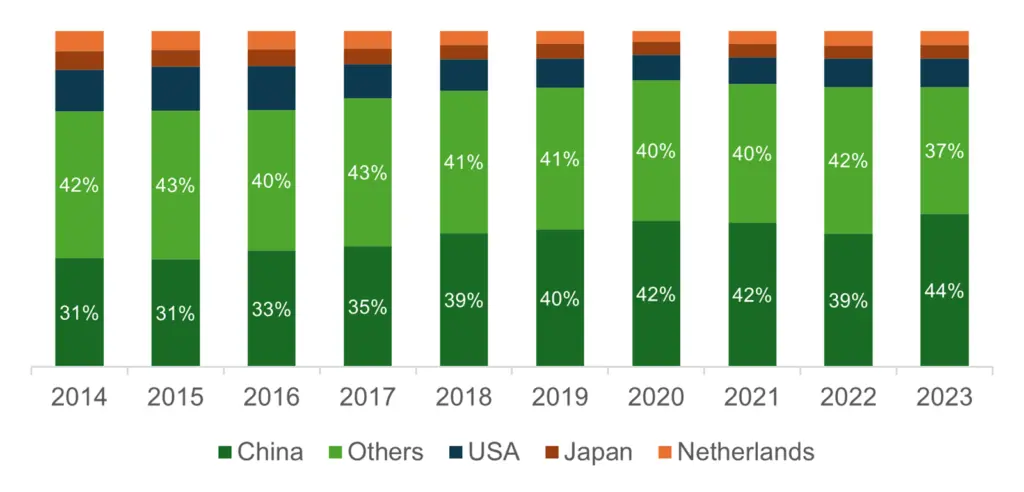
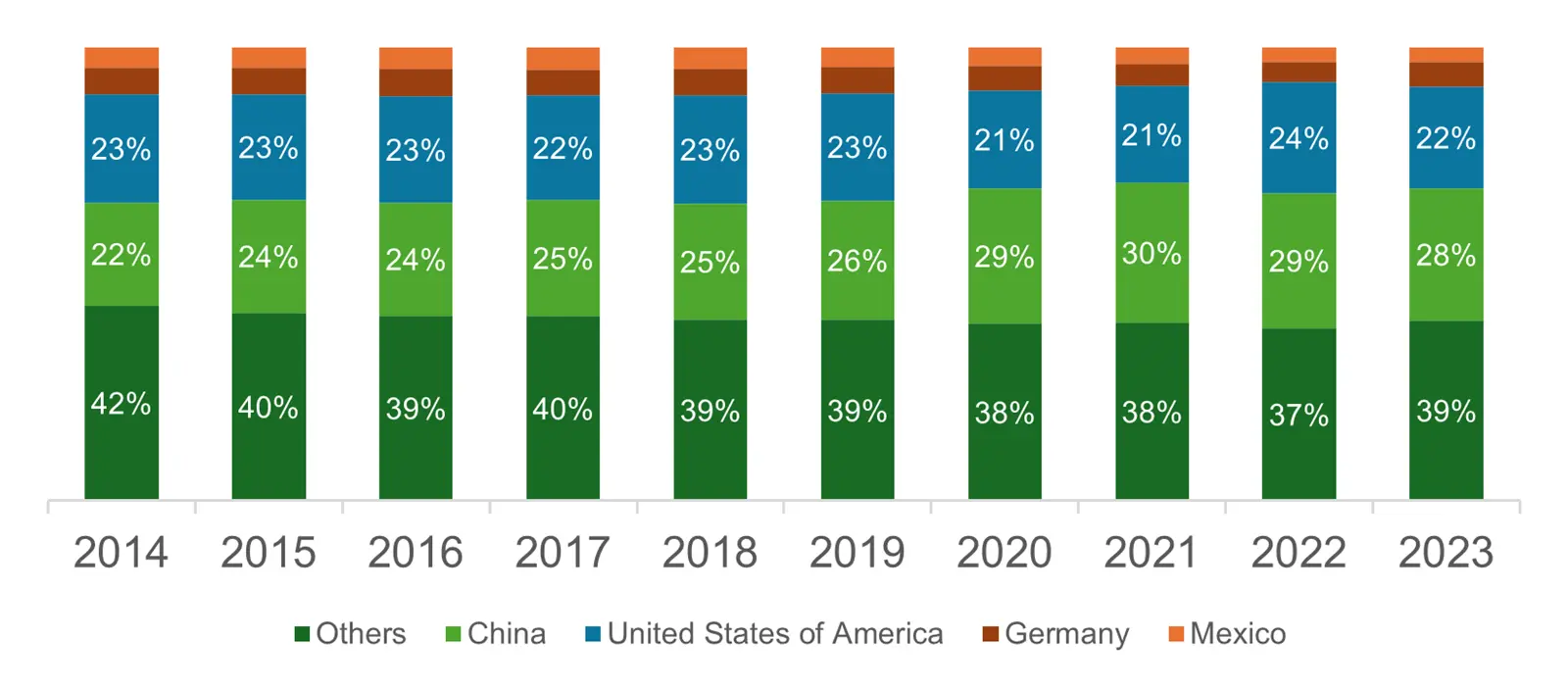
It is clear that trade is the key driver, as identified by leading information services provider Data&. Figure 1 confirms China’s dominant position in export trade to Latin America, with Figure 2 showing the same for imports. In both instances, China is the largest single trading country, based on most recent and confirmed information – it is also a position that looks unlikely to change moving forward.
In terms of volumes of cargo moving to/from China and Latin America, as Table 1 shows, exports to China are clearly dominant, accounting for around 91% of total trade volume activity for the most recent year data is available. However, it is clear that over the 10-year period shown, trade volumes have increased overall across both inbound and outbound cargo flows between the two areas.
| Exports in Million Tons | Imports in Million Tons | ||||||
|---|---|---|---|---|---|---|---|
| Source: dataand.com | |||||||
| 2014 | 303 | 2019 | 426 | 2014 | 29 | 2019 | 32 |
| 2015 | 336 | 2020 | 457 | 2015 | 30 | 2020 | 31 |
| 2016 | 369 | 2021 | 433 | 2016 | 24 | 2021 | 44 |
| 2017 | 398 | 2022 | 417 | 2017 | 27 | 2022 | 44 |
| 2018 | 430 | 2023 | 495 | 2018 | 29 | 2023 | 46 |
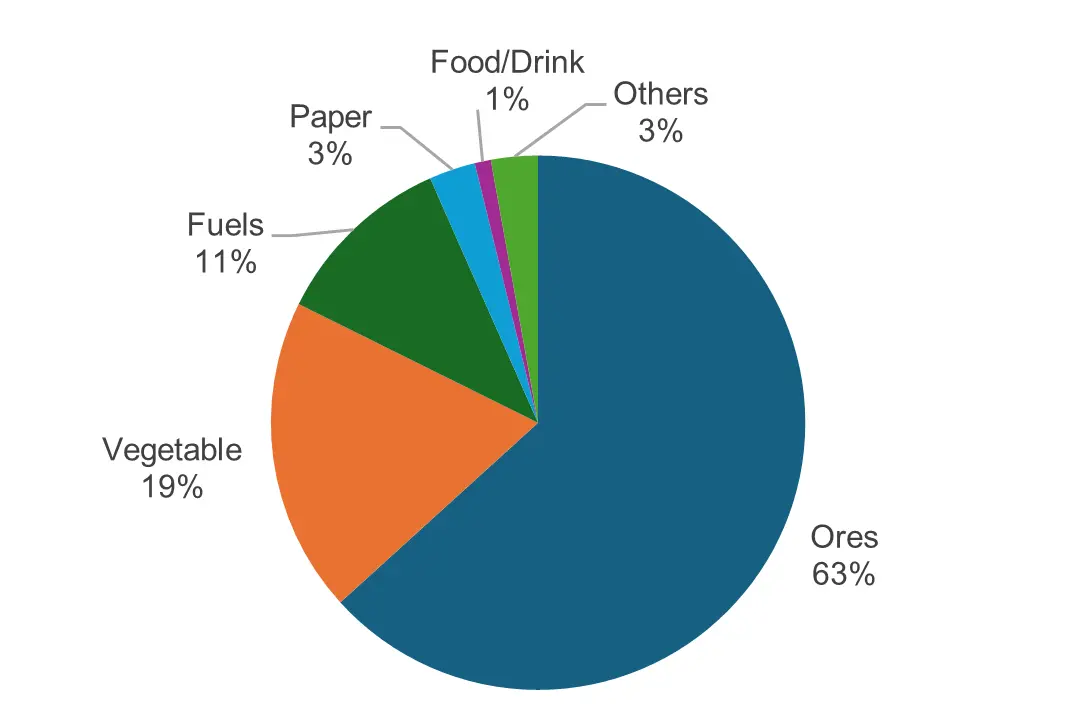
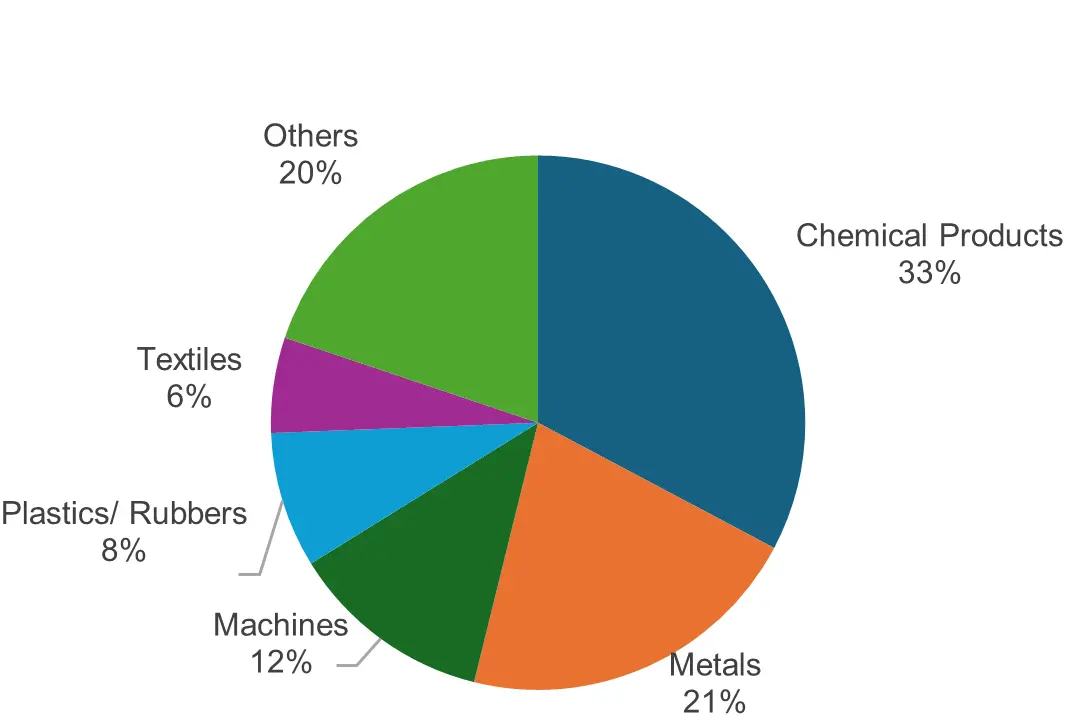
As Figure 3 shows, exports from Latin America to China are predominantly ores (with 63%), endorsing the much larger volumes being shipped. By comparison, the import commodities shown in Figure 4 are more widespread amongst different cargoes and lend themselves to greater use of containers
|
|
|
“Since trade between China and Latin America is almost all in commodities and goods, and given the large distances involved, all of this is transported by sea. Bulk carriers dominate exports from the region to China (agricultural products, minerals, metals, forestry, oil & gas) while the manufactured goods from China predominantly arrive in containers,” explains Taylor.
TRADE LINKS APLENTY
China has been Brazil’s main trading partner since 2009, when it overtook the US. The Asian nation is the world’s biggest soybean importer, and this remains a key commodity moving from Brazil. Indeed, in 2024, 28% of Brazil’s exports were shipped to China according to Agência Brasileira de Promoção de Exportações e Investimentos – ApexBrasi, who also noted that Brazil was China’s main provider of soy, beef, cellulose, corn, sugar and poultry.
While there are several key commodities that comprise the overwhelming majority of exports, the trade relationship with China is changing. The manufacturing industry represented 23% of Brazil’s exports to China in the first quarter of 2025, an increase of 6% over Q1 2024, according to the Brazil-China Business Council.
The balance of trade is also changing too, with Data& noting that Brazil is also importing more from China, with 26% of imports in 2025 estimated to have arrived from China, and 6% of cars in Brazil are now Chinese. Almost all of what is now being imported are manufactured goods like electronics, microchips, solar panels and memory cards.
Endorsing these changing trade trends, Hussein Kalout, International Advisory Board Member at the Brazilian Center for International Relations (CEBRI) confirms the future approach: “Brazil will resolve many of its trade issues by selling more to China and China will also benefit.”
Chinese-owned enterprises are also making significant headway in Peru too. In the mining sector, China leads in terms of foreign direct investment and in 2025, this activity totalled over US$13.5bn across mineral projects.
Plus, it seems that China is interested in other major infrastructure cargo projects involving these two countries. Both Peru and Brazil are part of China’s transcontinental railroad project to connect the Pacific coast with the Atlantic Ocean.
This project aims to facilitate the transport of Brazilian goods, such as soybeans and minerals, to China’s Shanghai port via Peru’s Chancay port, reducing maritime trade distance by about 10,000km and easing reliance on Brazil’s congested Santos port (where Chinese interests may also be targeting access).
Reports indicate that this project needs investment of more than US$ 1.3bn, but it is supported by Chinese President Xi Jinping as part of China’s Belt and Road Initiative.
VITAL COMPONENT INVESTMENT
Ports are clearly a vital component supporting Latin America’s trade activity with China, and Chinese authorities are continuing to increase their investment and interests throughout the South American region.
According to Drewry, Latin America remains a small component of Cosco’s current container terminal portfolio, at just 3.9% of the company’s equity TEU breakdown, although this is comparable to Africa (4.1%) and larger than the Mediterranean/Black Sea region (just 2.1%). However, it is expected to be a growing area of focus.
Looking at specific ports, the opening of Chancay just to north of Lima has been a point of major focus following Xi’s presence at the opening ceremony. Taylor offers an explanation: “The port itself mirrors the trade with China, being equipped for both container traffic and the export of mining and minerals, so close attention will be paid to the actual throughput and impacts on the regional market.”
The US$1.3bn project, funded with Chinese money, features purpose-built infrastructure designed to accommodate megaships and support integrated logistics zones to enhance operational efficiency and connectivity, although an employee from one of the existing two terminal operators at Callao (who wished to remain unnamed) confirmed: “Logistics facilities do not currently exist to support Chancay and will take around 20 years to properly develop competitive infrastructure.”
To achieve an economic level of utilisation and to help Chancay succeed, this new COSCO port will need to take gateway volumes from the existing terminals in Callao and transshipment volumes from other ports to the north and the south; COSCO is not currently a major player in the WCSA market, so it is reasonable to see the level of volume growth increase in 2026, although it does have existing close operating alliance ties with CMA CGM that could play an important role in developing growing container volumes.
Obviously, current operators in Callao, APM Terminals and DP World, are both fully aware of this position and will continue to point to Lima’s logistics infrastructure being located to the south of Callao (and hence further away from Chancay) as the key reason behind the new Chinese-backed port if it struggles to gain more traction.
There are other locations throughout Latin America where potential Chinese involvement in also likely. For example, Chinese construction companies are pre-qualified for the construction of the new outer harbour project in San Antonio in Chile, which should be awarded in 2026, and are likely to have offered highly competitive bids.
The other major country of interest is Brazil, where the country’s Ministry of Ports and Airports has confirmed that the forthcoming Tecon Santos 10 auction will feature a new concession model, particularly in how the fee is structured: “The Ministry of Ports and Airports will follow the TCU’s recommendations, including the requirement for a minimum concession fee. The goal is to balance the terminal’s market appeal with ensuring a reasonable minimum return for the public treasury, compatible with the scale of the project.”
The new terminal will cover 621,000m2 and be dedicated to the handling and storage of containers and general cargo. The federal government estimates that Tecon 10 will increase the Port of Santos’s annual capacity to nine million containers.
The winner of the auction will be the company that offers the highest concession fee, with a 25-year concession period and with ANTAC maintaining a preference for bringing in a new operator. Potentially, this provides an opportunity for a Chinese operator such as COSCO.
SIGNIFICANT YEAR
For the first time in more than a decade, there are several major new projects due to be awarded in the Latin America region in 2026, notably TECON10 in Santos, Brazil and the San Antonio Outer Port in Chile – this is in conjunction with the expected ramp-up of the new COSCO Chancay Port in Peru.
With ever-closer political and economic ties, 2026 could be a pivotal year in the growth of Chinese interests across Latin America.
Related Articles
 WORLD
WORLD
 WORLD
WORLD
 PRODUCTS & SERVICES