![PortStrategy[GreenPort]](https://www.portstrategy.com/wp-content/uploads/2026/09/PortStrategyGreenPort.svg)

Continued Hub Expansion
With a strategic location at the crossroads of global trade routes, ports across the Middle East play a critical role in facilitating trade movement between key markets in the east and the west. AJ Keyes tracks recent activities and assesses the impact of future expansion
Transshipment is a key component of the container port industry in the Middle East and there are number of largescale hub facilities supporting global shipping lines. However, the Red Sea shipping crisis is having a major impact on the region.
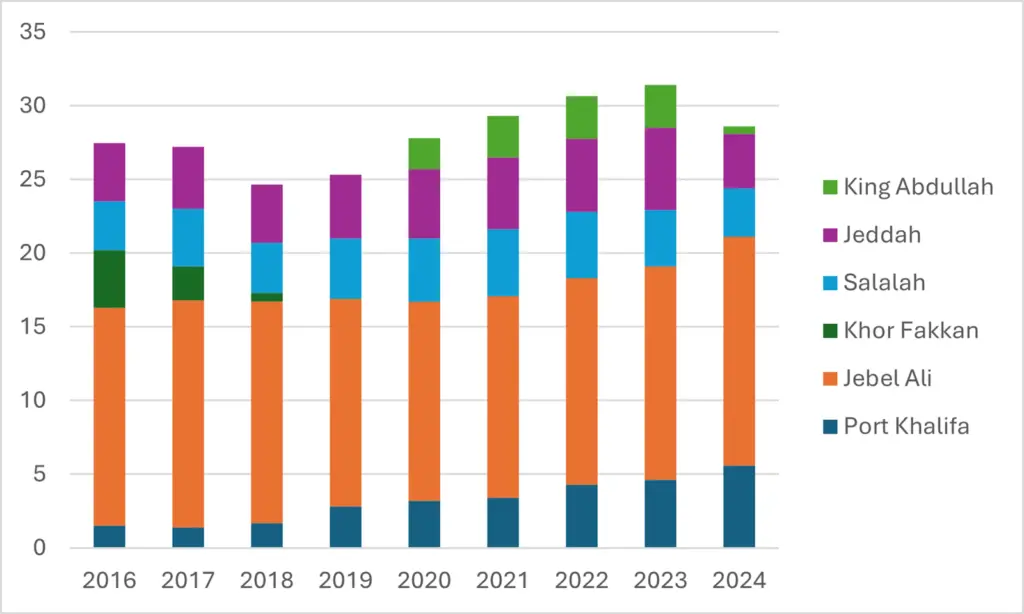
In terms of total volumes of the leading hub ports, the 2016 throughput of just under 26.5 million TEU has seen overall growth, but it has been inconsistent. Volumes fell to just under 24.7 million TEU in 2018 before returning to stronger increases to 31.4 million TEU by the end of 2023 – the impact of the Red Sea crisis resulted in 28.6 million TEU recorded for 2024.
Jebel Ali clearly retains the largest share of the container traffic being handled, with 54.2% in 2024, albeit that the Red Sea crisis has clearly impacted the position. In 2023, Jebel Ali’s share was 46.2%, which reflected a declining trend from 60.9% in 2018. The emergence of Khalifa Port was also a factor, with the home facility of Abu Dhabi Ports’ seeing an increase from just 5.5% in 2016 ramping up to 19.6% for 2024 – although this Arabian Gulf port also benefitted from the Red Sea problems with a jump of 5% from 14.6% in 2023.
MASSIVE DROP
According to the Saudi Port Authority (Mawani), volumes at King Abdullah Port were hit by a massive drop of 82.7% in 2024. In 2023, the port handled almost three million TEU but within 12 months this figure had fallen to 500,000 TEU. To put the situation into further perspective, in 2023, KAP handled 389 vessels above 15,000 TEU, but for 2024 just one vessel of this size specification called at the port.
Prior to the Red Sea crisis commencing, KAP was emerging as a fast growing, largescale container facility with volumes being generated by Mediterranean Shipping Co (MSC), supplying traffic for its operating arm, Terminal Investment Ltd. The facility was inaugurated in 2019 and by 2022 it had surpassed 2.9 million TEU due to a strategy of utilising the new port as a regional transshipment hub, along with other shipping lines using its strategic Red Sea location.
Fellow West Coast of KSA port, Jeddah, has also been impacted by the Red Sea crisis, with a drop of 33.4% in container traffic in 2024 on the 3.7 million TEU handled.
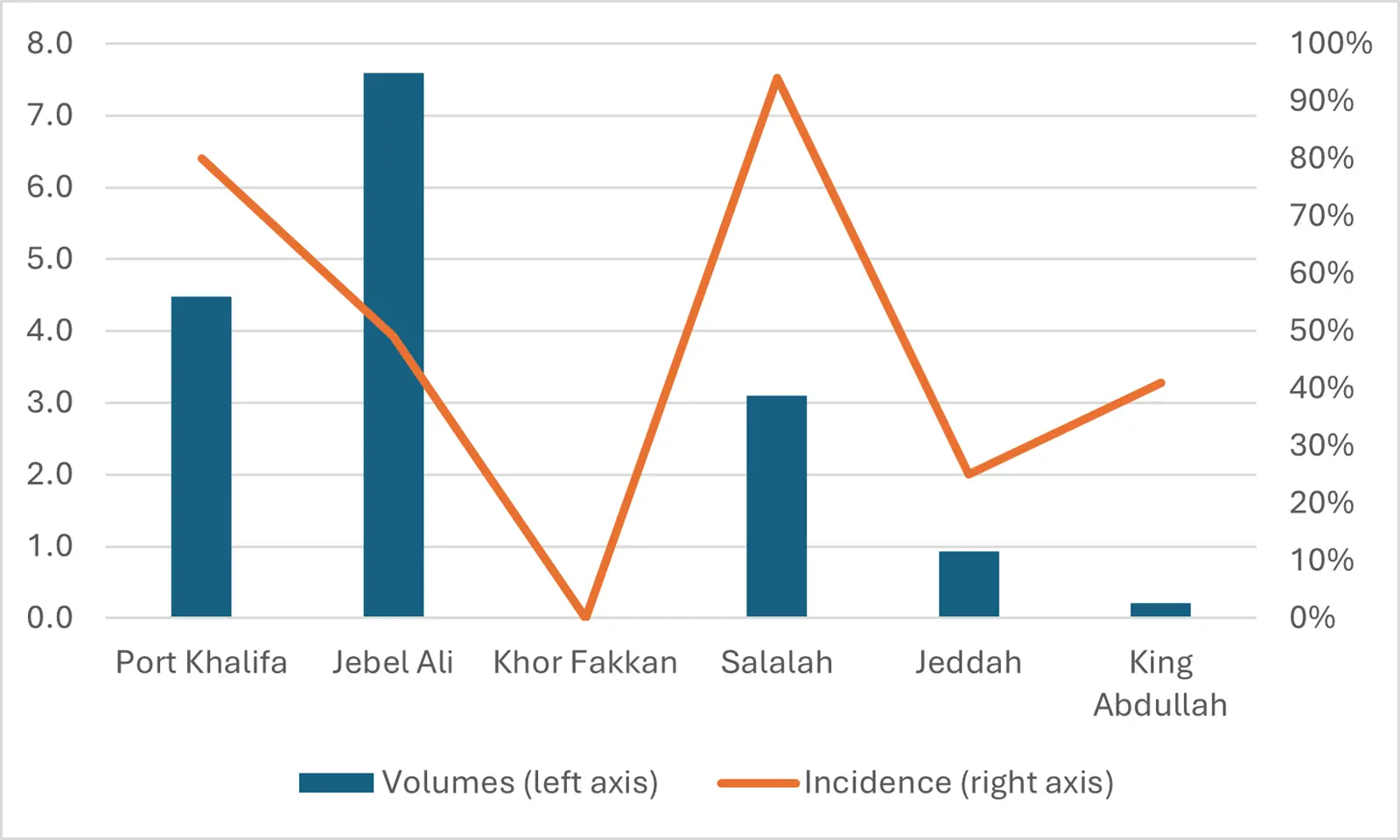
However, unlike KAP which has a heavy reliance on transshipment activity, Jeddah’s container throughput is split between transshipment and gateway cargoes, with import-export activity for the capital, Riyadh and the culturally important city of Mecca.
Transshipment volumes and incidence at the leading regional hub ports for 2024 can be seen in Figure 2.
CONTINUED EXPANSION
Continued expansion of container terminal facilities is planned in the Middle East, irrespective of the Red Sea shipping crisis. Table 1 provides a summary of the known / confirmed plans that the listed ports are undertaking.
Table 1: Summary of Confirmed / Known Expansion Plans at Hub Ports in Middle East
| Country | Port | Project | Expansion in Million TEU | Completion Date |
|---|---|---|---|---|
| Source: Ports, terminal operators, Data& | ||||
|
UAE |
Khalifa Port |
CMA Terminals |
+1.8 million TEU |
Start of 205 |
|
Total port expansion |
Form current 10 million TEU to 15 million TEU |
By 2030 |
||
|
Jebel Ali |
Terminal 4 |
+3 million to port total of 22 million TEU |
Plans underway |
|
|
Oman |
Salalah |
Six existing berths |
From 4.5 million TEU to 6.5 million TEU |
Completed in early 2025 |
|
KSA |
King Abdullah |
Total port |
25 million TEU |
Demand driven in phases |
|
Jeddah |
South Container Terminal (DPW) |
From 4 million to 5 million TEU |
“Paves the way to reach 5 million TEU” |
|
The following expansion summary applies to each hub facility:
- Khalifa Port – 15 million TEU by 2030:
The new US$845 million CMA Terminals facility in Khalifa Port, is managed as a joint venture between the CMA CGM Group’s subsidiary CMA Terminals (70 percent) and Abu Dhabi Ports (30 percent) and adds a further 1.8 million TEU of container space to the port.
The addition of this operation increases Khalifa Port’s annual container capacity by 23% to almost 10 million TEU per annum and represents a key step in reaching the goal of Abu Dhabi Ports in offering an annual handling capacity of 15 million TEU by 2030. The terminal also features shore-power infrastructure for vessels and is rail-connected.
- Jebel Ali – T4 Underway and Green Aims:
Jebel Ali’s current handling capacity is 19.4 million TEU across four terminals and over 100 berths. With a 2024 total throughput of 15.5 million TEU, there is some space to facilitate near-term growth without major congestion bottlenecks. Nevertheless, plans are underway to complete a fourth terminal, to boost capacity beyond 22 million TEU per annum, ensuring the ability to meet future demand for the current decade.
Greater use of autonomous vehicles is being introduced to transport containers within the port, supported by advanced digital platforms coordinating logistics operations, while implementation of carbon-reducing initiatives, clean energy sources and use of biofuels and electric vehicles are all underway.
- Salalah – Gemini Focus
In Q1 2025, APM Terminals-operated Port of Salalah confirmed expansion investment of US$300 million to ensure readiness for the new network under the Gemini cooperation.
This port investment includes upgrades to all six existing berths, 10 new STS cranes with the capability to handle ultra large vessels 26 containers wide increasing the number of cranes at the Port from 21 to 27 and an expansion of the yard to increase capacity from 4.5 million TEU per annum to 6.5 million. The new equipment list also includes 12 hybrid rubber tyred gantry (RTG) cranes, two reach stackers, six empty container handlers and 30 terminal trucks and trailers.
The Port of Salalah is a central component of the Gemini network, serving as one of the primary hubs supporting the shipping activity. In an August 2025 release, Vincent Clerc, CEO, Maersk confirmed that the “Gemini Cooperation was successfully phased in fully in June with reliability scores above the 90% target in its first few months of operation.”
- Jeddah – US$800 Million Investment
At the end of Q1 2025, DP World and Saudi Ports Authority (Mawani) unveiled a new state-of-the-art South Container Terminal at Jeddah Islamic Port, as part of DP World’s SAR 3 billion ($800 million) expansion and development programme. The three-year project more than doubled annual capacity at the facility from 1.8 million TEU to 4 million TEU and according to the operator “paves the way for a future capacity of 5 million TEU, with additional ship-to-shore equipment to be deployed as demand grows.”
Automated and electrified yard cranes have been introduced, along with an expanded fleet of quay cranes that will grow from 14 to 17 by the end of 2025, reaching 22 as the terminal scales up to 5 million TEU. In addition, the terminal connects advanced automation and digitalisation to improve operational efficiency. Smart systems will reportedly slash gate transaction times from two minutes to just 10 seconds supported by IoT-enabled cargo tracking and AI-powered cargo tallying for precise record keeping. Integrated with the terminal, Jeddah Logistics Park will streamline cargo transfers and enhance efficiency, with completion scheduled for Q2 2026.
- King Abdullah – Targeting 25 million TEU Capacity:
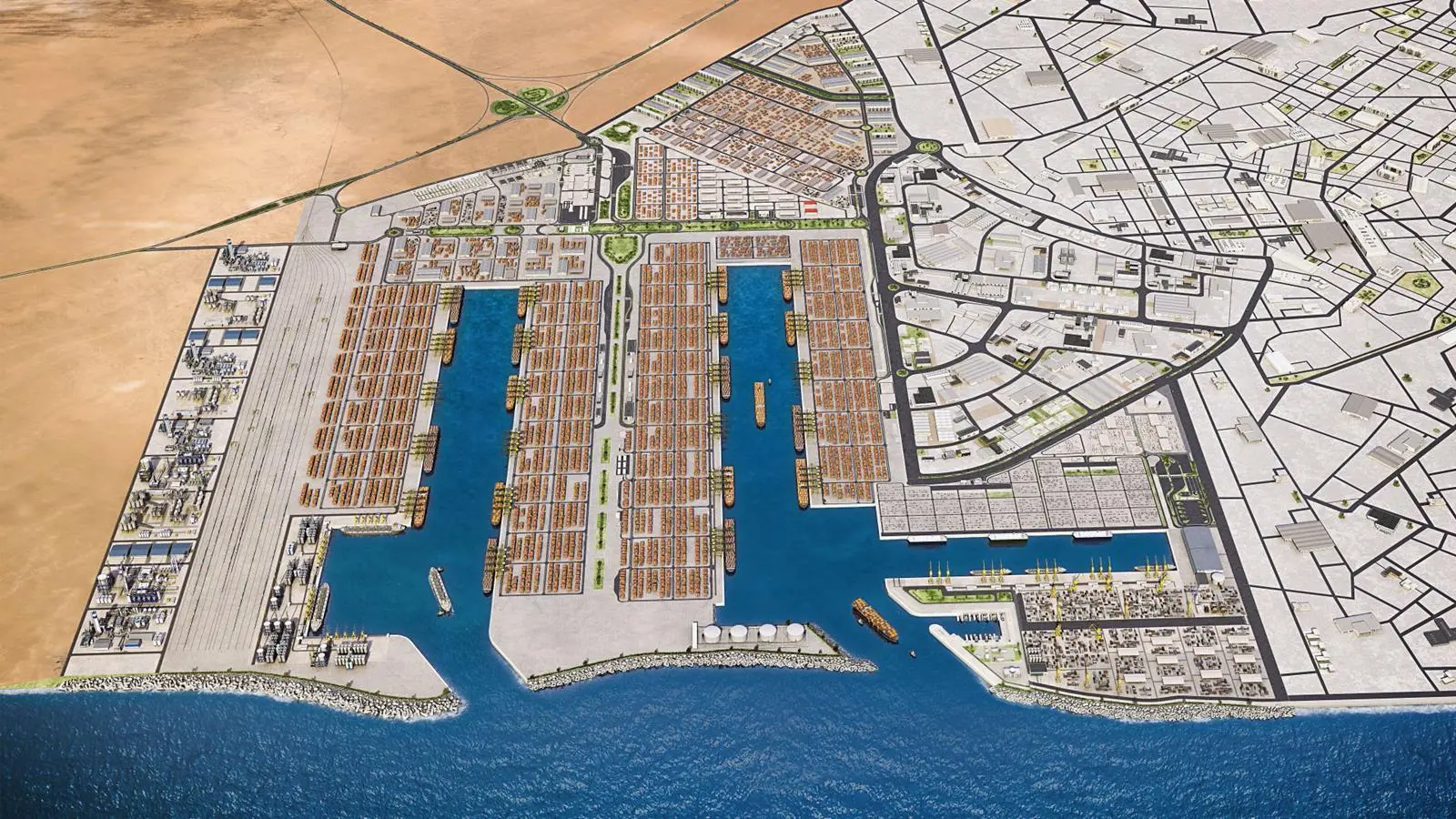
King Abdullah Port is the first privately owned, developed and operated port in the Middle East. Strategically located on the coast of the Red Sea in King Abdullah Economic City, King Abdullah Port occupies an area of 17.4 km2 and is in proximity to the cities of Jeddah, Holy Makkah, Madinah and Yanbu. Once completed, the port will be equipped to handle 25 million TEU, 25 million tons of bulk cargo, as well as 1.5 million CEU annually according to the port’s master development plan.
Featuring deep 18m berths, industry processing facilities, multi-level expanding operations, fully integrated Port Community and Smart Gate e-systems and multipurpose bonded and re-export zones, the port is a key component in the Kingdom’s Vision 2030 initiative.
BUILDING OUT OF CHALLENGES
It’s clear that the Red Sea crisis has impacted volumes for some of the transshipment hubs in the Middle East, while for others less so. However, one thing is clear, that investment in infrastructure is continuing and will carry-on, regardless of the turmoil and instability.
Related Articles
 WORLD
WORLD
 WORLD
WORLD
 PRODUCTS & SERVICES