![PortStrategy[GreenPort]](https://www.portstrategy.com/wp-content/uploads/2026/09/PortStrategyGreenPort.svg)



Full steam ahead
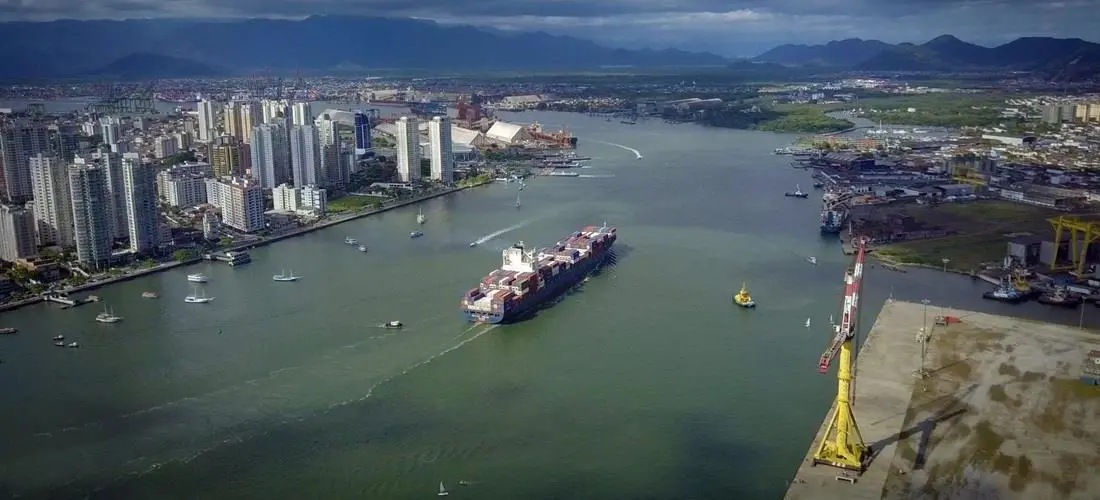
This is the year that promises to bring to the market the STS 10 container terminal opportunity in Santos, Brazil – the so-called jewel in the crown in Brazil’s port privatisation programme. Rob Ward assesses the project parameters and prospects
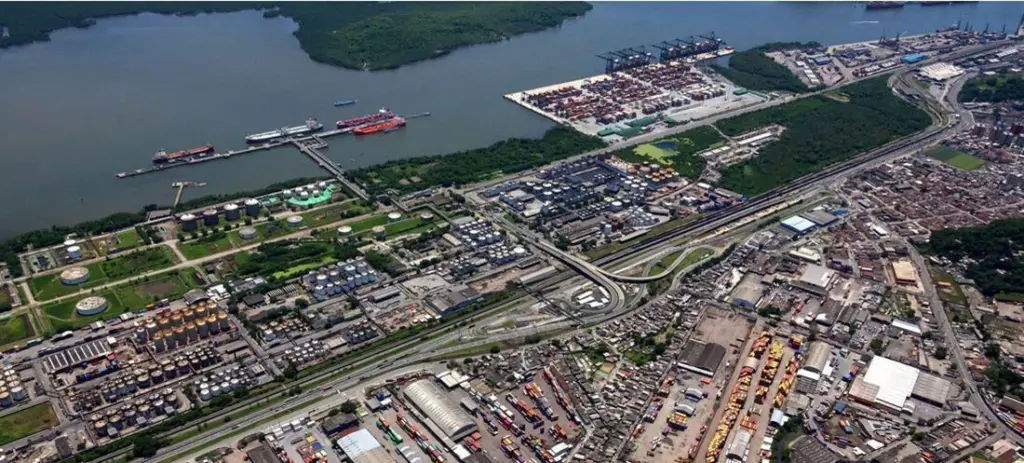
After several bouts of amazing U-Turns the Reais3.15BN ($532.6m) STS10 container terminal project in Santos is once again Full Steam Ahead, and, according to various expert sources in Brazil, the juggernaut scheme will not be for turning this time, although it might be up to some tweaking.
It is believed that the sale of a majority of Santos Brasil shares to French carrier CMA CGM, has paved the way for the 601,900 sq m STS10 project to proceed as it was the management and directors of Santos Brasil, a competing organisation, who were said to be the main opponents of STS10 since it was first mooted, almost 11 years ago.
And with rapidly rising container throughput figures for Brazil’s, and South America’s leading port for boxes (with nearly 4.8m TEU handled last year), the government in Brazil is keen to bring in much needed improvements: to cover state of the art equipment supply and other measures to cut back emissions and enhance environmental performance.
Among those known to be “very interested” in the tender are Maersk and MSC – who currently have a joint operation in Santos via BTP – as well Philippines based global operator ICTSI, China Merchants (CMPort, who currently own the TCP container terminal in Paranagua), PSA International (Port of Singapore), and, possibly, Ecorodovias (the owners of Ecoporto who say they will be interested if there is a strong general cargo element in the tender document). There is also a possibility that JBS Ports – the stevedoring branch of multi-national meat-packer JBS – will bid. This follows on from its initial toe-dip into the market sector in conjunction with Itajai port operations. GIC, the Singapore sovereign wealth fund, and McQuarrie, the Australian multinational investment banking group, are also said to be circling plus Abu Dhabi Ports is also known to be “looking towards Brazil”.
When STS10 was first mooted as a serious project, somewhere between six and eight years ago, there was also significant interest shown by Hutchison Port Holdings (which has two terminals in Panama and used to operate BACTSSA in Buenos Aires) but it no longer appears to be in the mix.
The tender document is reportedly to be made public towards the middle of the year.
PHENOMENAL GROWTH
During 2024, the port of Santos (and its four container terminals) handled 5.485m TEU, a phenomenal 14.7% increase over the 4.784m TEU of 2023. This took place against a background of a rapidly improving Brazilian economy.
A robust increase of 17.8% in bulk cargoes (up to 90.7m tons) was also a key factor in the port reaching a record throughput of 179.8M tons, 3.8% up over the previous year.
Beef and chicken exports were also star performers, rising 31.5% year on year. Further underlining the importance of the port of Santos to both the state of Sao Paulo and other hinterlands, the percentage share of overall Brazilian foreign trade passing through the port rose from 28.5% to 29%, with China now making up 27%. Some 53.7% of China’s overall trade with Brazil now passes through Santos: much of the rest of that figure goes via Paranagua, where Chinese Port Holdings (CPH) operates the TCP box terminal.
“We’ve been saying for a few years now that container throughput was inevitably going to grow at some point and the necessary capacity was not there to deal with that growth,” says Leandro Carelli Barreto, a director with the Solve Shipping consultancy. “Because of the unnecessary delays in recent years bottlenecks and inefficiencies have multiplied – compounded by the reluctance of carriers to use the Suez Canal, and bottlenecks at both BTP, following an accident and Portonave, in Navegantes, undergoing contract disputes as well as APMT being closed for three years {but is now open again thanks to local operator JBS Ports).
“Next year will again see long delays and we don’t expect there to be long-term improvements until STS10 is completed, probably by around 2030.”
He added that although Santos grew at pace, the containerised increases were even greater outside of the country’s top port, with the country average hitting 18%, with export growth at 15% and imports 20%.
Ports Minister, Silvio Costa Filho, has said the new terminals must come on stream “as soon as possible” and he will be working closely with all maritime and port authorities to make sure it happens.
Casemiro Tercio Carvalho, a director with the 4 Infra consultancy, which deals in Maritime, port planning and engineering, plus Mergers and Acquisitions, underlined to Port Strategy that the Brazilian container terminals’ cargo volume is increasing much faster now than the infrastructure can keep up with.
“A lot of containers are being shifted to Rio de Janeiro, Santa Catarina and Paranagua, which isn’t ideal when Santos is potentially the main hub port,” added Carvalho, who was the CEO of the Santos Port Authority, just a few short years ago, and has also held posts at a number of other port authorities, including Sao Sebastiao which may feature in some future breakbulk and other tenders. It is only 140km away and has large tracts of land that can be developed.
Other informed sources in Santos confirm that instead of STS10 being split into two or three sites (cruise, breakbulk and boxes), as has been mooted in the past, it will now be consolidated into one site, consisting of XXXsq m. There may, however, still be a component for breakbulk as there is a capacity shortage in Santos, which could become more acute if Ecoporto closes for business at the end of several six month extensions.
“I think there should be an option for breakbulk, rather than an obligation, and perhaps, in the future, breakbulk facilities could be expanded out of the Sao Paulo state port of Sao Sebastiao {some 120km from Santos],” says one of the veteran sources.
TENDER PARAMETERS
Sources close to ICTSI, which already has operations in Rio de Janeiro and Suape, confirmed that it will definitely be in the mix for STS10 and it will not be put off if there are last-minute changes to the tender document turning the scheme into a multi-purpose terminal.
“I think the pure box terminal operators, like Maersk, MSC and CMPort, might withdraw if the break bulk component is too large in the tender document, but I don’t see ICTSI doing the same,” says an informed source. “That format [large % of break bulk] might also suit Ecoporto.”
Ecoporto seemed to be front runner for a sizeable break-bulk terminal for the 12 months leading up to the middle of last year, but then “the political forces changed their minds again” and went back to the original formula. Also lined up in this scenario was a new cruise terminal for the Valongo (Downtown) area of the port, but now it appears that this will no longer come to fruition.
One anomaly pointed out by several sources is that MSC and/or Maersk have to relinquish their shares in BTP “Before they can bid”. One quotes a precedent whereby Grupo Libra – which was the first ever privatised terminal that moved from the Organised Port Area in Santos back in 1996 and went extinct in 2019 – tried to bid for three subsequent bids, including for Embraport (now DP World Santos) and was refused by the authorities on each occasion.
“What we don’t want to see is one company bidding for one terminal in a port while still holding on to another one as that is, as precedent tells us, against all the rules,” underlines the source.
Against this background, either Maersk or MSC needs to offload their share in BTP “before the process goes ahead” not during or afterwards. This is a conundrum that has so far not been resolved in the STS10 process and doubtless there is some behind the scenes lobbying go on about rule clarification or change regarding existing terminal operators bidding on STS10.
Related Articles
 WORLD
WORLD
 WORLD
WORLD
 PRODUCTS & SERVICES