![PortStrategy[GreenPort]](https://www.portstrategy.com/wp-content/uploads/2026/09/PortStrategyGreenPort.svg)





Scars And Costs
The Red Sea crisis continues to impact cargo flow dynamics for all shipping activities, with longer vessel sailing times and higher costs. AJ Keyes assesses the current position and challenges facing the container industry
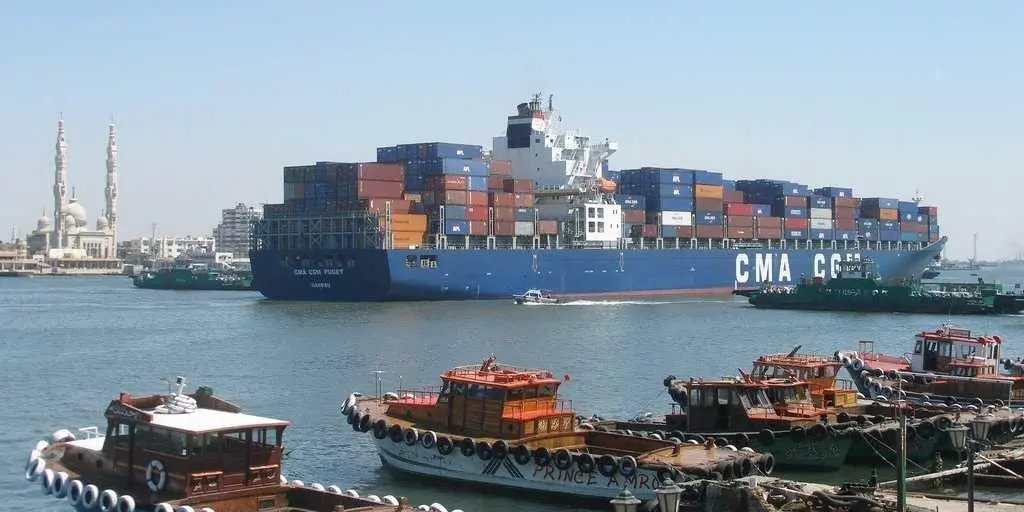
The Suez Canal is both a maritime choke point and a vital waterway for global trade. The waterway may only be 193km in length, but by connecting the Red Sea and the Mediterranean, the Suez Canal sees between 12% and 15% of worldwide trade and about 30% of global container traffic, according to the Suez Canal Authority (SCA).
To put this into perspective, SCA states that more than US$1 trillion in goods transit the waterway annually and on a “normal” operating day, an average of 50 to 60 ships transit this routing carrying anywhere between an estimated US$3bn to US$9bn in cargo value.
Given this strategic role facilitating the fastest sea route between Asia and Europe, any disruption to the Suez Canal has a significant impact on global commerce – and this is currently the exact position. Hence any disruption is an international concern and the need to protect trade flows and supply chains, reduce shipping and insurance costs, and support the flow of trade remains.
There is no doubt that the Suez Canal remains an economic powerhouse for Egypt overall and toll revenues set a record of US$9.4bn for fiscal year 2022-2023. However, with the Red Sea crisis truly biting for fiscal year 2023-2024, SCA reported a drop of -60.1% in revenues, as Table 1 summarises. Clearly, a massive negative impact for SCA and the Egyptian economy overall.
| Issue | Impact |
|---|---|
| Source: Suez Canal Authority base data | |
|
Total voyages rerouting via Cape |
6600+ |
|
Decline in container ships using Canal |
-71.4% |
|
Comparative decline in LNG / Tankers / Bulkers |
-86.7% / -40.7% / -36.0% |
|
Revenue loss for Suez Canal Authority |
-60.1% |
Clearly, the disruptions arising from the conflicts and issues creating the Red Sea crisis are having far-reaching economic effects, including on trade flows and supply chains. So, what is actually happening?
Attacks on shipping effectively throttled the Suez Canal from late 2023 and throughout 2024. With no confirmed attacks on shipping off the Yemeni coast since December 2024 until July 2025, there was even speculation that the threat posed by Houthi militants had been greatly diminished and shipping lines may look at returning to using the Suez Canal again.
Clearly any growing sentiments throughout the shipping industry that Red Sea transits could begin to increase were negatively impacted with the return of the attacks on cargo vessels.
TIME & COST CHALLENGES
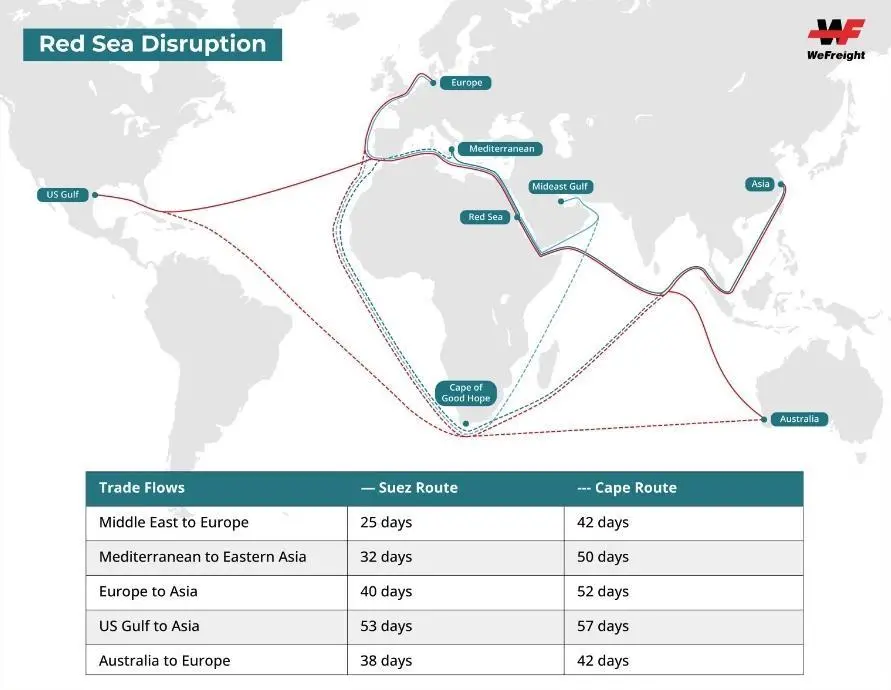
According to UAE based WeFreight, a rapidly expanding freight forwarding and logistics company focused on emerging markets, the additional sailing time from vessels rerouting from this transit waterway is clearly shown in Figure 1. The detour around the Cape of Good Hope adds a number of extra sailing days to Asia-Europe voyages, thereby placing tremendous pressure on just-in-time supply chains. This means that shippers and cargo owners that rely on faster supply-chain turnaround, such as electronics manufacturers and retail supplies, are having to cope with extended transit times and uncertain delivery schedules.
A further outcome of these longer routes is increased transportation costs. Leading vendor-neutral global freight booking platform, Freightos® (Nasdaq: CRGO), which has over 10,000 importers and exporters connecting with thousands of freight forwarders across the shipping and airline industries, states that global shipping capacity has, at times, shrunk by an average of 20% during the Red Sea crisis and this capacity crunch has pushed up freight rates on major trade lanes.
Cargo insurance rates for shipments passing through the Red Sea region also continue to increase. Policies that traditionally cost around 0.5% of cargo value rose to around 2% as the situation deteriorated and this has once again occurred in 2025.
As a result, these increased costs mean that a larger container ship – as typically would be using the waterway – face millions of dollars in extra insurance costs for a single Suez Canal passage. Such extra costs make the viability of using the Red Sea and Suez Canal financially challenging, if not unviable, for shipping companies to now consider this sailing route. Instead, sailing around Africa, despite the longer journey, remains the preferred route.
The aftermath of the July 2025 Houthi attacks resulted in a new insurance spike, with premiums subsequently rising to around 0.7% of the value of a ship in mid-July. This escalated from around 0.3% before the attacks took place, with some underwriters pausing cover for some voyages, according to reports from Reuters. To put the numbers into perspective, additional premiums of 0.3%-0.6% for Red Sea transits represent an extra (estimated) outlay of US$150,000-US$300,000 for a vessel worth US$50m
Nervousness moving forward, especially after the July 2025 return of attacks on shipping, is that insurance providers will once again become reluctant to cover Red Sea transits, with shippers facing the challenge of obtaining any insurance or needing government-backed guarantees. Until the situation changes and insurers do not designate the Red Sea as a high-risk war zone, insurance for cargo owners and ship operators will remain challenging.
OTHER CONCERNS
There are other concerns too. The International Monetary Fund (IMF) has recently stated that “continued disruption will put upward pressure on inflation in affected economies” due to a combination of higher costs for imports and delays to the logistics supply chain.
Additionally, the mass diversion of ships around Africa has a major environmental cost – longer voyages mean higher fuel burn and emissions. Freightos estimates that rerouting ships sailing 50-60% farther instead of using the Suez Canal route, produces an estimated 40% more carbon dioxide per voyage.
In its July 2025 earnings announcement, AP Moller-Maersk said the longer route has “added a lot of cost” for the company and other operators and this impacts profitability. Vincent Clerc, CEO, AP Moller-Maersk explains: “The Red Sea reopening looks unlikely and we still expect the disruption to remain with us for the full year with potential congestions to ensue,” and underlines, “Our breakeven point is, of course, higher now than it was in 2019.”
Yet despite the resumption of the Red Sea crisis, AP Moller-Maersk raised its 2025 profit forecast, citing stronger-than-expected volumes. It now expects global container growth of two-to-four percent, up from the previous estimate of one-to-four percent.
Semiramis Payu, CEO of US-listed Diana Shipping agrees. “This situation remains volatile and the Red Sea rerouting is likely to continue,” he confirms.
SCA is fighting back though and confirms that as of mid-July a total of 10 container ships had taken advantage of its 15% rebate incentive for any container ship exceeding 130,000 tons transiting the waterway. This offer was introduced in May and was set to run for three months but is now in place for the remainder of 2025. SCA confirms that, at the time of writing, CMA CGM has transited with six vessels and Mediterranean Shipping Co (MSC) with four vessels.
CONSUMER PAIN
The Red Sea crisis highlights the vulnerability of global trade routes to geopolitical conflict and the broad implications of such events on the global economy. The outcome is simple. The Red Sea crisis continues to result in increased operating costs for ocean carriers, which are subsequently being passed on to shippers – and, as a result, ultimately it will be consumers who pay more.
Related Articles
 WORLD
WORLD
 WORLD
WORLD
 PRODUCTS & SERVICES