![PortStrategy[GreenPort]](https://www.portstrategy.com/wp-content/uploads/2026/09/PortStrategyGreenPort.svg)




(Smart) business as usual
A J Keyes runs the rule over China’s recent container terminal performance – volumes, automation/investment in Smart Ports – and assesses what lies ahead
At the start of Q4 2024, there was a four-month slowdown for China’s exports. This took place against a background of heightened geopolitical tensions and fears of recessions. This, in turn lead to concerns about how container ports in China would be impacted.
Well, it seems that the answer is a simple one – it’s business as usual.
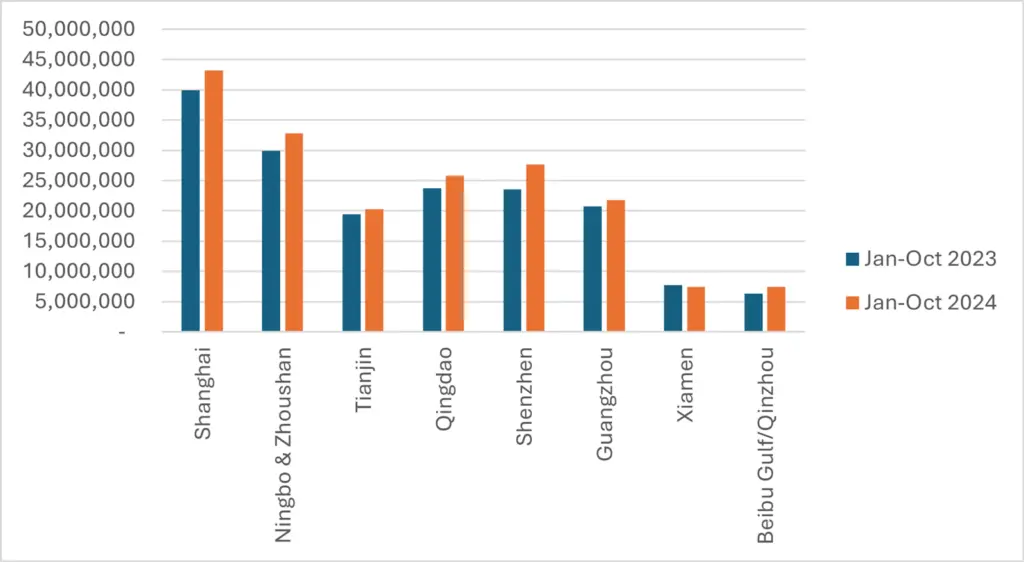
Figure 1 provides confirmation of container volumes handed for the largest container ports in China for the January to October 2023 vs 2024 period.
The ports listed are the eight largest volume facilities and collectively they handled 171.4 million TEU for the 10-month period in 2023, which rose to 186.4 million TEU for the comparable period of 2024. This is reflective of a 8.7% increase.
Overall, 8.7% for ports in China is not necessarily that impressive, compared to previous years, but it needs to be put into perspective. Shanghai may have “only” recorded growth of 7.6% for the period, but volumes were over 39.6 million TEU for the 10-months of 2023, rising to 43.3 million TEU one year later. These are substantial, and increasing, volumes.
In fact, all of the listed ports with the exception of Xiamen recorded positive increases, with Shenzhen the standout performer generating an increase of 14.9% as the 2023 period figure of 23.5 million TEU rose to 27.7 million TEU.
Another notable increase occurred at Ningbo & Zhoushan, which saw an uptick of 8.8% in the 2024 period when 32.8 million TEU was handled, compared to 29.9 million TEU in the 10 months of 2023.
2024 PERFORMANCE
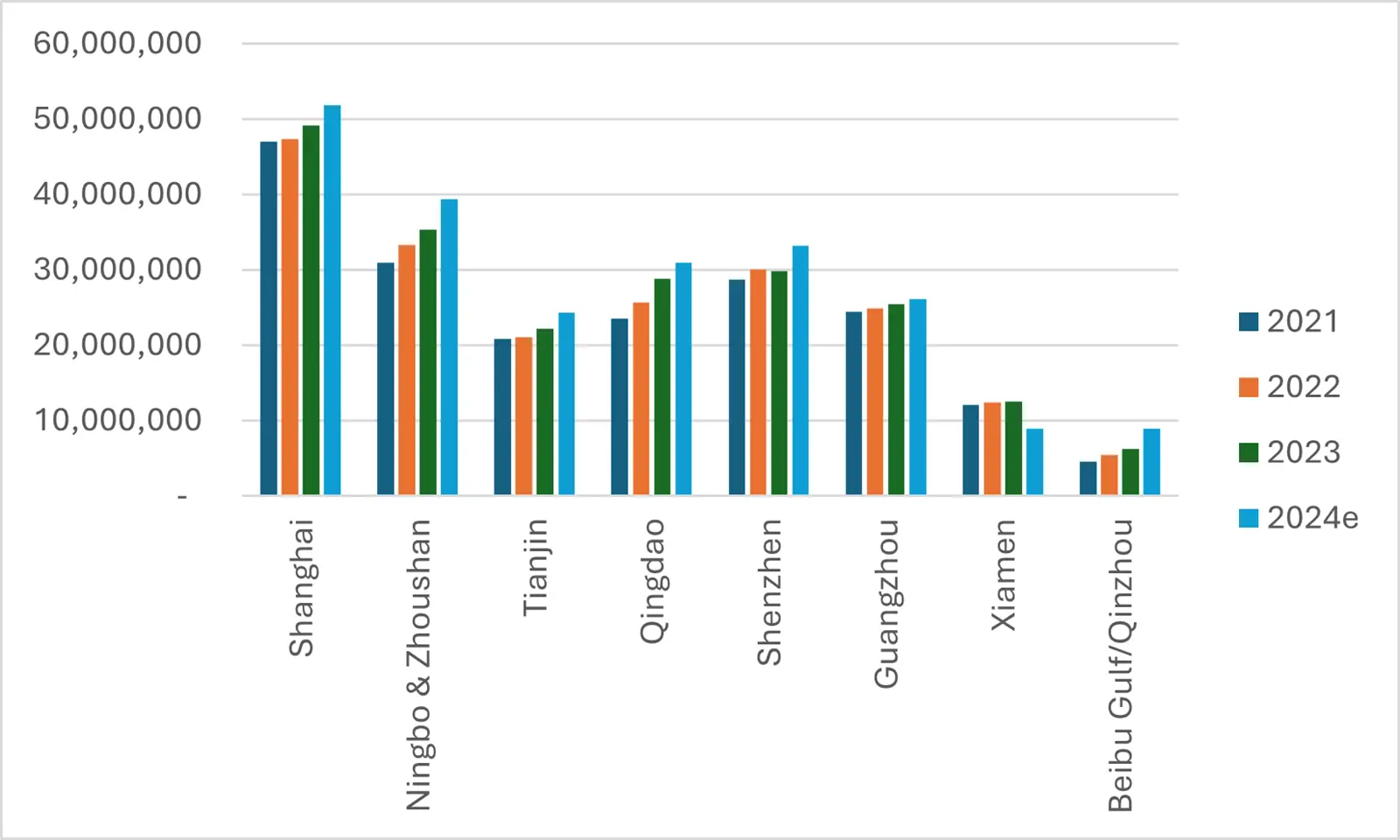
On the basis of the information contained in Figure 1, it is possible to understand the estimated full-year volumes for 2024 and how it compares to container activity at major ports in China in recent years. This information is shown in Figure 2.
The anticipated full-year 2024 throughput for the leading ports in China shows an increase over recent years for almost all facilities. For example, the largest volume port, Shanghai, handled just over 47 million TEU in 2021 and year-on-year increases have occurred with the total for 2024 estimated to be over 51 million TEU. A similar trend can be noted at Ningbo & Zhoushan, where the 2021 figure of 30.9 million TEU has risen annually to reach an estimated 39.4 million TEU for 2024. These trends are applicable for all ports listed, with the exception of Xiamen.
Beibu Gulf Port in South China’s Guangxi Zhuang autonomous region handled around 9 million twenty-foot equivalent units (TEU) in 2024. The port has maintained double-digit growth for eight consecutive years, ranking it among the top major coastal ports in China and into the top eight largest volume facilities in the country.
Xiang Zheng, Executive Vice-President, Guangxi Beibu Gulf International Port Group Co Ltd notesr: “In 2024, we focused on market demand and resource development, implementing tailored strategies to increase the development of specialised cargo sources. We continuously promoted the transportation of goods from Guangxi through Beibu Gulf Port. The container throughput of key customers within Guangxi is expected to have increased by 28 percent year-on-year in 2024.”
WHAT NEXT?
So, moving into 2025, what is expected for China and its ports in terms of growth? The consensus is that growth will continue, but it is likely to slow, as the following parties note:
- IMF: China’s growth forecast for 2025 raised to 4.6% from 4.5%, driven by stimulus measures
- Bank of China: Externally, tariffs targeting China following Donald Trump taking office may have a significant impact on China’s exports. It’s expected that China’s GDP growth will be around 5% in 2025
- People’s Bank of China: China’s economy is expected to maintain stable growth in 2025…. stimulus measures rolled out in late 2024 have already begun to revitalise production, demand, and market sentiment, which will further sustain the recovery momentum
- UBS: China’s GDP growth to slow to 4.0% in 2025 and 3.0% in 2026, with the assumption that the US hikes tariffs on China’s exports starting in September 2025 with China increasing policy support in response. Net exports will likely still contribute positively to GDP growth in 2025.
BEIJING: “TIME FOR SMART PORTS”
Even if growth does slow, an average of 5% on the volumes handled by China’s ports is still substantial and requires a robust approach to handling container volumes.
Technologically, China is taking the diametrically opposite approach to the US, namely going down the automation road with a growing number of smart ports – clearly a hedge against the potential implications of rising labour costs
At the end of 2023, China’s Ministry of Transport (MoT) was faced with the Beijing government’s five-year (2023-2027) plan for ‘Building National Strength In Transportation’ and ‘Overall Planning for the development of Digital China’.
As a result, the MOT ramped up a programme to use new and innovative artificial intelligence (AI) across the port industry. At the start of 2024, the MOT classified 18 automated terminals in operation with a further 27 facilities under development and/or undergoing upgrades.
AUTOMATED ENDEAVOURS APLENTY
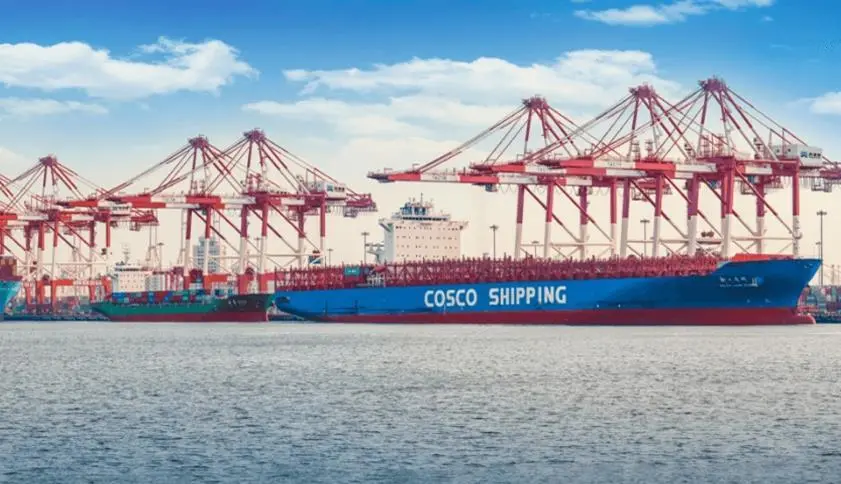

There is no doubt that ports in China are now fully embracing port automation, with terminals already operating in Beibu Gulf Port, Nansha, Taicang, Tianjin and Xiamen (Xiamen Yuanhai container terminal), and the Nansha (Phase IV) development.
The Nansha facility is located within the China (Guangdong) Pilot Free Trade Zone. This location also houses the country’s first digital service trade aggregation platform, which means automation is combined with digitalisation
The operation in Nansha utilises a range of different technologies, including the BeiDou satellite navigation system and 5G communications. All of the facility’s yard vehicles are driverless and the ship-to-shore (STS) cranes are both automated and work via remote control, meaning staff in the yard can be as few as five in total. Indeed, the terminal operator claims that a single remote operator can manage 10 STS cranes, at the facility handling in excess of 1.5 million TEU per annum.
Terminal management claim that this operation has 70% fewer staff than at a traditionally manned facility, and can guarantee more reliable and efficient levels of service – helped, it appears, due to equipment availability running at 99.8%.
In January 2025, this facility highlighted: “The terminal’s commitment to technology has been evident with 86 upgrades to our information system during the year, increasing the system test pass rate to 92.5%. This technological prowess contributed to significant increases in liner vessel operational efficiencies and average berth productivity.”
Elsewhere, Tianjin Port Authority is using technological partnerships for its recently developed smart container terminal. Global telecommunications company, Huawei, and China Mobile, support operations by using a mix of 5G, cloud computing, IoT and 4L automated driving technologies, with more than 70 Intelligent Guided Vehicles (IGVs) deployed.
Yang Rong, General Manager of Tianjin Port Second Container Terminal Co. explains: “Tianjin Port and Huawei used a wealth of new Information and Communications Technology (ICT) for our Intelligent Horizontal Transportation Management System. We created a next-generation ‘intelligent port brain’ with the system collaborating with key resources to automatically generate optimal loading and unloading plans. It also manages each piece of equipment, optimising the entire dispatch process.”
Interestingly, the rationale behind the development of this facility flowed out of recruitment challenges and staff shortages. By adopting smart port operations the port authority claims an employee reduction of 60% (compared to a manual way of working), along with overall cost savings of 30% and a 20% reduction in energy consumption – thereby ticking the box for greener port operations.
Localised reports in China state that there are 396 individual units of automated port equipment across the automated terminal facilities in the country, as of mid-February 2025. It will be interesting to see how this total grows moving forward, but for the moment, at least, it is (smart) business as usual in China in terms of volume growth and progressing automated operations.
Related Articles
 WORLD
WORLD
 WORLD
WORLD
 PRODUCTS & SERVICES