![PortStrategy[GreenPort]](https://www.portstrategy.com/wp-content/uploads/2026/09/PortStrategyGreenPort.svg)





Tariffs prompt new markets
High tariffs imposed by the USA represent a troubling scenario for Brazilian exporters but they also provide impetus to consolidate trading other trading relationships, such as with China, and to seek out new markets. Rob Ward reviews the news and trend lines
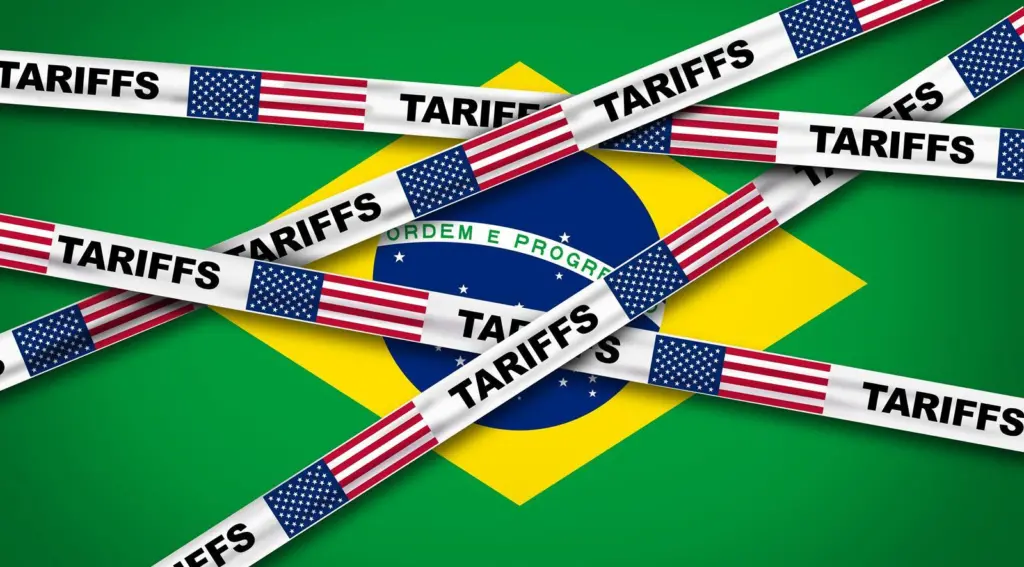
When it comes to the infiltration of Chinese companies into the fabric of Brazil and other Latin American countries, it is not just a case of the Chinese are coming, but that they have well and truly arrived and made themselves at home. Meanwhile, US interests, historically quite influential in Brazil, appear to be on their way out. Chinese firms are now deeply embedded into Brazil and the punishing Trump Tariff Wars, first mooted back in April but mostly coming into force in August, have given them added impetus.
This is especially true in the case of Electric Vehicle (EV) manufacturing and sales, as well as in the port and shipping sector. Certainly considering future projects, it is clear, for example, that various Chinese companies are keen to get a slice of the action when the Reais5.6BN (US$1.015BN) Tecon Santos 10 project, goes to auction later this year. (see page XXX). China is expected to be among the contenders bidding for this high capacity new terminal.
“It’s not completely new that China is interested in expanding into Brazil, especially our infrastructure, but it has gone rapidly into overdrive this year,” underlines Armando Freigedo Rodrigues, a director of Aquapar the maritime sector consultancy based in Rio de Janeiro. “It really does seem that Trump’s Tariff Wars will create some commercial opportunities for Brazil in China, especially in the agriculture sectors,” he adds.
The Chinese interest also gained momentum from Brazil hosting, in Rio, this year’s summit of BRICS (the grouping of emerging powers, led by Brazil, Russia, India, China and South Africa). Equally, it has been spurred by President Lula’s extravagant state visit to Beijing in May, where President Xi showed very clearly how seriously he regarded Brazil as a reliable world trade partner.
TRUMP TREATMENT
Trump slapped tariffs of 50% on the majority of Brazilian imports, including coffee, beef and several fruits but he exempted orange juice, commercial aircraft (Embraer), aircraft parts and energy products. Trump was seemingly advised by a Brazilian senator Eduardo Bolsonaro, son of Jair, the former President of Brazil (2019 to 2023), who fled to Mar a Lago, to get the US President to try and help his father avoid a trial for inciting an insurrection!
Uncle Sam has been playing a game of dare with China all year, as part of the US President’s bid to “stop the bad deals for the US leading to unfair trade deficits, and China, and now Brazil, have called his bluff. The irony with this, is that the US has not had a deficit with Brazil for 18 years and, in fact, ran a huge surplus of US$7.4BN last year; on about US$92BN in overall trade. Some commentators are calling Trump’s half-baked economics move “Tariffmagedon,” but for countries with tariff add-ons of more than 10% it is no joke and has caused “absolute chaos for port operations and supply chains.
According to Datamar data, more than 490,000TEU of containerised goods exported to the US since 2022 (including coffee and wood products) fall under US HS Codes listed for tariff enforcement, while just over 93,000TEU (mostly chemical wood pulp) are tied to products currently exempt, although these figures don’t include beef. The country is set to lose US$1BN of beef sales to the US this year alone. Mexico, Japan, China and possibly some European countries, are expected to take up some of this load, according to ABIEC, Brazil’s Beef Export Association, citing shipments up 13.4% to 1.47M tons and revenue up 27.1% to US$7.23Bn for the first seven months of this year, but thatwas before the tariffs kicked in!
Much healthier trade between Brazil and Argentina this year, has helped liner operator Log-In Logistica post record profits and terminal operator TCP (now owned by China Port Holdings), to report record throughput (803,041TEU for the first six months of this year). It is understood that a reviving Argentine economy could sweep up some off-loaded Brazilian exports such as coffee and Fruit.
A good example of the “chaos” was evident at the port of Vitoria, Brazil, where, at the end of July, one ship cancelled its call due to the high tariffs imposed and as a result did not load 1,500 containers. The cargo, valued at Reais360 million, was mostly made up of ornamental stone, plus coffee, ginger, musical instruments and beef, according to Vports, the port operator.
MORE FALLOUT
Vports notes, “more tariff fallout is expected”.
In terms of coffee Brazil is the biggest producer in the world and the US the largest importer but a 50% tariff on that commodity means vast quantities of coffee will no longer be headed for the US and Americans will have to source from other exporters, possibly Costa Rica and other central American countries. CECAFE, the Brazilian Coffee Exporters Association, states, “there is a lot of anxiety in the sector,” and it’s having a terrible impact on the logistics out of the three main coffee exporting ports of Santos, Vitoria and Rio de Janeiro.
Last year the US imported 8.1 million tons of coffee from Brazil, but this year shipments to the US have almost halved, from 721,718 bags (of 60 kg coffee) in January to just 440,034 bags in June. Importers from Belgium and China seem to have picked up some of the slack. Nevertheless, the danger for coffee producers, says CECAFE, is that the domestic market will be flooded, with consequent massive price drops. Various Arab countries have imported 31.5% more Brazilian coffee but all these changes, says CECAFE, will require many alterations to port rotations and supply chains.
China has moved up from 14th to 11th biggest coffee importer from Brazil. However, China is mostly a country of tea drinkers so is NOT expected to pick up much more of the slack over the coming years.
And it’s the same on the fruit front.
“Although the US only accounts for 2.4% of all Brazilian fruit exports for some companies, like Agricola Famosa, it can account for 12 to 13% of total sales,” said Valeska Cire, Brazil’s rep on the International Fresh Produce Association. As one exporter further notes: “it takes at least two years to find new fruit markets and that won’t help the mangoes waiting to be picked today.”
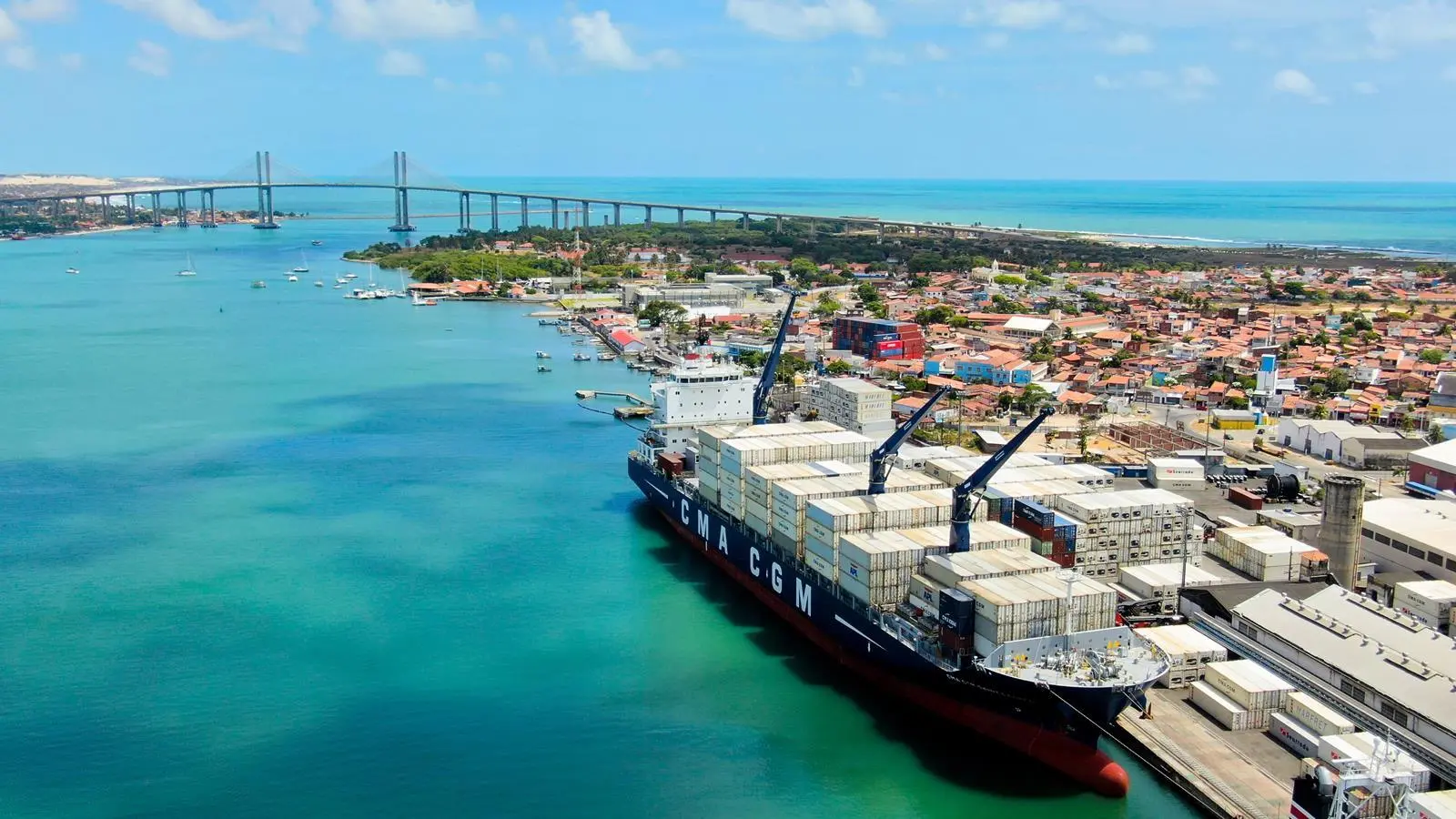
Mangoes usually get shipped from North and Northeast ports such as Salvador, Fortaleza, Pecem and Natal.
“What Trump’s actions did was to force Brazilian shippers to re-orientate the way they operate,” highlights Leandro Carrelli Barreto, a director of Solve Shipping consultancy. “I am now giving lectures all over Brazil on international scenarios, the tariff wars between the US and China, infrastructure and bottlenecks.
“From Manaus to Recife to Sao Paulo and down to Porto Alegre I have delivered almost 20 lectures over the past couple of months, mostly for importers and exporters.”
STRUCTURAL CHANGES
With the imposition of tariffs – given that this remains the case – it is plain that Brazilian exporters are seeking new markets to compensate for reduced demand from the USA. Up to mid-year this year, however, container trade statistics with the USA did not reflect the impact of new tariffs. According to Datamar, shipments in this period rose by 3.9% but for the second half of the year it notes that “companies have already begun evaluating alternative markets for products that will be subject to surcharges…”
In China trade, Datamar notes that containerised exports from Brazil actually fell by 0.4% between January and June 2025 with this said to be the result of 2global trade tensions, regulatory uncertainty and volatility in maritime freight costs.
The central trend in Brazil China trade is, however, a growth story.
As Datamar points out: “China remains Brazil’s top trading partner for both imports and exports. Nearly 50% of Brazil’s imports originate from China. In 2024, 1.595.302TEU were imported, compared to 1,220,337 TEUs in 2023. For comparison, imports from the United States, Brazil’s second-largest trading partner, totalled 325.493TEU.
Overall, in 2024, imports from China to Brazil grew by 30.7%, while exports slightly increased by 2.7%.
Related Articles
 WORLD
WORLD
 WORLD
WORLD
 PRODUCTS & SERVICES