Iraq’s huge Al Faw port project moves slowly on. But is it really necessary or is it just a ''rice bowl'' for a select few enabled by dysfunctional government?
To anyone wondering why the people of Iraq are fed up to the point of risking their lives in protests against incompetent, dysfunctional and corrupt government, look
no further than the Al Faw port project.
It appears to be a text book case study in a government and civil society short on technical and commercial competence as well as oversight and “checks and balances” but inventive and “entrepreneurial” when it comes to kickbacks and corruption.
The Al Faw project, in the eyes of many sector specialists, is a woefully unrealistic and unnecessary project. It shares some characteristics with neighbouring Kuwait’s long-suffering port project at Boubiyan Island.
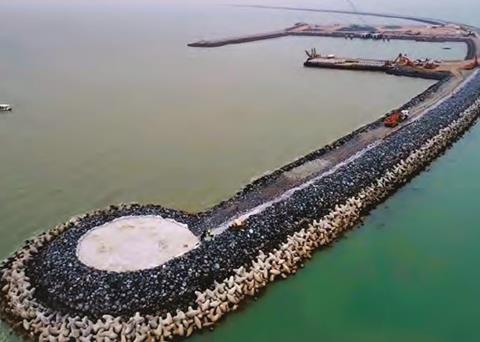
But, unlike Kuwait, Iraq cannot afford such reckless and wasteful spending. According to Iraq’s National Investment Commission’s plan (as presented in 2018), the Grand Port of Al-Faw will cost USD 6 billion and have 3.5 km of container berth, 3.5 km of bulk berths and 4.5 km for general cargo as well as 23 km of breakwater and a 30 km navigational channel.
It is readily apparent this will be an extremely expensive port. The breakwater alone is likely to cost in excess of USD 1 billion. It has quietly been under construction since 2012 by Daewoo construction and Archirodon. It has faced challenges – with part of the breakwater already collapsing without it becoming a news item. More recently, new contracts have been awarded for a 4.5 km temporary dyke (USD 200 million) and roads (USD 70 millions).
It would be an ambitious project for any healthy economy. For Iraq, it is highly questionable with no remotely realistic commercial rationale underpinning it. Current seaborne cargo throughput of Iraq’s ports is about 1.2 mill TEU containers, one million tons of general cargo and four million tons of bulk (grain, rice and cement primarily).
This is more than adequately handled by the Port of Umm Qasr which has ample existing additional capacity and plenty of space for further berths and yards being constructed (and can be upgraded to handle the world’s largest vessels by dredging its channel and basin for a fraction of the cost of Al Faw dredging).
Further, it is true to say that Umm Qasr Port is actually turning into a relatively high-quality port – with three international container terminal operators (Gulftainer, ICTSI and MSC) already operating in the port and various investors lining up to build further capacity in the port. This is impressive for the Arabian Gulf where no other port has the same level of intra-port competition (Abu Dhabi will eventually have three operators – when MSC’s terminal is built).
So, what is the argument for such a large investment Al Faw?
FLAWED VISION
Politicians and bureaucrats point to a larger vision where Basra is a gateway to Europe, harking back to the legendary Baghdad to Berlin (via Istanbul) railway but updating it so that now Asian imports to Europe will be shipped to Basra and then sent onwards to Europe on rail from Basra, via Baghdad.
Apparently, the idea is that this will be a much better product than using the Suez Canal. (The original Baghdad to Berlin railway was built between 1903 and 1940 and never played any commercial role.)
Practically speaking, this is “pie-in-the-sky thinking” and the argument behind it is to say the least spurious. When the Al Faw project was launched in 2010, the Minister of Transport at the time (Mr Amer Abdul-Jabbar) told Reuters: "This port will be considered the 10th most important in the world because it will connect the Gulf with northern Europe ... This will change the road map for world transport policy ... This dry channel would be a shorter, cheaper and safer alternative (to the Suez Canal).”
Despite the size and predicted commercial importance of the project, it has been moving at a very slow pace and without much visibility and transparency. Surprisingly, there does not seem to have been any serious debate in Iraq about the project’s feasibility, viability or progress.
The project suffers from a distinct lack of commercial rationale and as such It is easy to conclude the main drivers behind its development are more its ability to generate the continuous awards of contracts (triggering government payments) to suppliers than any deep founded economic necessity.
The Grand Port of Al-Faw is a prominent example of Iraq’s dysfunctional governance. It shows the lack of technical capabilities of its professional classes and the lack of political or civil society institutions that provide oversight and “checks and balances” as part of public sector practices. Sadly this, in turn, facilitates private interests “capture” of government policy making and government expenditure for, at worst, private gain.
It is no wonder that Iraq’s ordinary men and women, seeing oil income squandered and siphoned away from the public sphere and away from desparately needed public services, explode in protest.