![PortStrategy[GreenPort]](https://www.portstrategy.com/wp-content/uploads/2026/09/PortStrategyGreenPort.svg)



Back in the game
The Port of Portland (OR) is rebuilding its container throughput again and has recently signed a new deal to maintain international container activities at the port. Dean Davison assesses the strategy in play and what the future holds
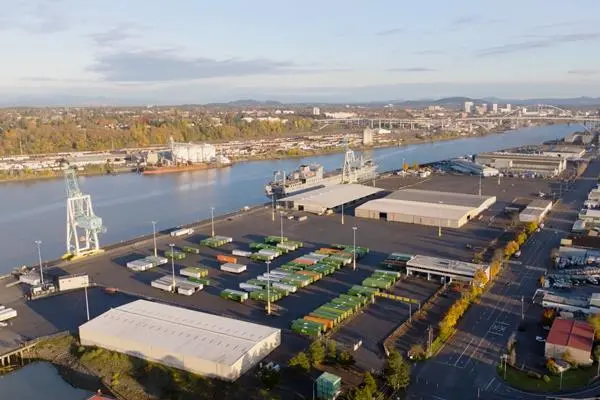
“We’re optimistic about container service and believe it’s an asset that Oregon businesses need now more than ever,” explained Kimberly Branam, Chief Trade and Economic Development Officer, Port of Portland, adding: “Without container service at T6, Oregon shippers would incur an estimated US$19.2 million in additional net trucking costs annually, and overall it costs Oregon shippers an average of US$585 more per container to move goods out of Seattle.”
Portland has had a traditional role handling containers and has handled almost 350,000TEU per annum in the relatively recent past.
Indeed, the port was a sufficiently attractive proposition that it even secured a terminal operating deal with global terminal operator, ICTSI.
However, subsequent inter-union rivalry issues commencing in Q3 2102, which saw the ILWU encouraging members to operate in a “slow and nonproductive manner” (electricians from rival union IBEW Local 48 were assigned the job of plugging and unplugging refrigerated containers, a job the ILWU asserted should be handled by its members while handling and moving containers in Portland). This action correlates with the strong decline in container activity at the port as ICTSI terminated its contact at the port in 2017 and subsequently won a court battle with the ILWU.
However, the Portland has been working to rebuild container activity since 2018 and underwent a process to secure a private operating partner, subsequently resulting in Harbor Industrial securing the contract.
“Harbor Industrial knows the market well and has a lot of experience in the industry, including deep experience at Terminal 6. We’re pleased to see them take on an expanded role as the full operator of our container and breakbulk services. This is great news for the workers and businesses who rely on access to global shipping. A thriving Oregon economy relies on international trade, whether you’re a business owner, a farmer, a rancher, or a consumer anywhere in the state,” confirms Branam
“With this agreement now in place, we are in a stronger position to provide regional shippers with the stability they need to grow their businesses, which in turn will drive economic growth and strengthen the local economy,” highlights Tim McCarthy, Chief Operating Officer of Harbor Industrial Services.
The deal with Harbor transitions the company from being a stevedore in Portland to the terminal’s long-term operator. A seamless transition is predicted by both the port authority and Harbor, with completion slated for the end of December 2025.
CHALLENGES, BUT CONTEXT NEEDED
Portland has traditionally faced a number of challenges in its role as a competitive container gateway, such as location, infrastructure limitations, financial issues and strong competition from other West Coast ports.
True, the port is located 100 miles upriver from the Pacific Ocean, resulting in extra steaming time and costs for ships, and limitations on the sizes of vessels that can access the port, but this is true of many other ports, in the US and throughout the world. The counter argument is, of course, it means the port is located close to its markets – just ask Baltimore or Antwerp, for example.
Portland has had recent financial struggles, with losses of US$30 million from container operations over the past three years, but this has to be put into context – the losses would likely not be so severe had momentum been maintained and volumes were on an upward curve? The 2022 total of almost 171,500 TEU fell to just under 99,000 TEU for 2024. Hence if the port was able to grow its traffic back to 350,000 TEU levels, then revenues would be higher.
The other key factor is port competition. Obviously Portland will always face stiff competition from PNW ports (and San Pedro to the south), or the proposed new Coos Bay intermodal port, but further context is needed here. If Portland is predominantly to serve Oregon and its population, then it is not necessarily looking to be a gateway for the US Midwest as its primary market.
“Scores of businesses throughout Oregon rely on Terminal 6 to ship their goods,” Governor Tina Kotek said. “Oregon communities will be better off because we came together and worked toward this shared goal.”
As Branam concludes: “Terminal 6 is an important piece of Oregon’s economic infrastructure, with container service supporting 1,500 family wage jobs and countless businesses across the state. Oregon is one of just 11 states with a trade surplus, exporting US$42 billion of goods and services each year. At least 1 in 8 jobs are tied to international trade, and a majority (88 percent) of the state’s exporters are small or medium businesses.”
Related Articles
 EQUIPMENT
 OPERATIONS
 OPERATIONS