





Land of opportunity
Mexico has long been a manufacturing alternative to China, but concerns over China’s economy and vulnerabilities to supply chain security from COVID-19 means further opportunities exist, as AJ Keyes discovers
A recent study from the Inter-American Development Bank (IDB) suggested that nearshoring could bring an annual US$78bn in additional exports of goods and services throughout the Caribbean and Latin America. Of this total, the IDB estimates that Mexico could be the biggest beneficiary with US$35.3bn per annum of goods exports.
With concerns over supply chain security one of the fallouts from the COVID-19 pandemic, a greater interest in nearshoring is a logical outcome. The concept of nearshoring is where a company moves all or part of its manufacturing and production closer to its final consumer. This reduces costs and, importantly, minimises supply chain issues that have been prevalent in many locations (especially the USA) since the pandemic occurred.
COVID-19 certainly gave the nearshoring concept a boost because the closing of borders globally impacted the provision of goods being shipped internationally, but it was not the only reason. For example, tariffs imposed by the US on China in 2018 caused some businesses to look for alternative markets to reduce costs. Also influential, the US-Mexico-Canada Agreement signed in 2020 brought manufacturers incentives to relocate supply chains and make more products in North America. Also, the war in Ukraine impacted the supply of various key raw materials, resulting in a search for alternate suppliers.
FUNDAMENTAL REASONS
What does this mean for Mexico and is the country taking advantage of any potential that exists? Well, there are several fundamental reasons why nearshoring is highly relevant to Mexico and why the country is in a good competitive position to attract investment, as Table 1 shows.
| Reason | Why Relevant to Mexico |
|---|---|
|
Proximity to US |
Borders the USA, so offers immediate access to major consumer markets via a shorter/quicker supply chain – USMCA deal means tariff-free options |
|
Skilled Labour Force |
Large and capable workforce, experienced in manufacturing and engineering – bilingual language facilitates communication and collaboration with US companies |
|
Cost Efficiencies |
Mexico wages higher than many Asian countries, but the lower transport costs to the US can offset this factor – real estate costs are reportedly reasonable |
|
Supply Chain Resilience |
Closer proximity means the US can be accessed via road/rail, cuts out the maritime/port supply-chain components – fewer parts in the chain. Nearshoring in Mexico allows companies to establish more agile and responsive supply chains, enabling faster delivery of products, and lower inventory costs |
|
Sector Capabilities |
Established capabilities in high-value sectors – i.e., automotive, electronics, aerospace, and medical devices |
Mexico already has an established role in nearshoring, but it can be argued that the country has already benefitted from the COVID-19 pandemic and concerns over China’s future role more than any other country trading with the US.
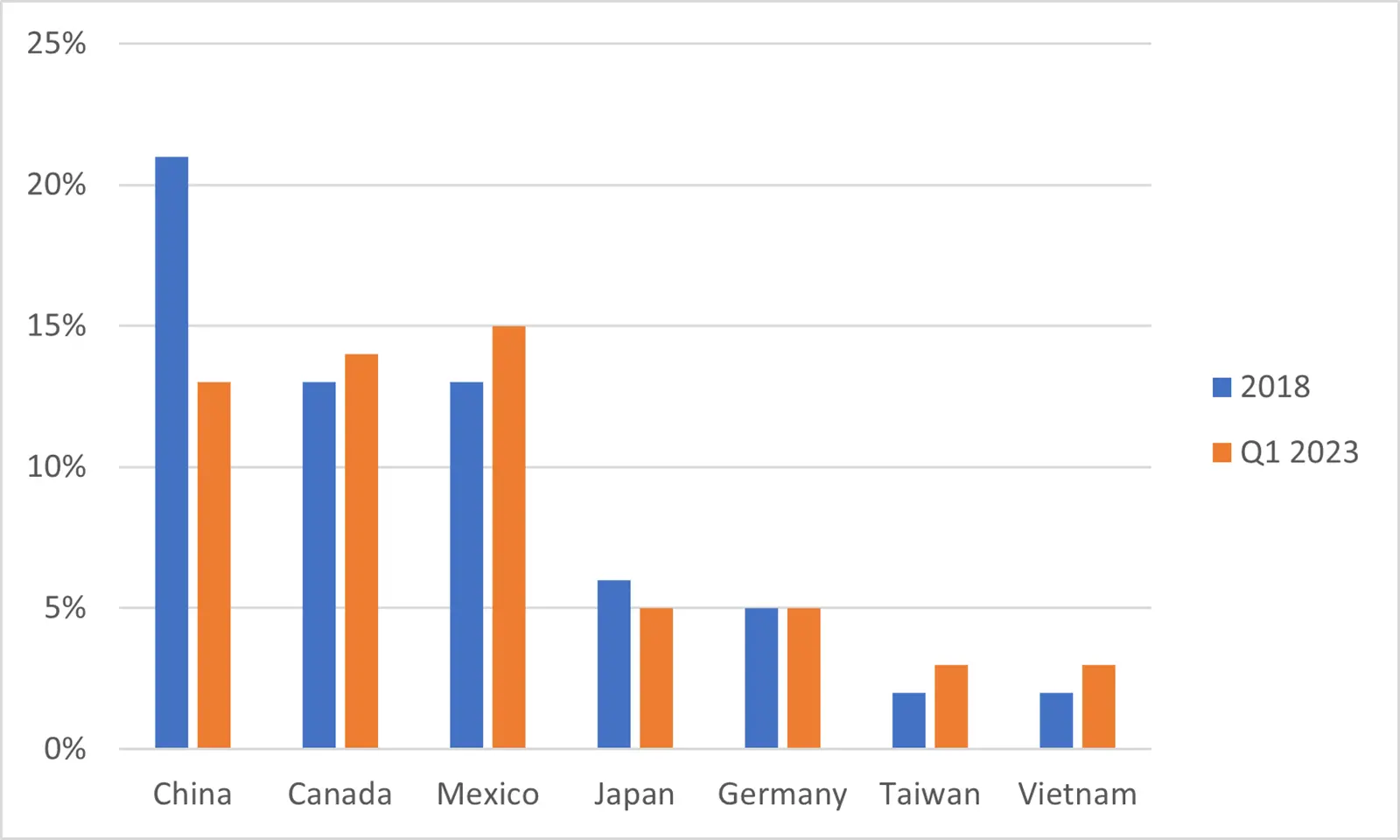
A comparison of the share of US imports by country of origin for 2018 and for Q1 2023 confirms that the country has taken some of the share lost by China, according to data provided by the US Census Bureau and shown in Figure 1. Here, China has seen its share fall from 21 per cent to 13 per cent, with Mexico seeing an increase from 13 per cent to 15 per cent, which places it as the largest provider of imports into the US in Q1 2023. At the same time, Canada also overtook China’s share in the same quarter, recording a figure of 14 per cent, while Taiwan and Vietnam also recorded improvements, with both locations seeing the 2018 total of two per cent rise to three per cent for the first three months of 2023.
Of course, the Q1 2023 figure is only a snapshot and covers just one three-month period, but it does endorse known trends suggesting that China’s dominance in serving the US is slipping, while Mexico has an opportunity to increase its trade activity with the US.
QUANTIFYING NEARSHORING?
So, is it possible to quantify how much Mexico could benefit from nearshoring moving forward? In terms of value, nearshoring has the potential to boost the growth of Mexican manufacturing exports to the US from US$455bn in 2023 to an estimated US$609bn in the next five years, according to Morgan Stanley. To put this into perspective, manufacturing exports currently represent about 40 per cent of Mexico’s US$1.3 trillion economy, but there are various areas where increases are anticipated. For example, US$94bn in gains in well-established sectors such as electronics and automotive, US$38bn from sectors that have benefited from free trade via the USMCA and US$22 billion from the increased manufacture of IT hardware and opportunities related to the electric vehicle supply chain (a US electric car maker is opening a new US$5bn plant in Monterrey) and other clean technologies.
As a result, new investment driven by nearshoring could reach an estimated US$46bn in the next five years, according to Morgan Stanley estimates.
For this to happen, the Mexican intermodal rail and logistics industry will need to be up to the task, with the ability to cross the US border underlining that an efficient operation will be needed to keep pace with opportunities.
The US Bureau of Transportation Statistics (BTS) confirm that there was a five per cent year-on-year increase in trucks entering the US at the key Laredo cross-border location in March 2023. This follows similar improvements at the start of 2023, with January seeing a rise of 9.6 per cent and February enjoying a 7.9 per cent rise over the corresponding periods 12 months earlier.
Furthermore, for the whole of 2022 cross-border trucking at Laredo, moving inland to US locations, represented a nine per cent rise over 2021. This is double the figure for the total inbound US trucks crossing from Mexico, which itself was up by 4.5 per cent in 2022.
Meeting US demand for automobiles and SUVs/trucks is already an established business activity, with largescale manufacturing plants in place from US companies, but with the US Federal Reserve System confirming that vehicle and parts production continue to increase (up by over nine per cent in April 2023, year-on-year). This is another activity expected to take advantage of more nearshoring.
MORE TRUCKING AND RAIL OPTIONS
While there are, of course, other border crossing locations linking Mexico with the US, Laredo offers a good snapshot of overall activity. The simple conclusion is that given increases in nearshoring in Mexico, with the major market served being the US, then more trucking movements can be expected.
The use of rail is the other key overland transport facilitator and North American railroads are continuing to improve service offerings form Mexico to the US – with the prize being the ability to serve the US Midwest and, specifically, Chicago.
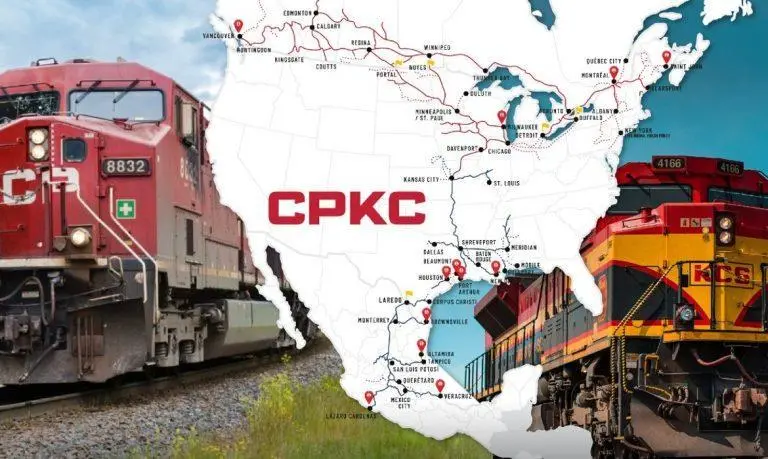
The newly merged Canadian Pacific Kansas City (CPKC) entity has already announced it is planning to use Lazaro Cardenas as a new, “safe” option for US imports from Asia. The aim here is to offer beneficial cargo owners greater supply-chain stability than using the San Pedro complex of Los Angeles-Long Beach and saving (according to CPKC) 10-14 days over the Panama Canal option.
With around one million TEU of unused capacity at Lazaro Cardenas’ existing two terminals (before any further expansion), there is certainly space, but the efficiency of the operation beyond the port’s boundaries must exist.
Here, CPKC is moving quickly. It has confirmed capacity in conjunction with Knight-Swift Transportation for a Mexico to Chicago train and also with Schneider International for a service between Central Mexico and the US Midwest. These arrangements offer a daily link between San Luis Potosi in Central Mexico and call at Monterrey, Laredo, and Kansas City en-route to Chicago.
However, the newly merged entity faces competition from Union Pacific Railroad, which has signed a deal with Canadian National and Ferromex to provide a joint service offering from Monterrey and Silao, Mexico, to Chicago and Detroit via Eagle Pass in Texas.
The actions of these North American Class I railroads indicates a belief in the potential for serving the US from Mexico and, in turn, supports growth in nearshoring activity in Mexico, with a specific focus on moving goods across the border and the ultimate aim of targeting the US Midwest and Chicago. The timing to take advantage of increased nearshoring from Mexico looks positive.
Related Articles
 OPERATIONS
 OPERATIONS
 OPERATIONS