


Peel: strength in diversity
Felicity Landon speaks one-to-one with Stephen Carr, Group Commercial Director, Peel Ports Group*
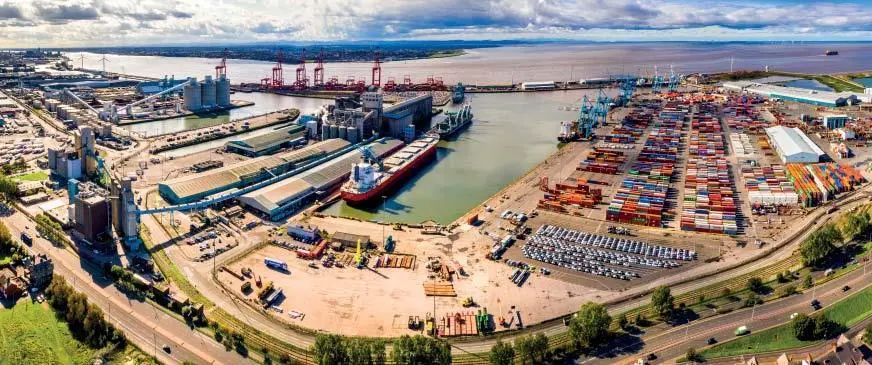
The Peel Ports Group is an acknowledged leader in meeting the needs of the short-sea and feeder sector, subjects that sit at the heart of the focus of the Coastlink Conference, soon to be hosted by the Port of Liverpool.* As a precursor to the event, PS sat down with Stephen Carr, Group Commercial Director, who addressed a variety of subjects relevant to the sector including: cargo ups and downs, Net Zero targets and opportunities, and why the proximity to markets message is as valid as it has ever been.
In the Manchester Ship Canal advertisements of the 1930s, the message was there: ship straight to the heart of the UK’s industry and population. “When you look back at how ports were positioned 100 years ago, when Manchester, Liverpool and London were the dominant ports in the UK, it was all about maximising that use of maritime,” says Stephen Carr. “Now, as [landside] transport becomes harder, with more congestion and the environmental considerations, the message is the same.”
While investment in the necessary infrastructure has, of course, been vital, “it is also the relevance to that market”. The difficulties of the past three years – the pandemic and the supply chain crisis that followed – have made clear the resilience offered by ports close to origin and destination, he says.
Coastlink focuses on the promotion of short sea and feeder shipping; that’s a good match for Liverpool and the Manchester Ship Canal, says Carr. “The message we have always argued around proximity to markets is just as valid – even more valid – today. It’s about reducing land-based transport, maximising the benefits to the supply chain. Our core message to people who move freight is exactly as it always has been; the benefits of shipping as close as possible to the origin or destination are more important than ever. That applies whether we are talking about future commodities such as hydrogen, containers and shortsea ferry, or the more traditional bulk products.”
The past few years have been a reminder that we can’t guess what will happen next; but from Carr’s point of view, there are some interesting prospects.
THINKING TIME
“If you think about that whole pandemic cycle and supply chain crisis, then coming into this strange economic environment with inflation and lack of disposable income, I think what we are noticing now is that senior supply chain managers can sit back and think for the first time in three years. All the attention from spring 2020 to the end of 2022 was effectively going to the managing of one crisis after another. For the first time in probably three years, people whose job and role is to think more strategically finally have the time to do that, instead of worrying about today and tomorrow.”
The economic climate is throwing up challenges, he says – not least, the high costs of inventory. “It is hard to forecast what is going to happen. I suspect we have one or two shocks still ahead, although not necessarily on the same scale. We are in a period of greater volatility; that is something we forgot about as a population over the previous 10-15 years. It is very much back to the boom and bust cycle.”
At some point, he says, energy prices are going to fall off – that may coincide with larger numbers of the population having more disposable income in a few months’ time. “How will people spend it? Will we then see a ripple effect of demand in the supply chain? Again, it is all about resilience.”
At Liverpool, containers and ro-ro are down, reflecting lower consumer demand, while other commodities are doing better – agribulks, construction materials, biomass. “The range of cargoes we handle is really important to us and the last year has probably demonstrated that more than ever. It is something we have always seen – one year we will be surprised by one commodity and shocked by another. So our diversity and commodity mix has always been really important.”
On top of that, says Carr, it is vital to have the port infrastructure that is able to respond with flexibility. The container terminal will always be for containers, he emphasises. “But it is knowing that you have the capability to handle different cargoes in the wider port estate.”
CLEAN MARITIME OPERATOR
In March, Peel won the ‘Clean Maritime Operator’ award in the Maritime UK awards – welcome recognition for the group, which was the first major privately owned ports organisation in the UK to declare a Net Zero target of 2040.
“As a consumer of energy and obviously delivering services to the wider supply chain, we are focused on transitioning our energy to Net Zero as fast as possible,” says Carr. “We have taken steps such as using HVO instead of diesel and transitioning our fleet around the port estate to electric.”
This time last year, some people were musing that the energy supply crisis and energy price crisis might push the transition to Net Zero down everyone’s priority list, he notes: “Our view is absolutely the contrary, it makes it even more important than ever to make the transition.”
Net Zero has two points of relevance for the ports group, says Carr – the other being how Peel Ports supports the production and movement of Net Zero fuels, including in the development, support and maintenance of offshore wind farms.
“Subjects that are attracting less attention are how do you move hydrogen from point of production to point of consumption? How do you move CO2 from point of capture to point of sequestration? These subjects are important in northwest England, especially because of the work Essar is already doing on hydrogen production.”
Essar’s Stanlow Terminals has announced plans to develop a new open-access import terminal for green ammonia in the Port of Liverpool; the proposal allows for the purchase and storage of more than 1m tonnes of green ammonia per year for distribution into the UK, or conversion back to green hydrogen for sale to industrial clients in the North West of the UK.
Meanwhile, Carr highlights the redundant oil and gas wells off the northwest coast, close to shore, which would be well placed for carbon capture trials.
“Our role in supporting the energy transition and those who are involved in enabling Net Zero is just as important to us as the energy we consume,” he says.
BREXIT REACTIONS
Alongside the upheavals of Covid-19 have been those of Brexit, the UK’s departure from the European Union, particularly for Liverpool, a major port for Irish Sea services. Carr is, however, upbeat about the impact.
“In the run-up to Brexit, we took a slightly different line in what we were talking about. Of course, the negatives that people were talking about were absolutely correct and valid, but also we argued that there would be some upsides. As an island nation, whatever we imported yesterday, we need to import tomorrow. We saw that there would be a swing from accompanied to unaccompanied routes, and some more from short distance ro-ro to longer distance sea journeys, on the basis that fewer European hauliers would want to travel into Britain and some of the traditional backhauls would not be there.
“How much of this is Brexit and how much is Covid is not clear, but what we have seen on the Irish Sea is a shift towards unaccompanied and into Northern Ireland, at the expense of southern (the Republic of Ireland), with Liverpool and Heysham the net beneficiaries of that volume. It is a smaller market because some of the volumes that used the traditional landbridge are now using direct services to the Continent, but we have more volume in a smaller market.”
In February, Stena Line signed a new deal with Peel to operate the 12 Quays port and ferry terminal in Birkenhead at least until 2100. Stena operates twice daily ferry services to Belfast and has recently purchased two sites next to 12 Quays for additional freight storage.
To balance out any loss of direct Irish Sea volumes, says Carr, Peel has seen the introduction and/or routing of ferry services between Iberia and Liverpool, some via Dublin.
Suardiaz has announced a new ro-ro service between Vigo and Ellesmere Port on the Ship Canal from June 2023, for Stellantis, and WEC Lines has introduced additional weekly calls in Northern Spain, Portugal, North Africa and the Canary Islands to its rotation into Liverpool.
Liverpool consistently takes the position as top UK port for container trade with Iberia, accounting for 56 per cent of the market in 2021.
“What we have seen, as we expected, is that the traditional supply chain did have issues, but it has shifted volumes to different routes. We were ready for that.”
The new NI Protocol announced by Rishi Sunak “will, if anything, probably push more trade through Northern Ireland than before,” says Carr. “Pre-Brexit, more traffic went across to Dublin and then up into Northern Ireland, whereas now it is becoming far easier to move cargo into Northern Ireland and it is more difficult to move cargo into Dublin from Britain.”
*In addition to the Port of Liverpool, host for the Coastlink Conference which takes place 3 – 4 May 2023, the Peel Ports Group’s portfolio includes the ports of Dublin, Clydeport, Heysham, London Medway, Great Yarmouth and the Manchester Ship Canal plus numerous affiliated services and facilities
Related Articles
 OPERATIONS
 OPERATIONS
 OPERATIONS