Buying a controlling interest in the Port of Piraeus was one of China’s first international moves to build its influence in the port industry, while Thessaloniki now has its own controlling Tsar. AJ Keyes looks at how the current ownership is faring in Greece
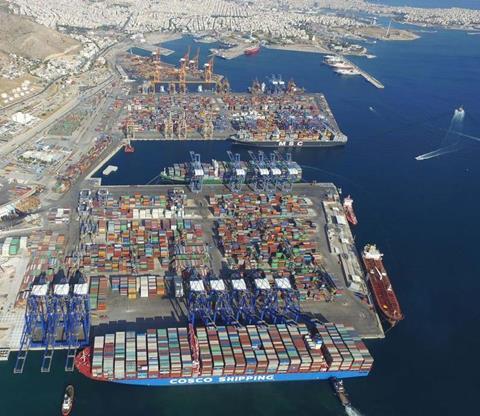
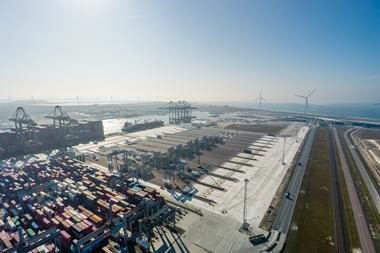
The Port of Piraeus is the largest container port in Greece and a major port facility in the East Mediterranean region comprising cargo terminals and a ship repair operation. It is also China’s gateway into Europe and the Middle East under Beijing’s Belt and Road infrastructure-building initiative.
State-owned China COSCO Shipping first secured the right to operate parts of Piraeus in 2008, during the middle of the Global Financial Crisis, which severely impacted the Greek economy . It acquired 51 per cent of the port’s Greek state-owned operator in 2016, then increased its stake to 67 per cent in October 2021.
Piraeus is a big player in the East Mediterranean container port market. The port’s piers offer a total length of 1150m and a maximum water depth of 18m, with a combined capacity of 7.2 million TEU per annum and serving ships up to 16,000 TEU in size.
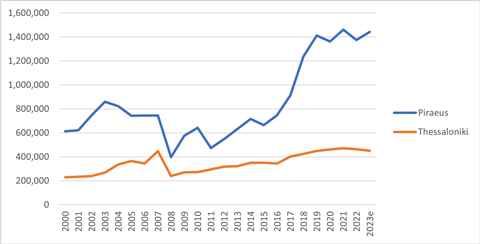
As Figure 1 shows, in the period from 2009, the first full year of COSCO operations, total container volume amounted to 577,000 TEU and rose to an estimated 1.44m TEU in 2023. The latter figure is based on H1 2023 being up by +4.9 per cent over the comparable period of 2022. This is equivalent to growth of 3.8 per cent per annum over the period.
Yet it is the period when COSCO took a controlling share of Piraeus, in 2016, when container port volumes were ramped up, rising from 746,412 TEU to over 1.41 million TEU by 2019 – and maintaining around the 1.4 million TEU total thereafter.
The Chinese shipping giant says it directly employs over 2000 people at the port and creates about 10,000 jobs overall.
Evangelos Kyriazopoulos Greek Secretary General for Maritime Affairs and Ports endorsed this statistic, confirming that in 2021, “ COSCO created 4279 direct and indirect jobs, equal to 0.12 per cent of total employment in the country, thus providing income to more than 11,000 citizens.” In round numbers, this contributes more than €1.4bn to the national economy.
While this may be true, there are concerns. Local residents in Piraeus feel that while jobs have been created, they are not “good jobs,” which is a longstanding comment from Giorgos Gogos, Secretary of Dockworkers Union of Piraeus Ports Authority (P.P.A.). He tells how some operations in the port rely on workers who are employed through contractors and receive no safety training – and it has resulted in accidents, with one well-publicised fatality occurring in Q4 2021 when a stevedore was struck by a container crane.
Nevertheless, the port authority is reporting further financial success. In a recent interview with Chinese media, Savvas Sanozidis, Board Secretary, PPA, confirmed “fantastic financial performance.” In 2023, PPA’s pre-tax revenue rose to US$79.20 million and dividends rose to the highest ever, jumping 65 percent to US$27.45 million, he said.
Regardless of the financial figures generated, there is still more work to be done by COSCO in the local community. “COSCO has not lifted the local economy as much as the community hoped,” Gogos has been quoted as saying, endorsing the level of unhappiness that remains.
RUSSIAN TSAR OF THESSALONIKI
Greece’s second largest container port, Thessaloniki, has also transitioned into foreign ownership. The Thessaloniki Port Authority (ThPA) was privatised in March 2018 and is now operated by South Europe Gateway Thessaloniki (SEGT) Ltd. The controlling shareholder of SEGT Ltd is Belterra Investments Ltd., which is owned by Russian billionaire, Ivan Savvidis, who effectively controls 71.85 per cent of the company’s shares.
Savvidis is one of Russia’s wealthiest oligarch’s and a former member of the Russian Parliament, but also reportedly had close links to Russian president, Putin. Savvidis has been regularly dubbed as the “Russian Tsar of Thessaloniki” in the press in Greece.
SEGT paid US$287 million for the port, but the full cost of the deal will reach US$1.36bn as it includes a commitment to invest around US$1.90 million in the first seven years of the project, as well as a further US$700 million in upgrading infrastructure over the 34-year concession period as the port seeks to re-enforce its role as a key kink for serving the wider Balkan region.
A Pier 6 container terminal extension of 440m and dredging to get 16.5m water depth is planned and is essential for the port to target larger and more frequent ships from Asia. There has been an increase in container traffic in Thessaloniki since the privatisation, with the 2016 total of 344,216 TEU rising by 3.9 per cent by the end of 2023 (based on an estimated 2023 total). This is in-keeping with overall growth in the country, but achieving further growth is reliant on improved infrastructure.
Piraeus and Thessaloniki serve different roles in Greece, of transshipment and transit markets, respectively. Both are privatised and under the control of potentially challenging organisations from China and Russia, respectively. Piraeus is further along the privatisation road, so it is hard to make a direct comparison to Thessaloniki, but for both ports potential remains for disruption and unhappiness at a local level, even if the national government seeks to portray a positive outcome of foreign involvement.