Technically it may not be misuse of the legal system but morally matters are not so clear cut. Mike Mundy dissects the real basis of APMT’s legal challenges over Tecon 10, Santos and DC2 Durban
Classic theory is that taking legal action is an initiative of last resort. Today, however, this does not stand as an entirely true statement – legal action is now in the toolbox of certain companies as an instrument used to challenge and frustrate processes, to seek to achieve a dominant market position and/or to maintain one. In short, legal action is now increasingly deployed as a tactical weapon and not just as a path to sensible conflict resolution.
The party bringing the action will undoubtedly argue that right is on its side – and certainly it has a right to initiate legal action but whether right is on its side in the fullest sense is questionable.
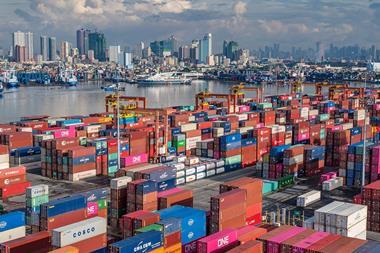
APM Terminals (APMT) recently launched a legal action against Brazilian regulator Antaq over the rules governing the public auction of the new four berth Tecon 10 container terminal in the port of Santos, Brazil’s major containerport. Antaq has structured a two-phase process under which existing terminal operators such as APMT and TIL, the terminal operating arm of MSC, are excluded from the first round of bidding and allowed to bid in the second stage, but only if there is not sufficient interest in round one and subject to them divesting existing terminal assets prior to signing a contract for Tecon 10.
The rationale underpinning the Antaq process is to ensure strong competition in the marketplace, encourage new market entrants and to avoid the negative scenario of market domination. This thinking certainly appears validated when it is appreciated that the existing APMT/TIL joint venture terminal in Santos, Brasil Terminal Portuário (BTP), offers a capacity of 1mTEU/yr with a concession extension approved in 2023, to 2047, entailing an investment package that will see a 40% boost in terminal capacity.
Existing annual capacity in the port of Santos as a whole is around 6mTEU/yr, Tecon 10 will add 3mTEU/yr, so, out of a projected overall capacity of 9+mTEU/yr BTP plus Tecon 10 would account for approaching half of available capacity. Factoring in other criteria such as berth length requirements for vessels and available draught this would rise significantly beyond the 50% mark.
It is hardly surprising, therefore, that, at the end of July, the Federal Court of Sao Paulo rejected, APMT’s request to suspend the bidding process for Tecon 10. The auction will proceed as planned. Had this not been the case then it is apparent that APMT would have secured a very strong, if not wholly dominant, market position in Santos and added to an already strong position in Brazilian container trade.
In addition to a 50% stake in BTP, APMT holds shareholdings of 75% and 30% respectively in terminals in Pecem and Itapoa, and is currently building an entirely new terminal in Suape. There is also a long-term strategic agreement, signed, in March this year, between sister company liner operator Maersk and Santos terminal operator DP World to make available more handling capacity. Plus, Maersk has a very strong position in Brazilian container trade overall including ownership of local liner operator Aliança Navegaçao, secured as part of its acquisition of Hamburg Sud in 2017. At the time of acquiring Alianca it was reported to hold a 59% share of Brazilian coastal container trade as opposed to the 21% held by Mercosul, the local operator Maersk owned but was required to dispose of as a condition of the Hamburg Sud acquisition.
This steady encroachment of influence over the supply chain has not gone unnoticed, notably with the Brazilian Association of Port Terminals accusing both Maersk and MSC of occupying and abusing their dominant position in the container business.
DURBAN HOLD-UP
Durban is another location where APMT has deployed a legal challenge – this time to change the result of a tender process for Durban Container Terminal Pier 2 (DC2).
Following a comprehensive tender process, International Container Terminal Services Inc. (ICTSI), the Philippines-based terminal operating group, was declared the winner. Its bid of US$618m (circa R12 billion) was more than R2billion above the second placed bid from APMT.
The latter, however, has contested the result in the courts stating that ICTSI did not comply with a specific formula used to calculate financial solvency – the net effect of which has been to put a brake on much needed investment in the terminal for over two years. This despite the fact that ICTSI was submitted to a further evaluation by an independent financial consultancy, over and above standard tender processes, whose report concluded that ICTSI was a financially strong, well-diversified company, with the proven capabilities to operate and improve the terminal.
While technically the legal challenge is about financial strength, drawing back the curtain on what lies behind it then it is clear that the real issue is about APMT and Maersk seeking to expand its influence over key South African linked supply chains. Already Maersk has ‘ownership’ of the majority of berthing slots at DC2. An uplift in terminal efficiency will open up more slots to competing lines – so even just maintaining the status quo puts Maersk in a winning position while South Africa as a whole is the loser.
It will be interesting to see if common sense will prevail in the pending legal ruling on the case.