






Ports will lead on 5G development
Ports will lead other industries in the development of 5G solutions, predicts a Latvian port currently testing 5G solutions in a bid to protect the environment and foster efficiency.
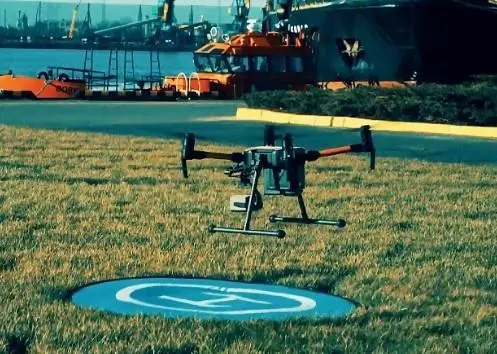
The Port of Riga’s testing includes a drone with artificial intelligence to determine pollution. The project, implemented in collaboration with LMT, uses a nascent drone traffic management platform being developed by LMT and Lufthansa Systems.
“With their relatively compact territory but simultaneously complex infrastructure and intensive logistics, in all probability, ports will be one of the first sectors in which solutions based on 5G will be developed,” said the port. “Together with its partner LMT, Riga also has the ambitious goal of maintaining a position among the leaders in this field.”
The port anticipates that 5G technology will be used for specific solutions that facilitate environmental protection, improved health and safety and operational efficiency.
Hamburg project
One of the biggest 5G projects globally is taking place in the Port of Hamburg in collaboration with Nokia and Deutsche Telecom.
Under real-time conditions, 5G technology regulates traffic light signals in order to ensure continual and safe movement of transport.
Hamburg’s team of engineers now has the opportunity to use augmented and virtual reality tools to obtain clear and precise information – using ‘digital twin solutions’ that make it possible to avoid errors in project development or in making improvements – this information transmission capacity is solely provided by 5G mobile infrastructure.
Specialists can also connect remotely to solve technical problems, using virtual reality glasses and video streaming. Environmental sensors fastened to ships measure the level of carbon dioxide emissions, while other sensors monitor the lighthouse, the technical condition of lighthouses and buoys and information about the need for maintenance.
By 2025, the Port of Hamburg plans to use more than 100,000 mutually connected Internet of Things sensors, said the Port of Riga. This would not be possible using a fixed network.
5G Internet of Things hardware makes it possible to support the operation of tens of thousands of devices, to ensure their battery life for over 10 years and transmit and analyse the resultant data efficiently.
Related Articles
 ALTERNATIVE FUELS GREENPORT
 ENERGY & TECHNOLOGY GREENPORT
 ENERGY & TECHNOLOGY GREENPORT