
A new decarbonisation survey finds progress has been made in US ports but there is a need for further study of the options and technology available. Panos Koutsourakis, VP Global Sustainability, ABS, elaborates
While the maritime industry has focused squarely on emissions from ocean-going vessels relatively less attention has been given to port emissions. These emissions are difficult to measure, in part because ports’ emissions come from sources often outside of the direct control of the port, including vessels, rail and trucks.
A new report aims to provide a concise and insightful update on the port decarbonisation landscape. It considers trends and lessons learned that will help port management, terminal operators, vessel operators, community stakeholders, policymakers and others work together toward maritime decarbonisation targets.
A unique collaboration between the American Association of Port Authorities (AAPA) and the American Bureau of Shipping (ABS) provides an opportunity to blend perspectives from practitioners in both port authorities and vessel operations. An advisory group of 15, including AAPA members, ABS personnel and industry, was formed to support the project in reviewing the survey questions, draft and final report.
A central goal of the analysis was to provide a snapshot of current trends and near-term goals. While much work has been and needs to be done on long-term plans and strategies for port decarbonisation, this report is focused on the here and now. What is working, what is not and what can the maritime industry learn from projects and planning efforts currently underway at America’s ports?
The survey uncovered broad challenges in the port decarbonisation landscape. In particular, transmission lines and charging infrastructure are being built at too slow a pace. Public funding is far too low to achieve advocates’ and ports’ decarbonisation goals. Technologies are not yet developed enough to allow one for one replacement of traditionally powered equipment.
In both written responses and in interviews, this report also uncovered tremendous opportunity in the port decarbonisation landscape. Even with the absence of strict regulation, ports are finding ways to work with their public and private stakeholders to build out new decarbonisation projects.
MITIGATING EMISSIONS
New models of electric, hydrogen, biofuel and other alternatively-powered equipment are being deployed across the country. Through these deployments, ports are moving cargo and passengers, powering vessels and mitigating emissions. Not only are these projects supporting the American economy and having positive environmental impacts, but they are also working out the kinks in new classes of equipment that have never been used before. With each new generation of equipment, manufacturers are improving energy efficiency, horsepower, range and more.
Ports’ private terminal operator partners are working tirelessly to procure and implement these technologies, and the public sector has made so much of this progress possible by making billions of dollars in funding available. The public sector also has a regulatory role to play, and our survey reveals that the federal and state governments should approach heavy-handed regulation with caution.
REGULATORY ENVIRONMENT
There are currently no federal government regulations specifically requiring port decarbonisation. As a result, the landscape across the port industry is uneven, with decarbonisation progress at specific ports largely driven by state and local regulation, customer demand and community pressure.
Action is often taken at the local level, with local governments with jurisdiction over port authorities setting decarbonisation goals. Perhaps the most prominent example is the South Coast Air Quality Management District (SCAQMD), which has jurisdiction over air emissions in several Southern California counties. SCAQMD has proposed an indirect source rule (ISR), which would require the Ports of Los Angeles and Long Beach to mitigate criteria pollutants significantly.
The California Air Resources Board (CARB) has also set several emissions standards to require vessels connect to shore power at berth, require harbour craft to mitigate emissions, and require the trucking industry to shift towards zero-emissions. While technologies and programmes to mitigate criteria pollutants and GHG differ, the result is often the same: implementation of zero-emission equipment. However, hybrid equipment can in many cases reach decarbonisation and criteria pollutant mitigation goals in far shorter timelines than zero emission equipment.
SHORE POWER STANDARDS
Cold Ironing, also known as Alternative Maritime Power (AMP), or more commonly shore power, consists of connecting vessels to shoreside power sources, thereby allowing electricity to flow from the port into ships.
Many ports are seeing a greater demand from vessel operators to support shore power connections.
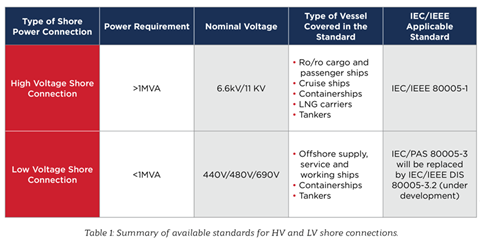
Shore power connections found in U.S. ports generally fall under types: high voltage system (over 1kV, AC) and low voltage systems (<1kV, AC). High voltage shore power systems support large vessels with high power demand such as cruise, containers, refrigerated vessels, etc. with 6.6kV or 11kV power systems. Low voltage shore power supports vessels with low voltage distribution system between 220 and 480V and lower power demand like fishing vessels, tugs, and offshore supply service and working ships.
Standardisation of shore power requirements for many types of vessels with LV and HV systems is still in progress and a challenge brought up in our survey question four. The need for standardisation of DC shore power connection systems to support all-electric vessels is also rising steadily.
The following table provides a summary of available standards for HV and LV shore connections. Shore power installations are very expensive and require upgrades to the port and grid infrastructure.
Public private partnerships and government grants play a crucial role. According to ports in our interviews, shore power systems can cost US$25 million per berth and US$1 million per vessel to be shore power compatible.
For ports with small budgets, infrequent calls from shore power-compatible ships, or frequent calls from bulk vessels, shore power systems may not be a cost-effective investment.
It is crucial that ports involve the utility companies from the initial planning stage to ensure that shore power systems can be supplied without interruptions and the infrastructure is designed to consider future power demand. Design should also consider the use of mobile cable positioning devices to ease connection.
LOCAL POWER GENERATION/STORAGE
The survey results show that, while there is mixed interest, ports are investigating the installation of local power generation. Per the survey results, local renewable power sources generally support less than 10% of the total power needs of the port. Solar PV leads the list of ports’ preferred local energy source. Building roof tops and canopies over parking spaces can provide space for solar power generation.
While ports play a pivotal role in the construction of offshore wind projects and the movement of onshore wind components, few seaports envision installation of wind power on port property. However, studies have indicated that that wind energy can be efficiently applied to meet the power demands of ports.
Fuel cells are also being investigated by many ports to support local power generation. By incorporating low/zero-emission energy sources and battery storage systems, ports are building micro grids that can support charging of electrical cargo handling equipment, vehicles and improve energy resilience.
THE WAY FORWARD
The report also shows the need for future study. Among questions that this report did not address, but would be valuable to have answered include how has the performance of low- and zero-emission equipment improved over time and in different conditions, including range, charging time and duty cycles?
What is the total cost of ownership of various types of equipment, and can low- and zero-emission equipment save money over diesel in the long run? What is the economic benefit of port decarbonisation, including energy savings, cargo-throughput and local health cost savings?
Through further standardisation and economies of scale, can the cost of low- and zero-emission equipment be reduced? Can the cost of charging and fueling port equipment be brought down through greater efficiency in transmission infrastructure build out? Would the availability of alternative fuels at American ports confer a global economic competitiveness?
All important issues worthy of further study.