





Cranking up capacity
Poland’s ports are looking to consolidate their current strong position. Will this continue the steady erosion of the role of German ports serving the Baltic? AJ Keyes looks at the shape of things to come
The emergence of DCT Gdansk (or the ‘Baltic Hub’ as it is now known) in Poland has challenged existing port infrastructure, especially the traditional role of serving the Baltic region via transshipment through German ports. Add to this trend the economic sanctions impacting Russian ports, and there is certainly now a “new normal” in place for the Baltic region. This raises a simple question – will the trend continue or will the German ports, notably Hamburg, fight back?
Economic growth in 2021 and 2022 for Poland shows the resilience to market fluctuations in the face of the COVID-19 pandemic, while the impact of the Ukraine conflict via the reduction of transshipment cargoes and feeder services to Russia / Kaliningrad, has helped augment Polish gateway volumes supported by high numbers of Ukrainian refugees increasing the local population and thus lifting consumer demand.
The key question is why are Poland’s ports proving successful and Hamburg, for example, is not?
BCT: SUCCESSFULLY DIVERSIFYING
Investment in infrastructure to be able to support ship size growth is an important factor, as is the ability to diversify to build on market strengths. As Table 1 shows, ports in Poland have continued to expand the quality of infrastructure and facilities.
ICTSI’s Baltic Container Terminal offers 800m of quay and good water depth to provide 1.2 million TEU of capacity per annum and serving a mix of feeder, short-sea and deep-sea customers, with MSC recently announcing a new call to be introduced on its Far East ‘SWAN’ service.
Operating at the port since 2003, with investment at the facility in excess of US$100 million, ICTSI has recently renewed its tenure at the terminal to run until 2053. However, this is more than just a facility for regional container activity, with the terminal successfully diversifying its service portfolio in two other key areas.
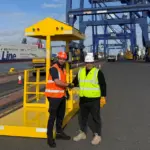
First is the handling of special cargoes such as advanced military equipment. “BCT has considerable expertise in this area,” emphasises Wojciech Szymulewicz, Chief Executive Officer, “meeting stringent security requirements, and as such enjoys the trust of the Polish army and Poland’s NATO allies.”
Then there is the handling of wind turbine components destined for use in onshore wind farms. It further expects to deploy this expertise in conjunction with offshore wind farms, which are planned for development over the short to medium term.
The Baltic Sea has enormous potential for offshore wind, with the current 2.8 GW of installed capacity expected to 19.6 GW by 2030 following a commitment from eight countries that border the region. Here, Poland will play a crucial role as it is targeting capacity of 6 GW by 2030 and 11 GW by 2040. As a result, BCT can expect to be at the forefront of supporting the industry moving forward.
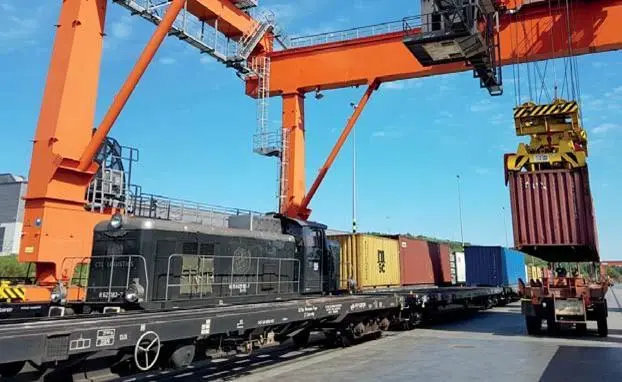
The continued expansion into these other cargo areas complements the terminal’s container activities, which extend along the increasingly important trans-European Baltic-Adriatic Corridor (Corridor VI). This route runs from Gdynia via southern Poland (Upper Silesia), Vienna and Bratislava and the Eastern Alpine region right through to Northern Italy, serving diverse industrialised centres en-route. With around 250 intermodal trains running per month, the facility is already seeing rail account for 30 per cent of annual throughput.
ICTSI is not the only global operator in the Polish market, with Hutchison Ports operating Gdynia Container Terminal (GCT), although more limited water depth and infrastructure has seen its major customer, CMA CGM, switch to DCT Gdansk (Baltic Hub. One shipping line executive covering the region said that as a result of the move, as much as 90 per cent of the terminal’s business could eventually depart. That leaves a significant gap that needs to be filled, although it is hard to see where the cargo will come from.
This is particularly the case with BCT now engaged in an investment programme which will see berth deepening commence in Q3 2023, with 15.5m gained within two years, and improved rail access and electrification.
NO LACK OF DEEPSEA PORT INFRASTRUCTURE
In terms of deepsea shipping, DCT Gdansk has two largescale terminals and deep water, able to handle the largest container vessels in service. Strong continuing demand means Terminal 3 is already under development and will take total container capacity to 4.5 million TEU per annum during the current decade.
Clearly, there is no lack of port infrastructure in Poland, with deep-sea, feeder, project cargoes and ro-ro all amongst the varied activities taking place.
Table 1: Port Infrastructure in Poland’s Major Container Ports, Q2 2023
| DB Port Szczecin: Inner Port | Świnoujście CT (Outer Port) | DCT Gdansk – The Baltic Hub: T1 & T2 | ICTSI: Baltic Container Terminal (BCT) | Hutchison Ports: Gdynia Container Terminal (GCT) | |
|---|---|---|---|---|---|
|
Total Quay length |
1000 m |
1300 m (750m Phase 1; 550m Phase 2) |
1300m |
800m |
812m |
|
Water depth |
9.2 m |
13.2m (current) 17m (planned) |
17m |
13m – deepening to 15.5m starts Q3 2023 |
11m (current) 15.5m (potential) |
|
Cranes |
2 STS |
6 (Phase 1) |
14 |
6 |
6 |
|
Estimated Capacity (TEU) |
120,000 (current) |
1 million (Phase 1) 2 million (Phase 2) |
3 million (current) 4.5 million (with T3) |
1.2 million |
636,000 |
By comparison, Hamburg’s two container terminal operators have both continued to invest in facilities recently and further expansion at the port is expected. Yet, as Table 2 identifies, this is not enough to stem the tide of change. The port is continuing to see its transshipment volumes diminish, with this activity falling by an average of three per cent per annum since 2014 when it handled more than 3.7 million TEU. The figure for 2022 was 2.9 million TEU. Bremerhaven saw a similar fall in activity in 2022, down from 2.9 million TEU to 2.7 million TEU.
Yet for the same period DCT Gdansk recorded growth of five per cent per annum, reflecting a continuing shift in emphasis away from Germany to Poland.
Ensuring sufficient depth of water in the River Elbe to satisfy the continued increase in container ship sizes has been the biggest challenge to Hamburg’s role as a major hub port of call for container shipping lines. Without comparable deep water and the ability to handle ever-larger container vessels (principally from Asia), Hamburg remains a less viable regional transshipment hub compared to Polish ports for serving the Baltic region. Yet dredging programmes do not appear to be a panacea for the port and its competitiveness.
Location can also not be ignored because Hamburg’s cargo terminals are 100km from the mouth of the North Sea and this is a distance that both the deepsea vessel and the feeder ships need to sail, there and back, before any onward sailing occurs. By comparison, the likes of DCT Gdansk and Świnoujście represent no deviation from shipping routes, minimising shipping line costs.
Table 2: Transshipment at Major German Ports 2014 – 2022, in ‘000 TEU
| Port | 2014 | 2015 | 2016 | 2017 | 2018 | 2019 | 2020 | 2021 | 2022 | CAGR |
|---|---|---|---|---|---|---|---|---|---|---|
|
Hamburg |
3,714 |
3,539 |
3,573 |
3,225 |
3,182 |
3,379 |
3,123 |
3,329 |
2,900 |
-3.0% |
|
Bremerhaven |
3,323 |
3,335 |
3,344 |
3,111 |
3,098 |
2,771 |
2,724 |
2,929 |
2,711 |
-2.5% |
|
Wilhelmshaven |
50 |
329 |
371 |
401 |
501 |
508 |
323 |
544 |
504 |
33.5% |
|
sub-total |
7,088 |
7,204 |
7,288 |
6,737 |
6,781 |
6,658 |
6,170 |
6,801 |
6,115 |
-1.8% |
|
1.6% |
1.27 |
-7.6% |
0.7% |
-1.8% |
-7.3% |
10.2% |
-11.1% |
The cargo shift away from Hamburg for transshipment containers is clear to see, but there is also the possibility of hinterlands in eastern Germany and Southwest Poland also deserting Hamburg to Poland as well.
The planned Świnoujście Container Terminal project, located to the east of the outer port in Świnoujście, if built, will offer a water depth of 17m and supporting container handling infrastructure of one million TEU per annum initially, with the potential to increase in phase two to around two million TEU per annum. The port has direct accessible truck markets in Northeast Poland and Northwest Germany (including Berlin), while it is very well-located geographically to Slovakia, the Czech Republic, Austria, and Hungary. This means transport cost structures for serving these markets appear highly favourable over Hamburg.
THE SQUEEZE IS ON
The squeeze on Hamburg’s volumes from Poland will likely continue if the forthcoming development of Świnoujście gains further traction (although there is no certainty regarding this as yet). This is in addition to DCT Gdansk bringing its Terminal 3 to fruition and offering more deepsea container capacity.
Yet, some parties contend it could be even more competitive for the German ports if the Polish government could streamline port authority management to deliver a more effective strategic approach. There is also the issue of introducing an effective National Port Masterplan.
Related Articles
 OPERATIONS
 OPERATIONS
 COASTLINK