![PortStrategy[GreenPort]](https://www.portstrategy.com/wp-content/uploads/2026/09/PortStrategyGreenPort.svg)






Global container trade resilient
Global container shipping volumes remained resilient in the first quarter of 2026 despite emerging disruption linked to the Gulf Crisis and instability around the Strait of Hormuz, according to new data from Container Trades Statistics.
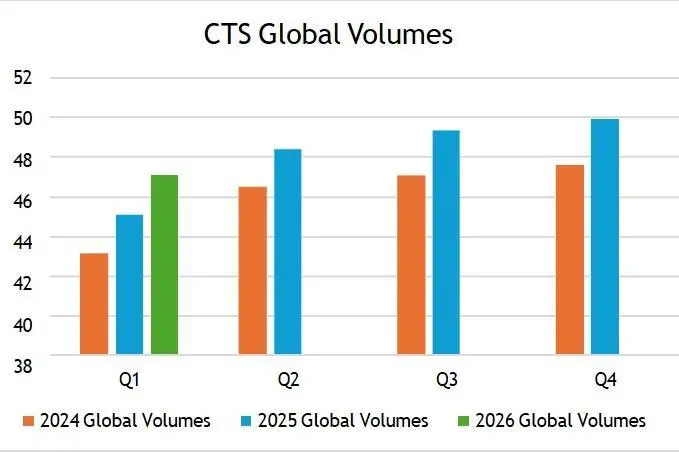
Total global volumes reached 47.2 million teu in Q1 2026, a 4.4% increase compared with the same period in 2025. However, analysts warned that underlying trade flows were already being affected by geopolitical instability.
“March 2026 figures are the first to begin reflecting the early impacts of the Gulf Crisis and the disruption surrounding the Strait of Hormuz,” Container Trades Statistics said.
While March volumes increased 5.8% month-on-month, they fell 2.4% year-on-year, suggesting early disruption to established shipping routes.
Container Trades Statistics noted that ‘global volumes remain strong on a quarterly basis’, but added that pricing signals are beginning to shift as uncertainty grows. The Global Price Index rose five points to 79, returning to levels last seen in December 2025.
The impact of the crisis was most visible in the Indian Sub-Continent & Middle East export region, which saw a sharp downturn in March.
“Exports from the Indian Sub-Continent & Middle East fell by nearly 29% year on year in March alone,” Container Trades Statistics reported. “This underlines the immediate disruption the crisis has had on one of the strongest-performing regions in recent years.”
Despite this, global trade growth was supported by strong performance in emerging markets. Sub-Saharan Africa stood out with a 17.7% rise in imports in Q1 2026 compared with the same period last year, driven largely by increased flows from the Far East.
Container Trades Statistics said: “The Far East–Africa trade was up by over 30% in Q1 2026, reinforcing the growing importance of emerging trade lanes in supporting global volume growth.”
North America was the only import region to record a decline, down 3.8%, reflecting softer demand and ongoing tariff-related uncertainty.
Looking ahead, Container Trades Statistics warned that the full impact of the Gulf Crisis is not yet visible in the data.
“Current CTS data suggests the conflict has already removed approximately 840,000 teu from global volumes in March alone,” the organisation said. “This reflects only around three weeks of impacted data, meaning the broader effects are likely to become more visible in the coming months.”
With freight rates expected to rise and routing disruptions likely to persist, analysts say the remainder of 2026 will be shaped by continued geopolitical and economic uncertainty.
Related Articles
 WORLD
WORLD
 PRODUCTS & SERVICES
 PRODUCTS & SERVICES