
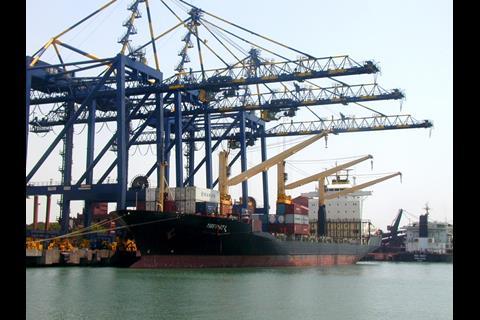
Radhika Rani examines the broken connectivity links holding back Indian port development
A thriving hinterland and proper connectivity are essential for the sustenance of India’s ports as port-based freight operations are projected to rise with growing exports and imports. But inefficient hinterland links could lead to a drastic increase in supply chain costs and inordinate delays in the movement of cargo.
The Planning Commission of India recommends that each major port or public service port should preferably have minimum four-lane road connectivity as well as double-line rail connectivity. Yet, a few state-run ports in India have been facing last-mile road connectivity issues and inadequate rail use, which has resulted in congestion problems.
For instance, Jawaharlal Nehru Port, India’s largest major port in container handling with a share of 55.25% in the year 2012-13, has only one approach road for container traffic. Similarly, Chennai Port, the second busiest container port lacks a dedicated access road and exit gate and has inadequate road conditions.
Meanwhile, non-major ports in India - primarily the upcoming private ports - have been gradually increasing their share of cargo handling. With regard to connectivity, they have been providing due attention and facilities to optimise their hinterland access.
While major ports currently handle nearly 70% of India's sea trade, that share has registered a dip since 2010. As per the Ministry of Shipping data, major ports handled 570.03m tonnes of cargo in 2010-11; that fell to 560.13m tonnes in 2011-12 and to 545.68m tonnes in 2012-13. While the share of major ports in cargo traffic decreased 3.3% in 2012-13, that of non-major ports increased 10.3% during the same year.
Open arms
India has welcomed the arrival of new entrants, private ports acting as new regional load centers that have the potential and the means to change hinterland logistics practices. By so doing, they differentiate themselves in terms of better tariff terms, efficiency and connectivity.
Chennai Port handles iron ore, coal, granite, fertilizers, petroleum products, containers, automobiles and general cargo items. Cargo to and from the port is handled through rail (33%), road (40%) and pipeline (27%). Of the containerised cargo, only 7% is handled by rail and the remaining 93% goes by road. The present average share of containers being transported by rail for exports is barely 6.2% while the majority is by road, as much as 93.8%.
India’s 11th Five Year Plan (2007-2012) identifies deficits in the transport sector and aims to modernise, expand and integrate transport services. For the ports sector, the Government has increased funding, allocating $13.55bn for development of various projects during the 12th Five Year Plan (2013-17). The aim is to increase annual capacity of major ports from the present 943.06m tonnes to 1229.24m tonnes by March-end 2017.
With respect to road connectivity projects, the Chennai-Ennore Port Connectivity Project and the Maduravoyal-Chennai Port Elevated Road Project next to the dry port and multi-modal logistics hub at Sriperumbudur have yet to see the light of the day owing mainly to lack of clearances. And so, poor connectivity & inadequate road conditions continue to plague export and import trade causing congestion and cost escalation not only for trade but for projects themselves.
As economist Michael Porter points out, profitable markets that yield high returns will attract new firms. Accordingly, the Indian ports sector has seen the entry of several players looking to take a slice of the big profits. These include Adani, Pipavav, Hazira on the West Coast and Kattupalli, Karaikal, Krishnapatnam, Gangavaram on the East Coast.
Chain connectivity
According to the Institute of Transport and Maritime Management Antwerp’s Dr Theo Notteboom, routing choices, and to some extent port choices, are strongly dependent on hinterland transport conditions, and the reliability of the total route has become increasingly important to those in the supply chain making the routing decisions.
The World Bank Port Reform Toolkit states that the significance of the entrance of new port facilities will vary from port to port depending on a number of factors, such as capital expenditure, new distribution patterns, provisions in operating agreements, natural barriers, magnitude of switching costs, cost advantage, and customer loyalties.
While customer loyalties can be ephemeral, quality of service such as responsiveness to customer needs, handling rates and clearance time, can differentiate the service provider and limit the threat of new entrants.
Lack of enough transport arteries and hubs not only propels other ports in the region to serve the spillover traffic from an overcrowded neighbouring port, it also serves as an advantage for shippers to take practical routing decisions to ensure economies of scale and service difference. Hinterland connectivity therefore points to the efficiency of the supply chain and serves as a benchmark for ports to gauge the scale of customer service.
One vision
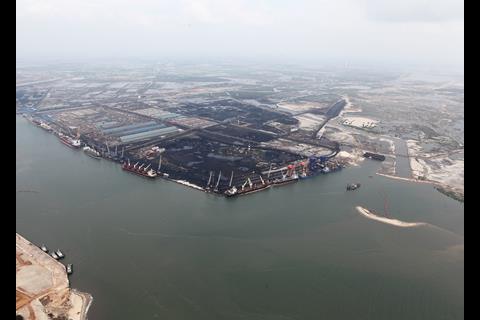
Krishnapatnam Port, 186 km north of Chennai in the lower East Coast of India, has a vision “to evolve as India’s largest gateway on the East Coast and the Port of Choice”.
The greenfield port situated in Muthukur Mandal of Nellore district, in the state of Andhra Pradesh, was developed on 6,500 acres of land by Krishnapatnam Port Company Limited. It started operations after phase 1 development in 2008, handling bulk cargo comprising ore, coal, agri commodities, minerals, edible oil, fertilisers and project cargo.
Container operations began in April 2013 and Krishnapatnam Port Container Terminal is poised to develop into a world-class transhipment hub by optimising necessary land and sea-side infrastructure. The hinterland extends to north Tamil Nadu, Eastern Karnataka, Andhra Pradesh and parts of Maharashtra through rail and road.
The port provides single-window end-to-end services from stevedoring to custom documentation and has a functional custom EDI connectivity and dedicated customs staff operate within the terminal.
The port handled 21.12m tonnes of cargo in 2012-13, a 40% growth in cargo over the previous financial year, with coal imports alone accounting for 16m tonnes. It expects over 40% growth in the current fiscal 2013-14, with volumes getting added through container handling at the new container terminal that became fully operational in April 2013.
A 40%-50% growth is expected this financial year and the port may reach 30m tonnes mark with coal alone accounting for 20m tonnes. Two jetties, one for LNG and the other for POL, are being built.
KPCL has a dedicated 26 km four-lane road connecting the port to the Chennai-Kolkata National Highway. Land acquisition has already been completed for the upgrade of the road to a six-lane road in the future.
On the rails
Krishnapatnam Rail Company Limited (KRCL) is a special purpose vehicle comprising the Government of Andhra Pradesh, KPCL and Rail Vikas Nigam Limited, that was formed to provide rail connectivity to the port.
A dedicated 19-km railway line connecting the port to the Chennai-Kolkata main line was laid in phase 1. Under phase 2, a 91-km new broad gauge line will be laid. This line will reduce the distance between the port and the hinterland in south-eastern Karnataka and south-western Andhra Pradesh by 70 km.
Another 114-km long broad gauge rail line, being built with the involvement of three government agencies and a private consortium, connecting the port to the hinterland is underway and is expected to be completed by mid-2014.
In view of the various business strategies being implemented by the port and the willingness of trade to partner, there is further potential for the industrial, commercial and agricultural growth in the hinterland.
Krishnapatnam Port has competitive advantage over other ports in the region with respect to hinterland connectivity, given its road and rail capacity, which has yet to reach optimal usage. The lower East Coast is a vibrant industrial belt and has cargo volumes crisscrossing the coastline. This is therefore bound to increase congestion on approach roads of ports or terminals. But with a proven track record for seamless flow of cargo, Krishnapatnam Port has the potential to be a class apart in terms of serving export-import trade.
Radhika Rani is alumna of STC-Group’s Netherlands Maritime University, 2012-13. The analysis, findings and conclusions of this article are based on and documented in a thesis, independently conducted and written by Radhika Rani, in partial fulfilment of her Master degree in Shipping and Transport at the Netherlands Maritime University in Rotterdam.