


Energy giant Woodside and a group representing recreational fishers have created an artifcial reef fishing activities and enhance marine biodiversity off the Western Australian coast, writes Dave MacIntyre.
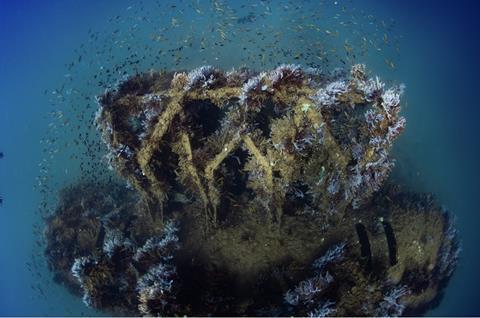
The Dampier Artificial Reef is backed by scientific research and community input, aiming to create a new marine habitat and boost recreational fishing opportunities in the Pilbara region.
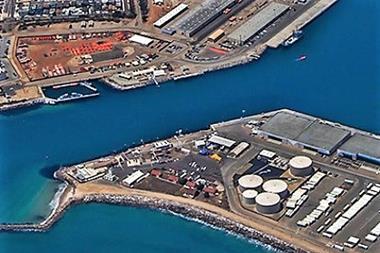
The reef consists of 48 purpose-built concrete modules installed in approximately 35 metres of water, near Rosemary Island in the Dampier Archipelago, 1260 kilometres north of Perth in Western Australia (WA). The archipelago is just off Woodside’s port facility, the Karratha Gas Plant (KGP), one of the most advanced, integrated gas production systems in the world, producing LNG, domestic gas, condensate and LPG.
With the support of the WA Government, City of Karratha, indigenous Traditional Owners and fishing clubs, the installation of the reef represents a significant collaboration to provide an accessible and productive marine environment the community can enjoy.
Protected habitat
The new reef aims to provide a high-quality fishing location for species such as Spanish mackerel, trevally, cobia, cod and even sailfish, while supporting local tourism.
Artificial reefs are colonised quickly. Upwellings created by the reef structure help concentrate baitfish, drawing sailfish and other predators to the surface. Fast-moving pelagics (ocean fish) such as Spanish mackerel, longtail tuna and wahoo are also expected to feature strongly on and around the reef.
Closer to the bottom, the reef’s complex structure provides excellent habitat for popular demersal species (living on, in or near the bottom of the sea) including Rankin cod, saddletail snapper, crimson snapper, Moses perch and coral trout.
The reef combines two complementary concrete module designs to maximise fishing productivity and environmental outcomes.
It has 24 Bombora modules (1.8 metres high), which provide cave-like features and hard surfaces for demersal fish and other marine life to inhabit.
There are also 24 Reef Pyramid modules, rising to five metres from the seabed and some of the largest concrete reef modules yet deployed in WA, creating strong vertical relief for baitfish, pelagics and larger demersals.
The collaboration is between Woodside Energy Group Ltd and Recfishwest. Woodside is a global energy leader who established the liquefied natural gas (LNG) industry in Australia in the 1980s. Today, its strategy is to thrive through the energy transition with a resilient and diversified portfolio of oil, gas and new energy projects in Australia, North America and Africa.
Recfishwest is the not-for-profit peak body representing the interests of the estimated 750,000 West Australian recreational fishers. It advocates for responsible fishing practices to ensure the sustainability of fisheries. The provision of optimal social and economic benefits and ensuring high-quality recreational fishing experiences are maintained and enjoyed, aligns with the integral lifestyle of Western Australia.
The installation of the reef was funded by Woodside and its joint venture partners in the Scarborough gas project, JERA Australia and LNG Japan. Scarborough is a major new development located in the Carnarvon Basin, approximately 375 km off the Pilbara coast. It is progressing towards its first LNG cargo, targeted for Q4 this year.
Woodside also had the support of its joint venture partner in the Enfield energy project, Mitsui E&P Australia, for its contribution to the acquisition of the concrete modules for the reef.
Enhancing fish habitats
Dr Andrew Rowland, chief executive officer at Recfishwest, says the deployment of the Dampier Artificial Reef will provide new fishing opportunities while enhancing fish habitats.
“Our collaboration with Woodside demonstrates what can be achieved when industry and the recreational fishing community work together for positive outcomes,” he says.
“These scientifically designed structures build healthier oceans, supporting biodiversity, boosting fish stocks and strengthening ecosystem resilience. Most importantly, they create fantastic new fishing opportunities particularly in this instance for pelagic species like mackerel and sailfish, and all the flow-on benefits that brings to coastal communities.”
Breyden Lonnie, acting executive vice president and chief operating officer Australia, Woodside, explained that he is excited about the collaboration and bringing the new reef to life.
“Woodside is excited to collaborate with Recfishwest and the local fishing community to bring this new reef to life. The reef is expected to provide a productive marine habitat for diverse species of algae and corals, supporting an abundance of fish life to feed and shelter,” he says.
“Not only is the reef expected to contribute to marine biodiversity; it will also be an added drawcard to boost fishing tourism to the Pilbara, supporting the local economy and communities.”
Reef expansion
Artificial reefs are rapidly shaping Western Australia’s expansive coastline, with several already deployed as far as Esperance in the deep south of the state, right up to Dampier in the north, a distance of 2200 kilometres.
Since 2013, Recfishwest has helped deliver nine artificial reefs along the WA coast, more than 1000 reef modules and close to 3000 tonnes of new fish habitat, covering 40 hectares of sea floor – the equivalent of around 17 football stadia of new fish habitat into WA waters.
The promising outlook for the Dampier reef is supported by experience elsewhere. Similar projects, such as Exmouth’s King Reef, have transformed bare sand into vibrant habitats supporting more than 150 fish species within five years.
Recfishwest’s artificial reef experts, along with trusted partners, have now acquired extensive artificial reef capabilities and knowledge to ensure the reefs have a consolidated place in Western Australia’s ongoing conservation of important aquatic habitats.
Recfishwest’s website has an interactive map where fishers can find out about the size, design and deployment of each reef and their development over the months. The maps give the coordinates of each reef cluster so fishers can home in on their targets.
The organisation will share updates as the new Dampier reef comes to life. Already, after the concrete modules were carefully transported and installed in early December, the first “tenants” were soon making themselves at home.
Marine construction
The Artificial Reef is another important project taking its place as a high-value marine construction project being undertaken in the Pilbara region.
In so far as the ports are concerned directly, Pilbara Ports has recently awarded a major contract for the design and construction of the Dampier Link Bridge, marking a significant milestone for the Dampier Cargo Wharf Projects on Western Australia’s mid north coast.
Pilbara Ports has also joined forces with Yara Pilbara to develop ship refuelling capability in Western Australia’s Pilbara region.
A recent memorandum of agreement will support the development of infrastructure and safety frameworks needed for ammonia bunkering at the Ports of Dampier and Port Hedland.
This is all important infrastructure work that the Australian Government has committed AUS$565 million towards what it calls ”common user port infrastructure upgrades” in the Pilbara. Of this, AUS$115 million has been earmarked for the Port of Dampier.
It’s good to note that in light of such major port infrastructure projects, the commitment to the protection of the local marine environment and the fishing community also remains high on the agenda.