




Getting alongside JIT
Technical innovation is playing an increasingly influential role in optimising the berthing process. New thinking and recent systems innovations are to the fore

Efficient vessel berthing can be influenced by a multitude of factors – sudden changes in weather, changes in ocean conditions, berth availability, congestion and the inability of vessel crew to respond quickly to any last-minute changes of plan etc. can all have an impact.
Overcoming such challenges, in a logical and safe manner, has in recent times become the focus of significant technical innovation assisted by the advent of the digital era. Notably, there is an emphasis on simple, accessible systems that store all the required information for fast decision making – a step on from what can be termed a more manual approach to vessel berthing.
Key drivers behind the emphasis on technical innovation to deliver safe and efficient vessel berthing include:
- A regulatory framework, focused on driving decarbonisation within the maritime sector that has evolved over the last few years – typically IMO’s targets to cut the sector’s emissions in half by 2050.
- The Just in Time (JIT) Arrival Guide developed by the Global Industry Alliance to provide the port and shipping sectors with practical guidance on how to facilitate JIT arrivals and achieve the inherent efficiencies that go with this.
- The Baltic and International Maritime Council (BIMCO) Just in Time Arrival Clause was also introduced in 2021 to encourage the greater adoption of this concept as a means of increasing shipping procedure efficiency and reducing CO2 emissions.
“The industry’s focus on decarbonisation is especially important within the context of ports,” says Bruce Mills, Business Development Lead, Ports, Wärtsilä. “As the connection between supply chain infrastructure on land and at sea strengthens, ports will have a pivotal role to play in enabling resilience and emissions reduction across the end- to-end supply chain.”
CONNECTIVITY KEY
Systems supplier OneOcean cites the figure of six per cent as the average time that working containerships spend at anchor – which means of course they are racking up costs as opposed to earning revenue. There is, therefore, alongside objectives such as decarbonisation and optimising supply chain operations overall, a strong commercial incentive to achieving timely and efficient vessel berthing.
So where does the process start to achieve JIT berthing?
The consensus on this is the real-time connection of all stakeholders: vessel operators, port authorities, terminal operators and other parties has to be achieved. This is an issue highlighted by Mills in the accompanying article in this issue, Overcoming Digital Fragmentation, where he emphasises the need to get away from what can be called data silos, unable to inter-connect with each other, and thus reap the benefits that standardisation offers. He says: “Taking a holistic approach can be transformational from a supply chain perspective. With greater supply chain connectivity and data-sharing comes the potential for JIT operations and the associated benefits. Not only can JIT arrivals reduce fuel use for ship operators, they can reduce congestion and delays in ports, thus improving safety, competitiveness and resilience of maritime operations.”
There are a good number of digital packages that can contribute to efficient berthing, the big question is connectivity. Where in the transport chain do they start? Voyage planning for vessels is identified as making a useful contribution to the process. OneOcean’s Passage Manager, system, for example, offers all data required on the viability of sea routes including routing parameters, vessel equipment and weather conditions. With all the necessary information housed in one place, this is said to make berth-to-berth voyage planning much easier.
OneOcean also offers other packages to the vessel operator that it says can facilitate JIT arrivals – there is FleetManager which aims to provide full situational awareness to shoreside stakeholders on the whereabouts and status of their entire fleet. This data, OneOcean contends, can prove to be an important link in the JIT value chain. There is also its Guide to Port Entry publication, and its digital equivalent, findaport.com. The company notes: “Being notified that a berth is available and that the ship can enter port is one thing, but knowing the port’s exact layout, its applicable rules and regulations, procedures, and requirements are things altogether different. All the benefits of arriving just-in-time can be wasted if the port entry itself becomes strewn with challenges. Comprehensive port data can play a powerful role in providing a planned approach that is efficient and minimises unnecessary manoeuvring.”
There are also structural changes required to facilitate efficient vessel berthing: OneOcean and Mills both cite the necessity of overcoming possible conflicts of interest in voyage charter contracts between the ship owner and the charterer. “As things stand,” OneOcean points out, “extended laytime with the vessel at anchor awaiting a berth can deliver demurrage benefits to the owner, while a JIT arrival would minimise the laytime and thus benefit the charterer.”
Equally, there is the issue of cargo being ready for loading at the terminal and the terminal properly set up to handle discharge operations which, in turn, can impact the interfacing of land-side transport systems. Real data connectivity is again key.
STEADY TAKE-UP
There is steadily growing activity regarding the adoption of digital solutions for efficient vessel berthing and cargo discharge/loading.
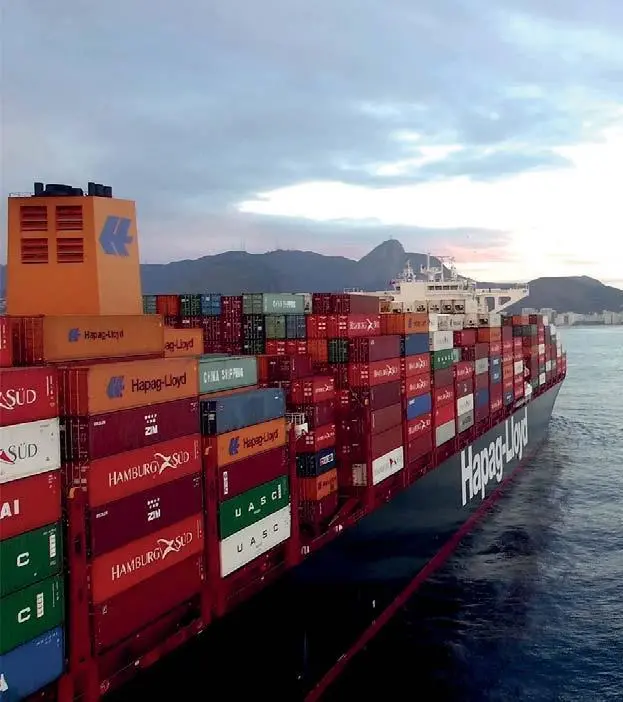
A five-year partnership was recently confirmed between liner shipping company, Hapag Lloyd and Portchain to deploy Portchain Connect across its global operations. Portchain Connect digitises the process of aligning berths between carriers and terminals, enabling them to make timely and more frequent scheduling decisions.
Using Portchain Connect, Hapag-Lloyd will transform traditional email and phone communication into a digital information flow for aligning berth arrival information with terminals, giving its terminal network immediate access to schedule updates and key vessel call information on the platform.
The alignment process provides the opportunity to capitalise on the benefits of JIT arrivals – a process which the IMO estimates can reduce CO2 emissions and bunker consumption by 5.9 per cent in the 24 hours leading up to arrival.
Shekou Container Terminals is another company to recently implement Portchain Connect and similarly Antwerp Gateway, where DP World is the operator.
Also of note, the Port of Algeciras has worked on a pilot project in conjunction with Maersk Line, APMT Marmedsa and PortXchange. As well as helping to lower emissions, the PortXchange platform provides one central focal point for all parties involved to be up to speed with unfolding real-time data. Port and vessel operators are instantly notified via PortXchange if there are any changes in scheduling. If a berth has to be rescheduled, this means that the vessel can optimise its speed accordingly and lower the level of unnecessary emissions.
FUTURE R&D
Looking ahead, Mills says the future of systems will be more integrated, whereby industry players will be looking at the entire vessel schedule. “This is where the JIT concept will play a critical role. Moving forward will be reliant on extending these capabilities and ensuring that they’re embedded in the whole operation.”
Elaborating, Mills says that the industry needs to explore how to extend the latest developments. “We need to look at a vessel’s schedule much further, beyond the next port of call. Instead, looking at the entire journey: so, not just vessel to port, but port to vessel to port. To do this, we need to better understand, not just the estimated time of arrival at the next port, but the estimated time of departure from the same port as that will be critical in determining what the estimated time of arrival at the port after that will be.”
However, this is where things start to get more complicated. He points out: “In order to be able to calculate the estimated time of departure from the next port we need to take into account many more variables. For example: are there any delays in cargo operations? Are there delays in employees coming onboard the vessel? Are there any delays in the availability of tugs to be able to depart the vessel?
“The good news,” he underlines, “is that advanced technologies, such as Machine Learning (ML) and Artificial Intelligence (AI), can support accommodating these variables. That’s because ML and AI technology can help us to make more informed decisions by, for example, helping to understand what’s happened in the past so that we can better predict what the likely estimated time of departure will be in the future.”
Related Articles
 EQUIPMENT
 EQUIPMENT