


LIFE CYCLE COSTS DRIVE INVESTMENT DECISIONS
Alex Hughes talks to two of New Zealands leading forest products companies about their approach to equipment procurement, performance and ROI considerations.
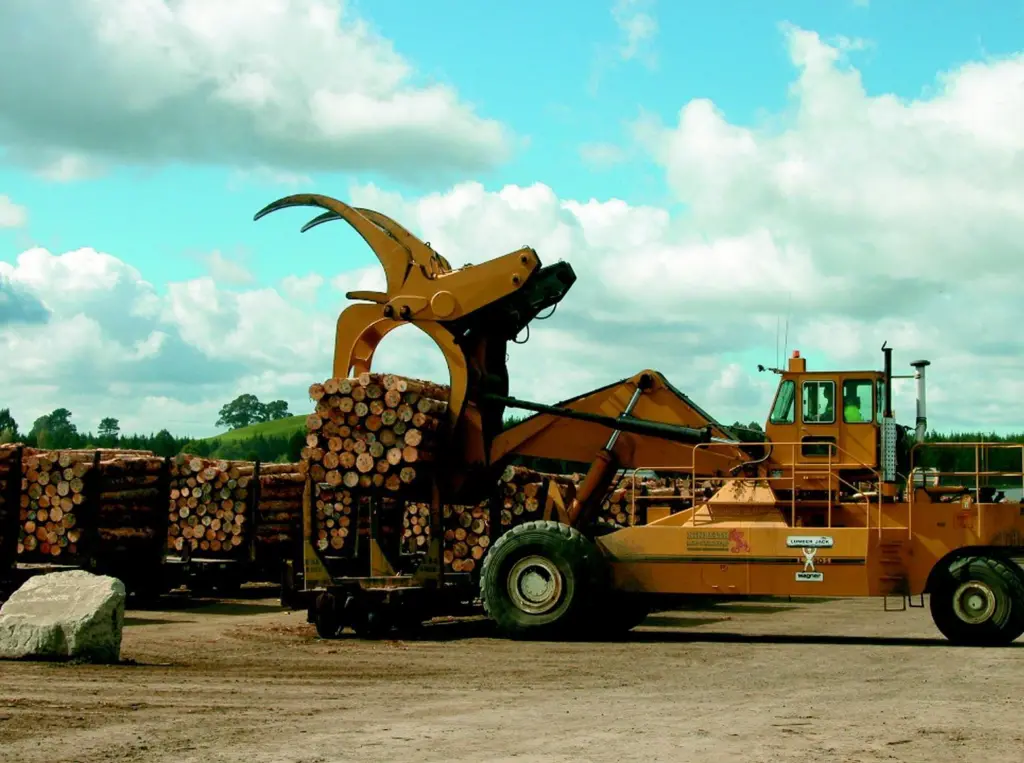
Owens Cargo Co Ltd has established a reputation as one of New Zealand’s leading log marshalling companies with additional general cargo interests in containers, paper reels and wood pulp spread across ten domestic ports. It is also the Australasian agent for US manufacturer Allied Systems, whose Wagner “Lumberjack” range of log-stackers is a particular feature of its own domestic operations.
Fleet manager Alan Johns explains that Owens operates several different types of ‘Lumberjacks’, of which the mid-range L90 is the most common; the lighter L70s and larger L120s have lift capabilities of 32 tonnes and 54.5 tonnes respectively.
“The ‘Lumberjacks’ are essentially very simple, robust machines, which have a big long base and a high degree of stability. We operate two-wheel drive models, which are very cheap to run, although fourwheel drive variants also exist, ” explains Johns, adding that a customised L90 costs in the region of US$750,000.
Apart from a few components peculiar to Allied Wagner, units are supplied with off-the-peg engines, transmissions and axles, therefore making them easy and cheap to repair or upgrade. Owens nowadays mainly selects Cummins engines, although has previously used Caterpillar power trains. Clark has become the preferred supplier for both axles and transmissions.
The robust nature of the body shell has allowed Owens to rebuild its oldest machines; these rebuilds cost half the sticker price of brand new units. Even some of the oldest log-stackers, which date back to the late 1960s, have undergone rebuilds, involving a conversion to the latest electronically-controlled engines and installation of modern transmissions.
“The Wagners are often required to work around the clock, averaging around 4,000 hours a year. We consider rebuilding them when they have put in upwards of 20,000 hours, although some fitted with Clark transmissions are still going strong even after 50,000 hours, ” notes Johns.
The majority of the company’s fleet dates to the 1980s, with the only recent acquisition being made in 2003. Based on an average annual working life of 4,000 hours, Johns calculates that the ROI on an L90 would be made within ten years, assuming a residual value of approximately US$200,000. A total or partial rebuild would then be undertaken ensuring a continued return on the initial capital.
Johns claims that the big advantage of the Wagners is that they have remained design simple, with few major changes having been made to the body shell. Nevertheless, he argues that upgrading the highly durable cabin could add value to the end product by incorporating a wraparound windscreen and by introducing more user-friendly controls.
Operationally, at Owens’ largest port operation in Mount Maunganui, four L90 equivalents and two L120s are in almost constant use. The former mostly discharge incoming logs, while the latter transfers them to the quayside, where a Komatsu WA600 pivot steer loader places them into loading frames, which are hauled on board vessel using the ship’s own lifting gear. In general, one pivot steer loader is sufficient to feed three on board hatches.
Owens operates a mixed fleet of Komatsu, Liebherr, Caterpillar and Volvo pivot steer loaders. Previously, Caterpillar 966s and 980s, whose durability impressed Johns, were the favoured machines.
However, the most recent purchases have been three Volvo L220s and two Liebherr L580s. Products being supplied by European loaders, notes Johns, are ergonomically very sound. They are also becoming more compact, although without any fall-off in performance.
The biggest loaders used by Owens are the Komatsu WA600s, whose parts back-up and overall serviceability have opened doors.
Costing US$700,000, the WA600, like all pivot steer loaders, requires heavier maintenance than rigid framed machines, particularly on components such as the transmission, drive shafts and central pivot.
“We would like to see a reduction in the cost of maintaining pivot steer loaders, ” stresses Johns, nevertheless conceding there is probably little that can be done to drive down overall running costs given the greater fuel consumption of their larger engines.
Furthermore, because of the heavy-duty nature of the work, pivot steer loaders need much earlier rebuilding than the Wagners; this would be undertaken after 27,000-30,000 hours, compared to an upper limit of 50,000 hours for a Wagner. Return on investment is broadly similar, although achievable within seven years.
LEASE OR PURCHASE DEPENDS ON ROI “For accounting purposes, two of the six pivot steer loaders we operate at Mount Maunganui are leased, ” comments Johns, adding that each capital purchase is analysed, then either leased or bought outright depending on the best internal rate of return achievable.
For woodchip handling at its Marsden Point operation, Owens has recently taken delivery of a Wagner CHD100 chip carry dozer. This very large machine is driven by a 525hp Cummins engine and replaced two tracked machines on chip pile maintenance duties during export loading.
“Although it is shaped like a loader and pivot steers, it has an oscillating bogey at the front to which the bucket is attached. This allows the tyres to remain constantly in touch with the ground for maximum traction and stability. Furthermore, it has a simple two-axle drive and can both lift and carry. The biggest bucket which we could attach would be of 38 cu metres, but we normally use one of 31 cu metres, ” says Johns.
These bucket loaders, which can also work with coal, cost US$650,000. They are extremely reliable, with a slightly smaller version than that currently used by Owens having reputedly worked 180,000 hours before the differential failed!
Domestic rival Pan Pac Forest Products Ltd operates a 1.25ha chip export facility at the Port of Napier. Incoming consignments arrive by road, with trucks unloading 24/7 into a hopper feeding the main stockpile. A contractor, who provides the mobile plant, then marshals the incoming chips. During loading the ship is kept stationary with 750 tonnes per hour loading rates achieved through the use of one fixed and two mobile belt conveyors.
A number of performance parameters are continually monitored to ensure that Pan Pac operates efficiently. These include the chip stowage factor, loading rate, chip size quality compared with stowage factor, loading time, uptime and overall maintenance requirements.
Related Articles
 NEWS
NEWS
 CONTAINER & CARGO HANDLING
 OPERATIONS