





MIND THE EXIT ARRANGEMENTS
Exit arrangements from terminal concessions are not always high on the agenda when it comes to drawing up such agreements. Mark Lloyd-Williams, Partner at Norton Rose, suggests they are worthy of more attention as Mike Mundy reports.
Speaking at the recent MedTrade Conference, held in Venice, Lloyd-Williams brought into focus the increasingly important aspect of the legalities covering exit arrangements from port concession agreements. This is a subject that is today increasingly in the minds of financiers of new port concessions in particular and to a lesser extent in the minds of port authorities and other government agencies with responsibility for the issuing of concession agreements.
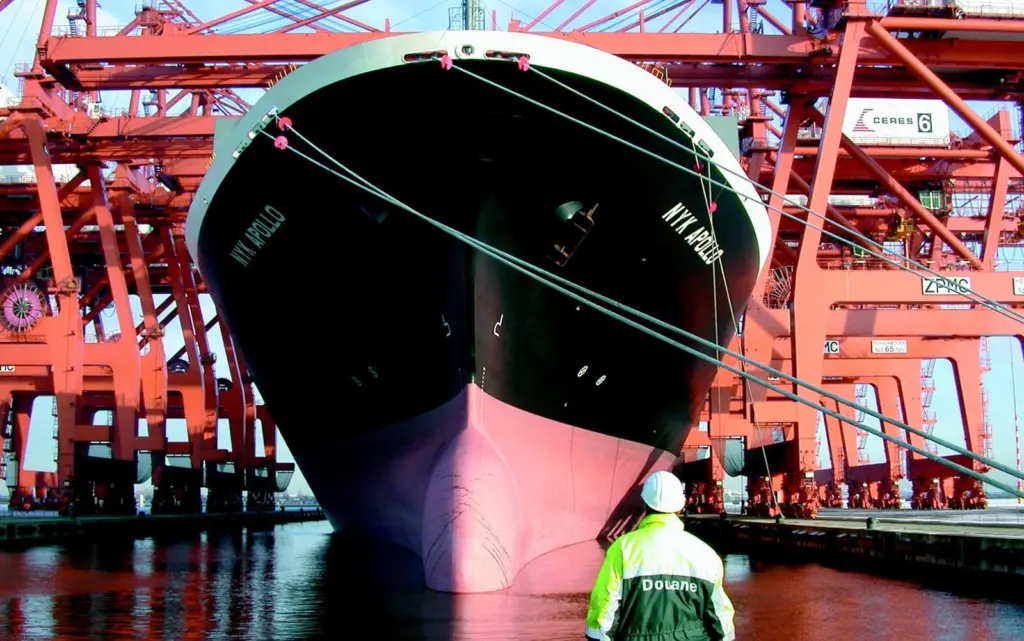
What precisely has pitched this subject into the foreground recently is not too difficult to fathom – namely, the growing resale activity in the terminal sector as epitomised by the resale of large terminal groupings such as those acquired by the Japanese shipping line NYK from the Ceres Group or by Hutchison from Hyundai Merchant Marine or the transactions that P&O Ports undertook in the USA to give it a strong presence along the US East and Gulf coasts. And today, of course, there is also the example of the resale of the CSX World Terminals group.
The development of a growing resale market in port properties, particularly in the container sector, is without doubt a primary driver for port concession agreements to address more closely the exit arrangements from concession agreements for the parties or party that originally signed up to an agreement. Indeed, this is an aspect that both sides signing up to a concession agreement – for example, the landlord port authority and an incoming terminal operating group – should consider more in-depth, not just the latter party.
Invariably, port authorities and other government agencies do not want to wrestle too much with the thorny subject of an early exit of an investor or group of investors from a terminal concession agreement, whether this is by transferring the concession rights to another company or by terminating the agreement. To introduce this subject at the time of what effectively amounts to the original contract negotiation still has, in many cases, something of a negative culture about it, even though recent experience is increasingly telling us that it really does constitute good business practice and corporate governance.
It also has to be acknowledged that it is not only the port resale market that is generating such a requirement. There continues to be, for instance, failures in terminal operating concessions, including high profile ones such as the failure of the Ceres Paragon Terminal to meet its payments to the Amsterdam Port Authority prior to the Ceres Group’s takeover by NYK of Japan. NYK, in turn, has, of course, recently decided to put this terminal up for sale following its inability to attract any major customers and thus it also stands today as an example of the growing port resale activity – and yet another signpost to the need to address exit arrangements under the terms of a terminal concession agreement.
LEGAL FOCUS As Lloyd-Williams points out, from the port authority’s or government’s point of view, the main reasons for private sector involvement in port activities are: the injection of capital; technology transfer, improved working practices/efficiency, upgraded and expanded services generally, and increased entrepreneurship and innovation.
It is a fact of life, however, that the various bid criteria that port authorities, government treasury departments and other involved public agencies lay down when it comes to selecting an inward investor do not always result in the best investor being selected at the end of the day. The kind of “tick this box” criteria to see who qualifies to bid on and potentially win a concession, is a long way from appreciating the nuances of the different investor profiles, and ports that go that extra mile to understand these are in reality few and far between. Hence, there is normally always some degree of risk attached to signing up any incoming investor and this in itself is yet another reason for public bodies in particular, to consider the aspect of exit arrangements and frankly not to be “touchy feely” on this important subject.
And all the more so when it is taken into account that container terminals in particular now have a much higher average investment requirement than even five years ago – as the container system has scaled up so have investment requirements commensurately.
Lloyd-Williams, who together with his team at Norton Rose has the reputation of being one of the leading lights in port transactions, summarises in legal terms the position as regards exit arrangements as follows:
THE PORT AUTHORITY/PUBLIC AGENCY STARTING POSITION Prohibition on transfer of the concession or possibly even assigning by way of security Prohibition of granting security over land Prohibition of change of control of the operator He further observes, however, that against this stance:
Financiers will want assignment of contract as security (if possible), incorporating the right to step in and replace the operator, and Operators will want the right to sell down all/part as soon as possible.
In effect, he suggests that at this stage there are varying positions and it is through sensible negotiation that a mutually agreeable compromise is reached. And in this respect, he offers the following as the “usual position” while acknowledging that every agreement will have bespoke aspects and reflect national characteristics:
USUAL POSITION Assignment of concession Prohibition on transfer of interest for at least a period Possibly transfer after a period (e. g. 3/5 years) Possibly incorporate a buy-back option for the port authority/public agency Possibly, and if the project is a greenfield site being bank financed probably, agree a financiers’ step-in right and the right to appoint a replacement operator.
Lloyd-Williams adds, however, that in the latter respect port authority consent is usually required to appoint a new operator and the criteria of what is a reasonable course of action can come into play here.
He further notes, at a practical level, that experience shows that where the document governing the terminal concession is a fairly unsophisticated one, that it may be possible to transfer the interest upstream without any consent being required – for instance, it is believed that this is the case with certain Chinese terminal concessions.
There are also, in his view, relevant so-called satellite issues that can be worthwhile considering in conjunction with exit arrangements, usually measures designed to release funds to the shareholders in a concession agreement, for instance, through a flotation of the operating company on the local stock exchange or via use of securitisation, a bond issue or a refinancing.
MESSAGE CLEAR The message is clear. The changing nature of the private sector port business, and as part of this, increasing resale activity in particular, warrants increased attention to exit arrangements from port concessions.
It is probably the case for example, that certain host port authorities to the CSX World Terminals’ concessions are now considering this aspect and at least in one or two cases probably wishing that they had paid more attention to it at an earlier stage!
Generally, it is not the case that the legal architecture will seek to prevent what amounts to a business being handed on from one party to another, it is simply that proper attention to this aspect at the time of the concession agreement being formed can provide a properly structured framework for this to take place in without all the problems that come with the “too little, too late” syndrome.
Lloyd-Williams therefore, as part of a wide-ranging speech on port concessions, highlighted a very useful area of contemporary challenge when he spoke on this aspect on behalf of Norton Rose at the recent MedTrade Conference.
Related Articles
 CONCESSIONS & INVESTMENTS
 PORT & TERMINAL NEWS
 INSIGHT & OPINION