


New Zealand: Whither ports after mergers?
Merger and acquisition activity has left New Zealand’s main container ports facing months of uncertainty.
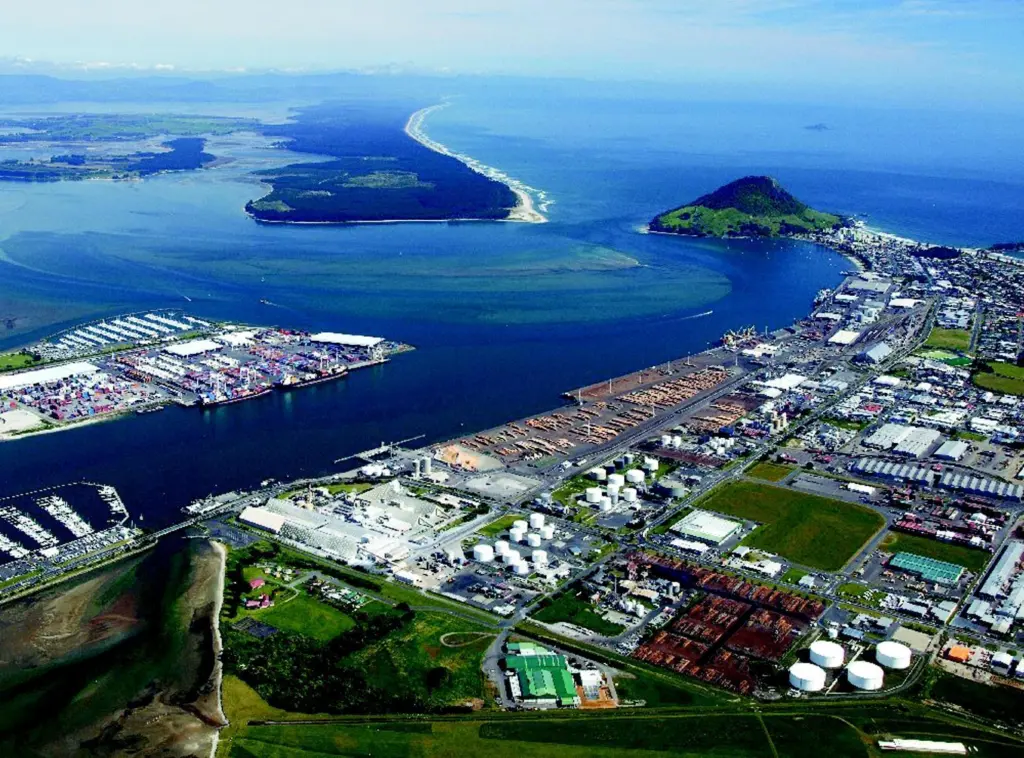
That uncertainty is not just as to what levels of shipping services they will see through their terminals, but even as to whom their customers are likely to be.
Undoubtedly, the major cause of change will be the merger and acquisition activity in the container sector where Maersk’s takeover of P&O Nedlloyd and the proposed Tui (Hapag-Lloyd) acquisition of CP Ships, has huge repercussions for NZ trades.
P&O Nedlloyd has the greatest spread of involvement in the diverse NZ trades, and its historical connection through to the UK and Europe is emphasised by its cornerstone position in the NZEuropean Alliance’s “Eastabout” string, featuring 4,100TEU vessels.
Seven of the ten vessels in that trade carry P&O Nedlloyd’s colours – until February. Then, the NZ-European Alliance will be no more in its current form, the vessels will no doubt carry the sky blue of Maersk, and they will form part of an as-yet-unknown service string operated by the Danes.
So the NZ market, and the ports, will be facing up to a situation where the largest shipping service provider and the largest independent will be one. This will not just affect the NZ-Europe trade, but those to the US East Coast, Australia, Asia and others.
The commercial repercussions for NZ ports with a major exposure to both Maersk and P&O Nedlloyd – for example Auckland, Tauranga and Napier – are severe. The merged carrier will command significant aggregated cargo volume and will therefore have, from day one, greatly-increased bargaining power. As the ports scramble in competition for the service strings that the new Maersk will decide upon, they know already that they will be asked to trade increased cargo throughput in exchange for reduced margins.
In some cases, they will fear losing out altogether. P&O Nedlloyd was in the throes of influencing a review of port selection between the incumbent Auckland and the pretender Tauranga for the 4,100s prior to the Maersk bid. Many felt a switch to Tauranga was a real possibility. That has been put on hold pending the takeover but it will certainly come up for review when Maersk has put a new management team in place. Both those ports have a lot of chips on the table at present, with no certainty as to how Maersk will play its cards.
FURTHER PERPLEXITY The Hapag-Lloyd takeover of CP Ships (assuming no late counter bid from CMA-CGM) adds to the perplexity for the NZ ports. Here we have the No 3 line (in terms of exposure to NZ trade lanes) being commandeered by a player with important niches in the NZ markets, for example with meat shippers to Europe.
Once Maersk pulls P&O Nedlloyd out of the Alliance, the rest of the Alliance partners have to decide what kind of service strings to cobble together, not only to protect their market shares but also to offer a competing service to whatever Maersk rolls out.
The trouble is, these carriers are perhaps left in a reactive position, having to wait to see what service strings and port calls Maersk puts up, before cementing their own ideas in place. If they are reactive, then the NZ ports are still further down the pecking order. They have to negotiate with Maersk, Hapag-Lloyd and the remaining Alliance partners, knowing they are dealing with a set of hypotheses that probably will not start to clear until nearer Christmas.
The irony is that this is all happening in a situation where acquisition activity has changed the face of NZ ports in another way. The acquisition of Ports of Auckland by its major regional government authority shareholder means the port is no longer a listed company on the NZ stock market. It still, however, has a brief to act in a fully commercial manner.
Meanwhile, the largest NZ exporter, Fonterra, has just opened its huge distribution centre in the Waikato region, midpoint between Auckland and Tauranga, and is waiting to see how the carrier mergers pan out, before pursuing its strategy for longterm collaboration with rail, its shipping providers and a chosen main export port.
Everything, though, is on hold while the notice is being worked out on existing shipping contracts, and while the new power blocs decide their next move. Which leaves NZ’s container ports facing months of puzzling uncertainty.
Related Articles
 WORLD
WORLD
 PORT & TERMINAL NEWS
 PORT & TERMINAL NEWS