![PortStrategy[GreenPort]](https://www.portstrategy.com/wp-content/uploads/2026/09/PortStrategyGreenPort.svg)


No summer of love in europe
A combination of system congestion further aggravated by strikes present a challenging scenario for container ports in the Hamburg-Le Havre range. AJ Keyes assesses the situation and what the rest of 2022 will bring.
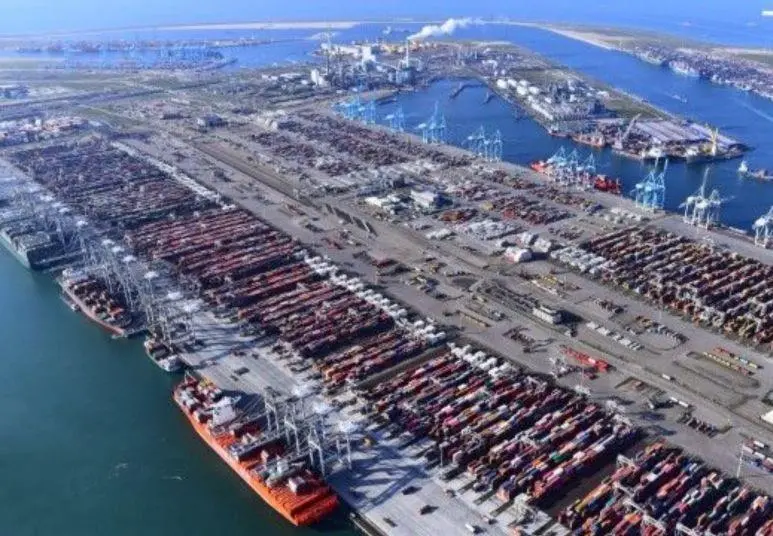
The North Continent port region is well established and remains a key element in Asia-Europe liner schedules, but if the ports thought the position would return to normality quickly after COVID-19, they were very much mistaken. There are now challenges with system congestion and industrial unrest, with the latter brought on by a growing energy and cost of living crisis. Add in strong competition from DCT Gdansk, collapse of the Russian feeder market and uncertain UK traffic flows then there is certainly, no “Summer of Love” for the container port industry in this port range. So, can the major ports recover, and if so, over what timeframe?
While ’Heavyweight hurdles’ addresses the position in more detail for German ports, notably Hamburg (plus a consideration of the development of DCT Gdansk), and ’MSC Going Large in Le Havre’ cover the Antwerp & Rotterdam issues (with the expansion of Le Havre included), the recent and ongoing challenges being faced can be summarised as follows.
The importance of the Hamburg-Le Havre port range in North Europe is undeniable to the container industry. It drives demand on the Asia-Europe container trades, which services the largest vessels in operation on a global basis.
This port range is not a single market but instead a series of intersecting markets, hence French ports compete with Antwerp and (to a lesser degree) Rotterdam for northern French cargoes and Antwerp and Rotterdam directly compete for local and transit markets to the Ruhr and southern Germany. At the same time, German ports are competing for domestic cargoes with Rotterdam and Antwerp, with DCT Gdansk also now of note.
Figure 1 over the page provides a summary of the location of the ports in this region.
THE BIG THREE
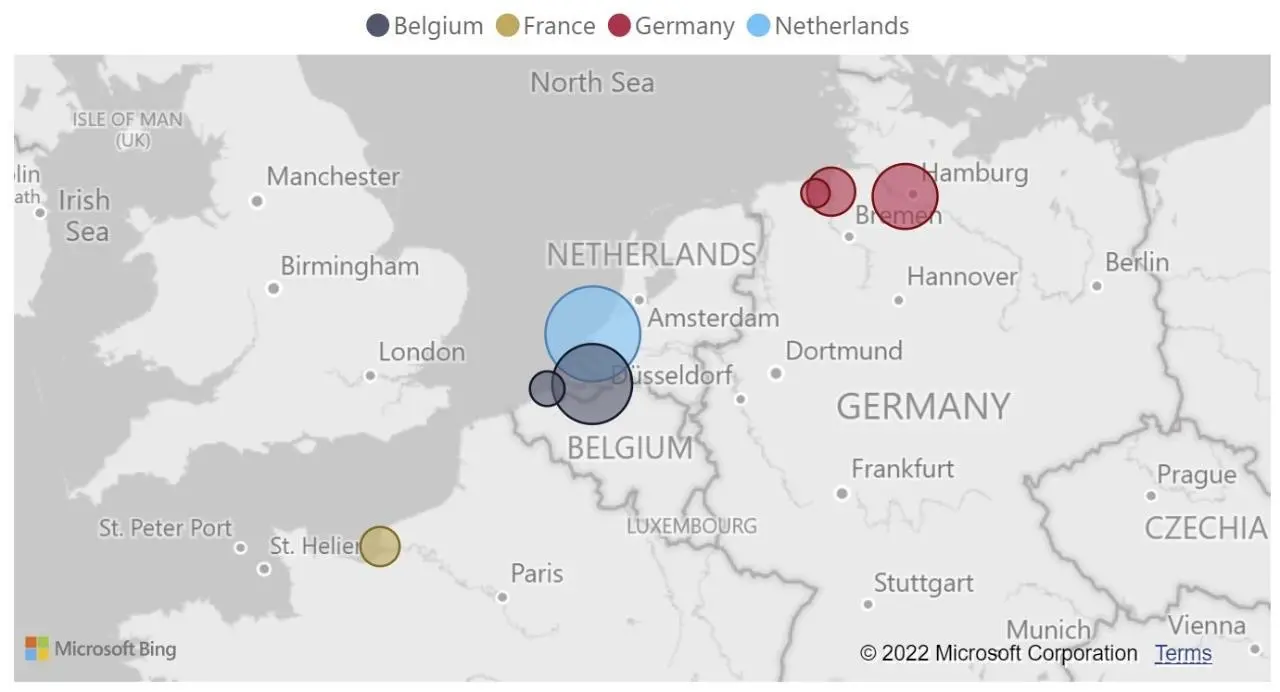
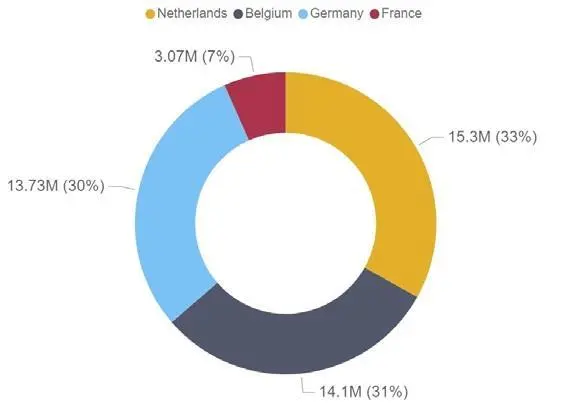
Figure 2 offers a summary snapshot of total container volumes by country, for facilities included in this competitive port range. It can be seen that between Belgium, Germany and the Netherlands there is a reasonably consistent split, with little difference between the 30 per cent retained by German ports up to 33 per cent by the Netherlands – with Belgium sandwiched in between the two on 31 per cent – making up the “Big Three” container port volume countries.
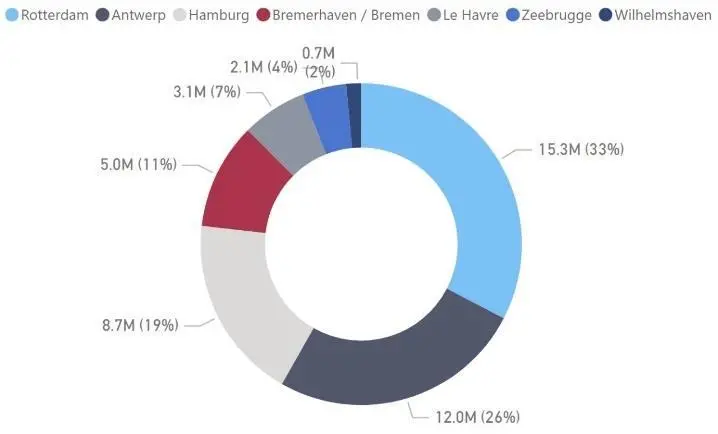
A tough 2022 is underway for the major ports in the region. For H1 2022, Rotterdam handled 7.3 million TEU (down 6.2 per cent on H1 2021), with Antwerp seeing 6.8 million TEU (down 4.4 per cent), although Hamburg did manage to record a 3.3 per cent improvement to just under 3.2 million.
A recent trend in the region is the use of secondary ports – ports traditionally less favoured on liner schedules – such as Zeebrugge, Le Havre, Wilhelmsen etc. which are benefitting from port congestion elsewhere. They are, however, unlikely to maintain this position when current logistics problems are resolved, and “normal” conditions re-emerge. These ports are included in the assessment on subsequent pages.
“WARNING STRIKES” HIT REGION
The largest container volume ports of Rotterdam, Antwerp and Hamburg are all major hub operations, with consistent and steady trades/liner calls and significant investment by the shipping lines.
So, while the make-up of this port market is well-established, how have the different facilities in different countries fared over 2021-2022 and what are each expecting moving forward?
Since July 2022 there have been “warning strikes” in German ports by 12,000 dockworkers, which shut down terminals in Bremerhaven, Hamburg and Wilhelmshaven, while a one-day national strike in Belgium impacted operations at Antwerp as unions in the country are seeking better pay and increased investment in the public sector, and similar industrial action was seen in France.
Any planned strike or industrial unrest is against a backdrop of persistent congestion across the North Continent region which continues to delay ships. One shipping line executive, who did not wish to be named, elaborates: “After the lifting of Shanghai’s two-month lockdown and with the peak season then upon us, the last thing the industry needed were continued bottlenecks across the logistics supply chain. Little relief was expected, and this is exactly what has been occurring.”
From a port perspective, the perennial subject of poor vessel schedule reliability on the Asia-Europe trades remains a concern and an influencing factor here. Current indications from specialist information supplier, Data&, is that for Q1 this year average delays for late-running vessels was up to 10 days, with little change expected for Q2.
While the German port strike situation has recently been resolved, the Europe-wide discontent has spread to the UK, with port strikes in Felixstowe and Liverpool either planned or ongoing (at the time of writing, end of August 2022). This is of relevance to North Continent ports, notably Antwerp and Rotterdam, who serve the UK market via regular, daily, transshipment feeder services. This latter trade route is the subject of detailed analysis in the article, Brexit: UK Trade Impact Unfolds.
Related Articles
 EQUIPMENT
 OPERATIONS
 OPERATIONS