




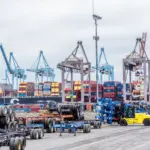

Port and terminal insurance
Ports are happy to play it safe when it comes to insurance choices, reports James Brewer

An island of stability in an ocean of financial turbulence: that is the comforting image that has emerged of relationships between trusted insurance providers and their ports and terminals customers.
Many corporate entities may wish to bash the bankers for their reckless attitude to risk, but overwhelmingly they look more kindly on the performance and security offered by their insurers and brokers, many of whom are based in London.
A series of natural disasters and instances of operational carelessness mid-decade evoked fears among port authorities that they might face a steady rise in premiums. Two factors came to their rescue: the first was the late 2008 downturn in trade, which cut the movements of cargoes and slowed ship speed and activity; and more importantly, the persistence of competition in the insurance market which reined back any pressure on rates.
Capital which might have been deployed for more grandiose investments is finding those other avenues scarce, so it is being parked in the insurance sector. “There is over-capacity, and that is creating a lot of competition,” admits one London underwriter.
As expected, the throughput of insurance business has reduced over the last 12 months, but there is a feeling among insurers that it will pick up during 2010. Rates are unlikely to undergo any dramatic change during this year, and clients could even win slight reductions if they can demonstrate continuing good risk management on the quayside.
Prices will only begin to stabilise when capital exits the sector, or when there is a nasty surprise such as a hurricane inflicting damage on a big port, an event of the type we were mercifully spared during 2009. In fact, it has been a relatively benign year for claims, especially in Europe and North America, although a severe tropical storm named Ketsana in September 2009 hit the Luzon province in the Philippines, and an earthquake in Indonesia and typhoon Melor in Japan the following month caused chaos in their respective areas. Reinsurers of property/casualty business as a whole enjoyed a stable 2009, with insured losses globally totalling just $24bn. In 2005, Hurricane Katrina alone had cost $70bn.
A slightly more remote possibility that could lead to premium hardening is defections from the market as a result of too many underwriters getting involved in areas with which they are not too conversant. There are said to be some who are looking to pull out of the sector, but others are weighing up the sector as an opportunity, eyeing the prospective margins on the premium.
The comfort factor is looming especially large this year. This was reflected by the experience of the major mutual, the TT Club, which is entitled to evaluate as pleasing the level of retention of clients and flow of new business in January, which is a key date for policy renewal by many of its members. For the last decade, the club has each year retained well above 90% of its members, a result said to reflect the degree of consistency in its service. Although the TT Club is a key participant, this is not a complete market picture, because many of its competitors will be discussing renewals with their clients at different points of the calendar.
It seems that although a lot of business is being marketed by risk managers as part of a review of their insurance arrangements, to date there is not a great deal of movement of accounts from one insurance structure to another. That is a trend that lodged into place over the whole of last year.
There was nothing as exciting as the 2008 changes, under which Hutchison Port Holdings transferred its property and its liability cover from the TT Club to two separate syndications of Lloyd’s and London operators, while the club by mutual agreement parted company with the huge property book of DP World.
Given the consolidation at the top end of the ports sector, the TT Club realised that the kind of global property programmes needed by such players were better met by the ample capacity of the big insurers than by a niche marine insurer.
Largely because of the insurer’s close attention to claims servicing there is usually an ongoing friendly relationship between underwriter and client.
“I think the market is very supportive of the port and terminals business,” says Julien Hubbard, a director at broking house Tysers. “Underwriters have a far greater understanding now of the ports and terminals industry and their requirements. Therefore if a port suffers a major loss or several large losses in a 12 month period there is not a knee jerk reaction of applying a significantly large increase in premium, but an attempt to help resolve the problem and work together with the port operator to this end.”
Brokers are pleased that there has been growing awareness of port safety issues. For instance, a short time ago the TT Club, the Port Equipment Manufacturers Association (PEMA) and ICHCA announced a joint initiative to establish minimum safety standards for quayside container cranes.
Although the TT Club has pulled back from major global property programmes, which in any event some say are under-priced, it still has a keen interest in covering property. Brian Wood, underwriting director for the Thomas Miller-managed club, says: “We continue firmly in the area of providing port and terminal property and handling equipment as part of our insurance package.”
Many in the insurance sector worry over cost-cutting in employee training, and equipment maintenance, which translates directly into increased exposures. Over the next couple of years, the threat will increase as these ‘economy’ measures flow through, fear underwriters.
Meanwhile, much work still has to be done on the terminal problem of theft. Mike Davies, chief executive of the Singapore branch of AXA Corporate Solutions, and chairman of the cargo committee of the International Union of Marine Insurance, is concerned about the accumulation of value in cargo losses from warehouses and land transport, resulting from the amount of trade in high-tech goods. Violence is being more frequently used against warehouse-keepers and other personnel.
The TT Club’s reduced exposure to large property accounts has been balanced by an increase in the numbers of transport and logistics companies on its books, especially in the US and Europe, including some business that a while ago it might not have expected to be able to win from competitors. In addition, two of TT’s most aggressive competitors during the last five years have recently left the logistics insurance sector.
During 2009, the TT Club reduced its cost base and restructured its reinsurance, and it is viewed in the market as having taken a more aggressive stance. Meanwhile, Mr Wood says: “My perception is that the economic downturn has re-emphasised the desire for more certainty in terms of the insurance purchase. We feel that, in particular, the small- and medium-sized operation tends to stay with us on the back of the club’s reputation for paying claims and giving assistance when members have difficulties.”
Among competitors at Lloyd’s, there is little enthusiasm for writing risks 100%, given the scale of potential loss. There is a lot of comfort for such insurers in having others subscribe to a large percentage of the risk in order to absorb claims more easily.
Another point of reassurance for port clients is that there are many familiar faces in terms of the personnel underwriting in this niche sector, both at Lloyd’s and in the London and international markets. People may switch companies, but they stay in the market.
Related Articles
 CONCESSIONS & INVESTMENTS
 PORT & TERMINAL NEWS
 INSIGHT & OPINION