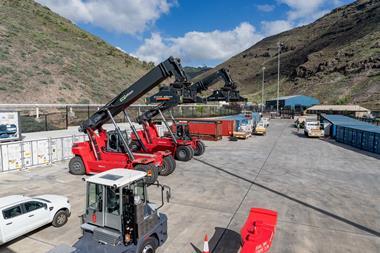


The port tyre sector is growing in importance off the back of the expansion of terminal infrastructure, increased automation in material handling and the growing demand for durable and long-lasting tyres.
SECTOR ANALYSIS: SMART TECHNOLOGIES, RESILIENCE AND SUSTAINABILITY ALL RISING IN IMPORTANCE IN THE TYRE MARKET
The port tyre sector is growing in importance off the back of the expansion of terminal infrastructure, increased automation in material handling and the growing demand for durable and long-lasting tyres.
Research and Markets Port and Industrial Tires Business Research Report 2024-2030 says other market drivers supporting growth include: “the integration of smart tire technologies, such as sensors and predictive maintenance tools”. These themes can clearly by seen in the company-by-company profiles below, from the deployment of AI to Continental’s ‘smart port evolution’ which includes digital tyre solutions at the heart of this. The new products detailed below also highlight the importance of an increase in tyre life and enhanced durability.
The report singles out the increasing use of recycled and re-treaded tires, which further expands market opportunities for sustainable solutions. The use of sustainable materials within tyres is another strongly growing theme, with new developments including the development of renewable material (see below).
Research and Markets’ report forecasts that the port and industrial tyres business is expected to reach US$7.1 billion by 2030 with a CAGR of 3.9 per cent.
EFFICIENCY, SUSTAINABILITY, AI AND SMART SOLUTIONS TO THE FORE
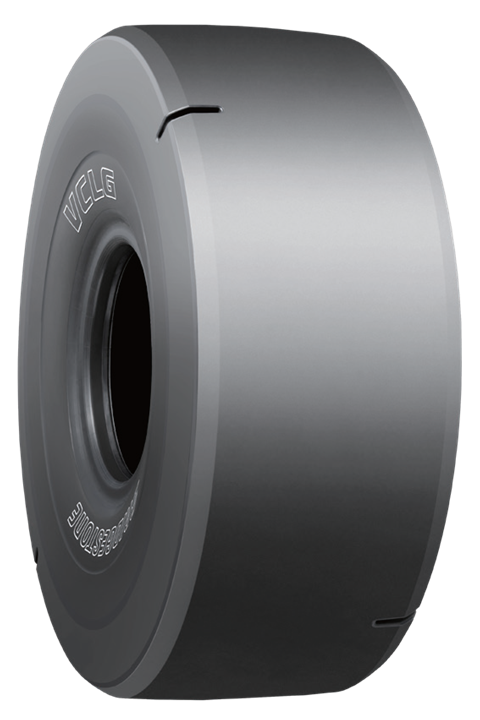
Bridgestone Americas: The US company has launched a new tyre for reach stackers that is says delivers better heat resistance, more load capacity and extended life. The new Bridgestone V-Steel Container Lifter G-Smooth (VCLG) 18.00R25 is the company’s latest smooth tyre in port operations. It has been designed with a three-star rated casing structure providing six per cent more load capacity and enhanced durability. The company says that it has a 20 per cent longer tyre life - courtesy of its deeper tread - realising enhanced productivity and long-term cost savings. Another feature is its increased resistance to tyre heat generation caused by heavy usage in severe operations. Rob Seibert, President, Off-the-Road, US and Canada, Bridgestone Americas, said: “Given the unique conditions of the port segment, the VCLG has been specifically designed to meet the demanding needs of reach stackers, keeping operations moving.”
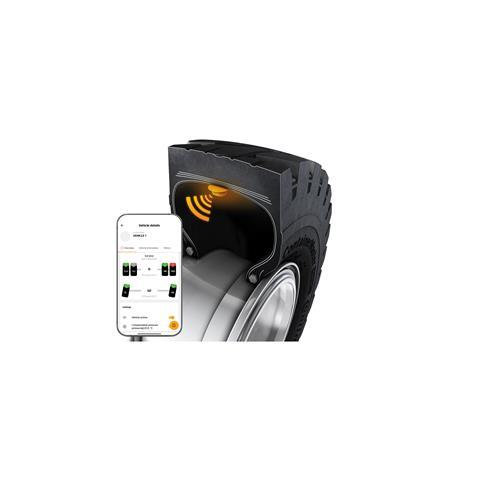
Continental: This Germany-headquartered company used TOC Europe 2024 as a platform to advocate for a digital transformation in port operations and present tyre and digital technologies that fulfil its vision of “Smart Port – Better Flow”. Federico Jiménez, Head of the Port Operation Tires Business Field, Continental, explains: “We firmly believe that digital solutions – seamlessly intertwined with high-end tire technologies – are the key to sustainable ports. We are committed to supporting this smart port evolution with a portfolio that combines adaptability, efficiency and environmental responsibility.” Continental notes that for the first time, it has presented a complementary digital solution portfolio unique to the port segment, consisting of tailor-made scalable solutions suited to different applications. These include ContiConnect, the fleet management platform for large port operation fleets, which has now been equipped with Bluetooth-enabled sensors, and ContiConnect Lite, a leaner, free-of-charge version for mobile devices that does not require any additional hardware other than a Gen2 tyre sensor. There is also Continental’s new entry-level solution: the new Valve Cap Sensor for efficient tyre pressure monitoring and which offers easy installation directly at the tyre valve.
Recent uptake: Continental has been chosen as the preferred supplier for Maritime Transport’s UK rail and freight terminals through Continental’s strategic service and distribution partner, T&C Site Services. To coincide with the switch to Continental rubber, Maritime Transport also began trialling the ContiPressureCheck tyre pressure monitoring system (TPMS) on a number of its machines. On the back of this, approval was gained for a full-fleet installation.
Magna Tyres: The company has launched the Magna M-STACKER, aimed at reach stackers, empty container handlers, and heavy-duty forklifts. As the successor to the Magna MB01 and MB01+ tyres, the M-STACKER is designed with improvements that optimise durability, performance, and operational efficiency. Offering 25 lugs, three more than its predecessor, the Magna M-STACKER provides superior resistance to heat build-up, which helps significantly reduce the risk of overheating during intensive operations. Another key feature is it employs a higher percentage of natural rubber in its composition, which lowers internal heat generation. “This improvement not only extends the tyre’s lifespan but also ensures better performance under continuous heavy loads,” Magna Tyres underlines. The M-Stacker has been engineered to deliver up to 32% more operating hours compared to the MB01 and MB01+ tyres. A wider tread ensures more even wear, reducing the overall degradation of the tyre. In testing, the M-STACKER maintained 60% tread life after 2,260 hours of use, which is a “significant improvement over its predecessor”. With two additional plies on each sidewall (increasing the total from 20 to 22), the tyre offers 15% thicker sidewalls, resulting in improved stability and smoother operation under load. The Netherlands-headquartered company manufactures a range of off-the road and tyres for industrial sectors.
Michelin: Recent developments for the French company include MICHELIN Connected Mobility, which the company says provides fleet support for safer, more efficient and more sustainable operations. This focuses on four major thrusts: providing high-tech tyres; managing and optimising tire performance, access to fleet management solutions via MICHELIN Connected Fleet, which combines vehicle data with driver behaviour and access to a new, automatic predictive and alert maintenance solution - MICHELIN Smart Predictive Tire. MICHELIN Smart Predictive Tire simultaneously notifies fleet managers and service providers in the case of abnormal pressure, temperature or wear and tear. The solution also sends a weekly predictive maintenance report for tyres so vehicle downtime can be anticipated and prioritised, and to avoid multiple mechanical and tyre interventions. This new feature is enabled by MICHELIN QuickScan technology (automatic wear and tear diagnosis system), a TPMS pressure sensor to automatically check tyre pressure in real time and Michelin predictive algorithms to convert data into personal recommendations, adapted to each fleet.
Nexen Tire: South Korea’s Nexen Tire is boosting its AI capabilities with the implementation of its AI-based automated tyre product inspection system for manufacturing processes. The product inspection system is applied using machine vision technology, which analyses visual information through a camera. The system has achieved a defect detection reproducibility rate of up to 99.96%. It detects minute defects that human inspectors might overlook, thereby contributing to enhancing the quality of finished products. The company has boosted the system’s practicality by automating the entire process of AI training and application and has implemented a platform-based system, which it says marks the first such application in the tyre industry. The platform-based system enables immediate application to new factories or equipment. The company is also integrating XAI (eXplainable AI)-based design processes and 3D printing for mould production into tyre development. XAI analyses information including basic designs and key design variables, enabling it to maximise tyre design efficiency and propose the optimal structure and design that meets the requirements of tyre developers. A statement adds that it “leverages XAI-driven designs to create Virtual Tire Models, assessing product performance in virtual environments, thereby increasing accuracy and speed in tire development”.
Nokian Tyres: Finland’s Nokian Tyres is boosting sustainability after signing a development agreement that aims to add renewable material made from residue birch bark to tyres. The agreement with Swedish biomaterial science company Reselo AB is to further develop their renewable material Reselo Rubber as a potential new raw material in tyres. Reselo Rubber is a completely renewable material made from birch bark sourced from the residue of the global pulp, paper and plywood industry. The aim of the cooperation agreement now signed is to develop the material further to adapt it for commercial tyre production. “According to the initial laboratory tests we have conducted on Reselo Rubber, it has great potential to replace traditional fossil-based materials in tires. Furthermore, the material is not only renewable, but we believe it may also be used to improve the tire’s performance features,” says Heini Siekkinen, Senior Manager, Research & Sustainability, Nokian Tyres. One of Nokian Tyres’ sustainability goals is to have 50% of the raw materials in its tyres renewable or recycled by 2030.
Yokohama: The Japan-headquartered company announced in July last year that it had entered into an agreement to purchase the Off-the-Road tyre (OTR) business of The Goodyear Tire & Rubber Company. The OTR business provides tyres for the port industry among others. The agreed acquisition price is US$905 million. Yokohama said that the product line-up covers the wide range of OTR sizes, from smaller tyres with diameters of up to 25 inches to large- and ultra-large tyres with diameters of 49 to 63 inches. Yokohama said it expects the acquisition to provide the company with product development and production capabilities for large- and ultra-large tyres that it currently lacks. It added: “This acquisition will lead to further growth of Yokohama’s OHT business through synergies generated by the combined strengths of Yokohama and Goodyear’s OTR business in all areas, from the development of new products and services to manufacturing, sales, quality control, and ESG.” Goodyear said that pursuant to a Product Supply Agreement to be entered into with Yokohama, Goodyear will manufacture certain OTR tires for Yokohama at some of its manufacturing locations for an initial period of up to five years after the closing of the transaction.