



Singapore to start truck platooning trials
The Singapore Ministry of Transport (MOT) and PSA Corporation have signed agreements with two automotive companies – Scania and Toyota Tsusho – to design, develop and test-bed an autonomous truck platooning system for use on Singapore’s public roads.
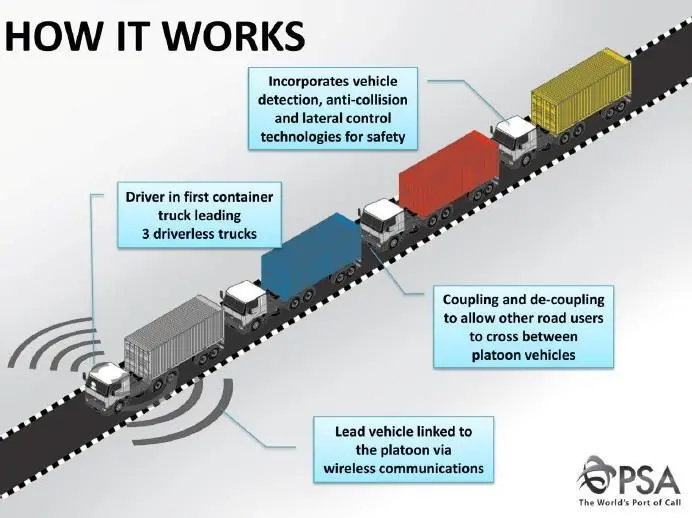
In the Singapore trials, the trucks will transport containers from one port terminal to another.
Mr Pang Kin Keong, permanent secretary for transport and chairman of the committee on autonomous road transport in Singapore, said that truck platooning technology presents the country with an opportunity to boost productivity in both the port sector and the trucking industry. It also opens up opportunities for truck drivers in particular to take on higher-skilled roles as fleet operators and managers, he added.
The truck platooning trials will take place in two phases over a three-year period from January 2017 to December 2019. The first phase, which will last for a year, will focus on designing, testing and refining the truck platooning technology to adapt to local conditions.
Scania and Toyota will conduct the trials in their respective research centres in Sweden and Japan. Depending on the outcomes of the phase one trials, MOT and PSA will then select one of the companies for phase two, which will consist of local trials and development of the technology in Singapore.
The trials will initially involve inter-terminal haulage between Brani Terminal and Pasir Panjang Terminals, and may eventually be scaled up for haulage within the port area, as well as between Pasir Panjang Terminals and Tuas Port.
Regional chief executive of Southeast Asia at PSA Ong Kim Pong added: “As PSA prepares for our future terminals at Tuas, it is timely that we move on to the next steps in developing autonomous truck platooning technology.
“I am excited by the progress being made, as it underlines our joint commitment to being future-ready, while also helping us continue to serve our customers better through fast and efficient inter-terminal container movement.”
Related Articles
 EQUIPMENT
 PORT & TERMINAL NEWS
 PORT & TERMINAL NEWS