



The big wave
Tidal energy can deliver bounties for open-minded ports, explains Stevie Knight
Wave energy technologies are growing up – and welcoming ports could find themselves with both an income and power stream. And it’s powerful. As a very rough rule of thumb, solar energy averages around 300W per m2 in southern Europe and again, taking a yearly average, UK wind (at 25 m) can give you 350W per m2. By contrast, wave energy reaching the UK averages out at over a hundred times that amount – somewhere between 30,000 and 60,000W per metre.
In fact the worldwide potential of the ocean energies is estimated at around 1.8 terawatts; further, it’s usually predictable and satellite forecasts can tell what’s coming three or four days ahead (unlike wind or solar energy), allowing the grid to manage supply and demand.
This combination of attributes could ramp up wave energy’s development, bringing with it a cash flow for a number of ports including those who simply weren’t in the right place to cash in on the wind bonanza.
In fact, wind and waves are quite often separate deals, says Chris Ridgewell of Helsinki-based AW Energy: “Take the UK for example: a lot of the wind energy is on the east coast, but on the west coast, we can see a lot of wave opportunities.”
Further, while offshore wind is well developed in Europe there’s been very little in the southern hemisphere and here wave energy looks like leapfrogging ahead.
It’s largely down to the bathymetry, explains Tim Finnigan of BioPower Systems (BPS): “One reason we don’t have offshore wind in places like Australia is because the water gets deep too fast, it’s not like Europe where you have many shallow areas that extend quite a long way from the coast… So in this part of the world, at least at present, near-shore wave energy is just more viable.”
Mixed blessings
But if a port starts asking what kind of characteristics might tip the balance in favour of one kind of facility or another – then it gets tricky. Contrary to expectation, the bountiful nature of wave energy is a mixed blessing: energy can be harvested at so many points along the wave that there’s a plethora of approaches (there’s estimated to be more than a couple of hundred patents in existence). So, although it’s fired up people’s imagination it has also put a stumbling block in the way of maturity.
Dr Finnigan says: “The fact that the devices haven’t consolidated yet is an issue, and it doesn’t help there are quirky ones popping up all the time. Wave needs to converge on just a few – maybe just one or two – proven concepts.” Interestingly, he adds “it does help that there have been some casualties”, explaining there needs to be a clear pathway forward before industry can get behind wave power and start to bring in economies of scale.
Despite the tumult, investigation yields a few thumbnail sketches of the future, and while some elements will call on the same kind of solutions as its wind forerunner there could and should be important differences.
Firstly, many designers including AW Energy are trying to avoid the steep deployment costs that have caught offshore wind in a painful, decades-long struggle to justify itself. Secondly, there are also maintenance issues to take into account – this last helped to kill Portugal’s Aguçadoura Wave Farm.
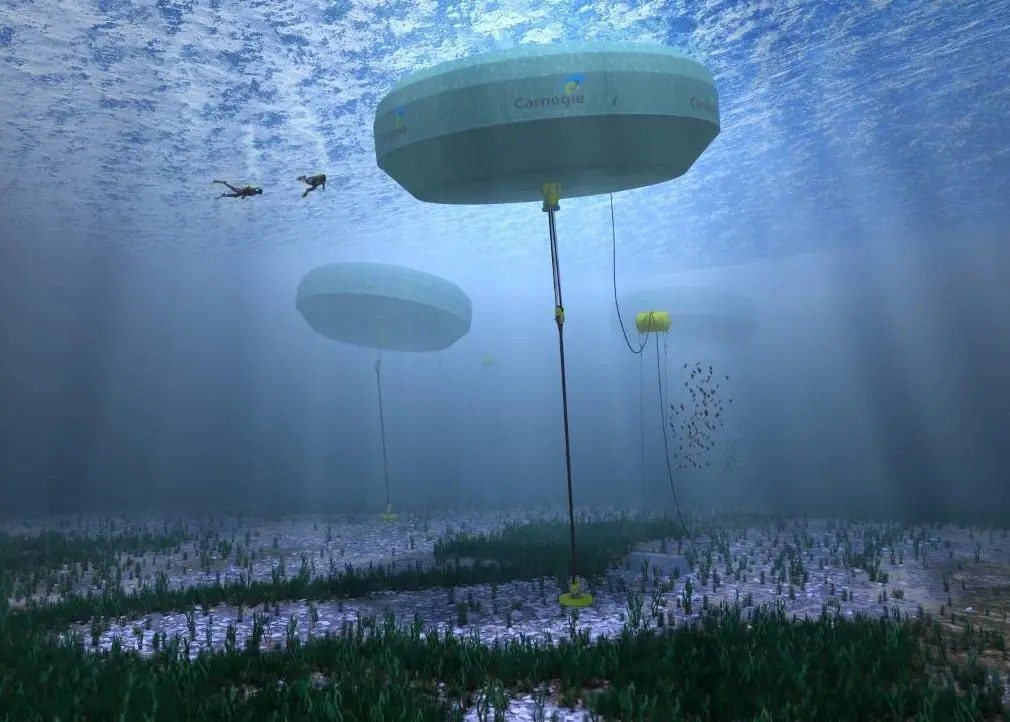
Therefore a ‘small is beautiful’ approach has been taken by a range of designs; wave riding solutions such as Protean’s Wave Energy Converter or Carnegie’s CETO buoy-like, relatively manageable components. Further, while the full size 350kW Waveroller is a subsurface panel around 18m by 10m, the main section is hollow which keeps the weight down.
Further, wave has an important advantage: “A lot of wave energy devices have a sweet spot: some of them, like ours, are in relatively shallow water within about a kilometre of the shore,” explains Mr Ridgewell.
As a result each element can be positioned by an offshore support vessel and dive teams. Even when it comes to stringing a number of the Waveroller devices together in a commercial array, according to Mr Ridgewell “you would probably only require a small jack-up, the same size that’s now being left behind by the wind industry, to gain efficiency”.
Therefore Mr Ridgewell sees technology of this size as gaining important buy-in from the port community: “You don’t need to bring in big, heavy-lift vessels or huge cable layers, and you will probably be able to use the local infrastructure and the local workforce,” he concludes.
Large scale
The full-size Biowave is a different proposition: while still positioned close to the coast it is around 25m high and 200 tonnes. Although the various elements can be dismantled for repairs, it still relies on sturdy quayside facilities during deployment. Therefore BPS has focused on Portland, Australia as no others had “the depth alongside, a sheltered area and a wharf that could support the lifting capacity of the crane”, says Dr Finnigan.
At this scale, wave tech deployment could prove a nice little earner: “We contracted a heavy -ift ship and made extensive use of the port for berthing, partly to avoid bad weather but also to prepare and assemble the equipment… and we are using the port to moor up our maintenance rig.
“Of course there are substantial fees attached to all this,” he says, adding Portland has already benefited from the berthing fees, pilotage, tugs and so on. “There’s quite a bit of involved in it all… Ballpark figure? Well it is in the order of A$100,000 so far.”
The port’s attitude is pivotal says Mr Ridgewell, even more so if the devices are still in the pilot stage. In fact, Peniche, north of Lisbon, has been home to two prototype Waveroller devices so far “and the warm welcome we’ve had has made a huge difference to us getting the devices off the ground and into the water… in fact just how willing the local industries are to support you can mean the difference between success and failure”.
He says that when it comes to commercial arrays just outside port areas, the benefits could point in both directions: “There are a lot of synergies… if you can take some of the pounding wave energy away from the infrastructure you potentially increase its longevity, plus local aquaculture can be helped if you knock out a bit of the scouring action from the waves. Ports require a lot of energy and they’re often a long way from the grid – so the provision of local power could also be an interesting element.”
WRAPPING IT ALL UP
Microgrids could be the ‘next big thing’ for ports, especially those distant from the domestic supply – or even those who need autonomy when it comes to other services, such as fresh water. For example, a couple of years ago Carnegie Wave Energy showed it was possible to use wave-riding buoys to power a desalination plant in Australia’s largest naval base, HMAS Stirling, on Garden Island in Perth.
But it’s possible to go much further: add a battery to stabilise the power and you have your own not-so-small energy ecosystem.
Recent developments should give even the naysayers pause for thought. Wave technology is ramping up; Carnegie’s latest CETO 6 machines have more than four times the output of the previous model and these will be able to deliver 1MW to shore.
Given this leap, a further deployment at Garden Island is looking to bring wave, solar power and batteries together; this should yield roughly 3MW of power for an investment of around US$7.5m including the control system and tie-in to the desalination plant. More, a CETO array in the Wave Energy Hub in Cornwall, UK aims to return 10MW or 15MW when completed.
However, it’s not all about the technology: Carnegie and partner EMC see the future as containerising elements like the battery array for easy deployment and delivering it alongside reasonably priced finance; the idea is to get to as close to plug-n-play as possible.
This, explains Carnegie’s chief executive Dr Michael Ottaviano, will overcome the usual barriers to entry that often stops remote areas from taking advantage of the very innovation that could help them break out of the low investment trap. According to him, scalability and affordability issues “can be overcome by an innovative, nimble organisation delivering an integrated clean power, water and financing solution” in one shot”.
Related Articles
 NEWS
NEWS
 CONTAINER & CARGO HANDLING
 OPERATIONS