



VICT cranes order
Victoria International Container Terminal (VICT) has invested in new cranes to help expand its capacity.
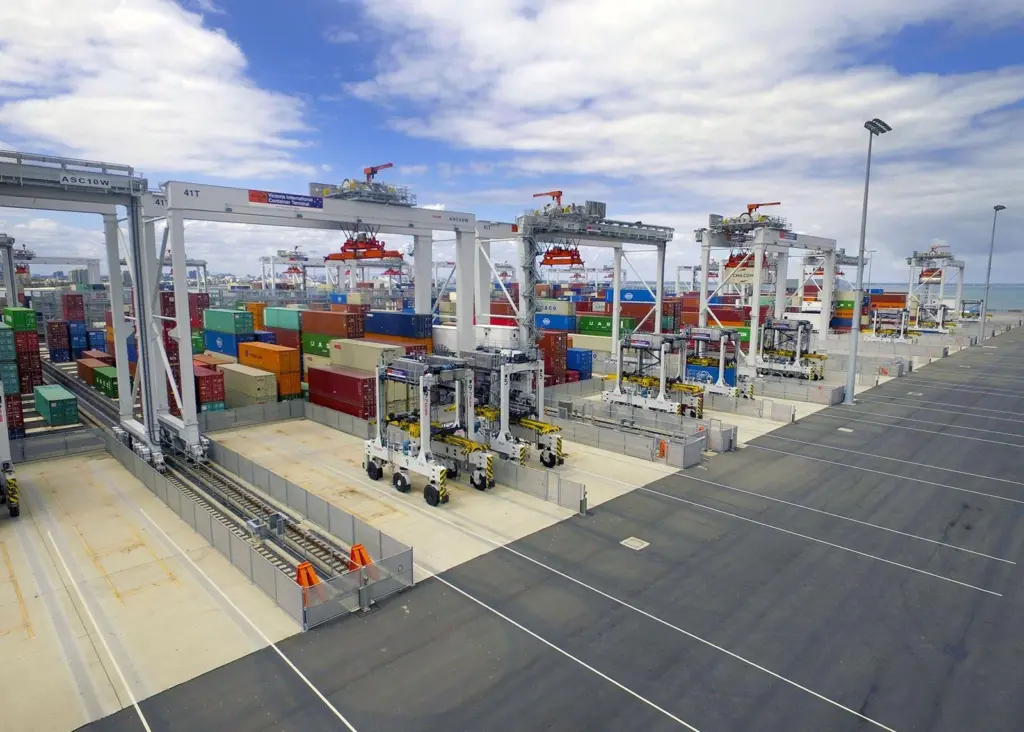
The ICTSI-owned terminal at Webb Dock East in the Port of Melbourne has made a repeat order for six Kalmar Automatic Stacking Cranes (ASCs).
Jon Wheeler, chief operating officer at VICT, said: “Kalmar solutions form the backbone of our operations at Webb Dock East. The yard capacity expansion and the new Automatic Stacking Cranes will allow us to increase the productivity of our operations to meet the growing customer demand on both quay and landside. The additional storage blocks will also add resiliency, allowing for improved planned maintenance, minimising disruption to our stakeholders.”
Australia’s first fully automated container terminal
VICT is Australia’s first fully automated container terminal which welcomed its first vessel in March 2017 and since then has handled the largest in capacity, longest in length and highest exchange within Australia in a single call. The 35-hectare terminal has a design throughput capacity of over a million TEU and is the only terminal in Melbourne capable of handling the largest container vessels.
The six new Kalmar ASCs are part of VICT’s capacity expansion program, and the cranes will join the current fleet of 20 Kalmar ASCs operating at VICT that have been delivering truck turn times of sub-35 minutes.
The cranes will be delivered fully erected and tested to ensure rapid, smooth integration into the terminal’s automated operations.
VICT’s automated operations are powered by Kalmar One Automation System – a complete end-to-end system that combines Kalmar automated equipment and a pre-integrated and tested software solution.
The OneTerminal deployment at VICT currently includes the recently upgraded Navis N4 Terminal Operating System (TOS), a Kalmar Automatic Stacking Crane system with 20 Kalmar ASCs, 11 Kalmar AutoShuttles, and the Kalmar Automated Truck Handling system.
Earlier this year, VICT ordered an additional six Kalmar AutoShuttles to be delivered by the end of this year, increasing their total fleet to 17 units.
Delivery is expected to be completed in Q2 2023.
Related Articles
 EQUIPMENT
 EQUIPMENT