




East Coast benefits
Industrial action and congestion at ports on the United States’ West Coast are pushing shippers to move instead to the east, says supply chain analyst, FourKites.
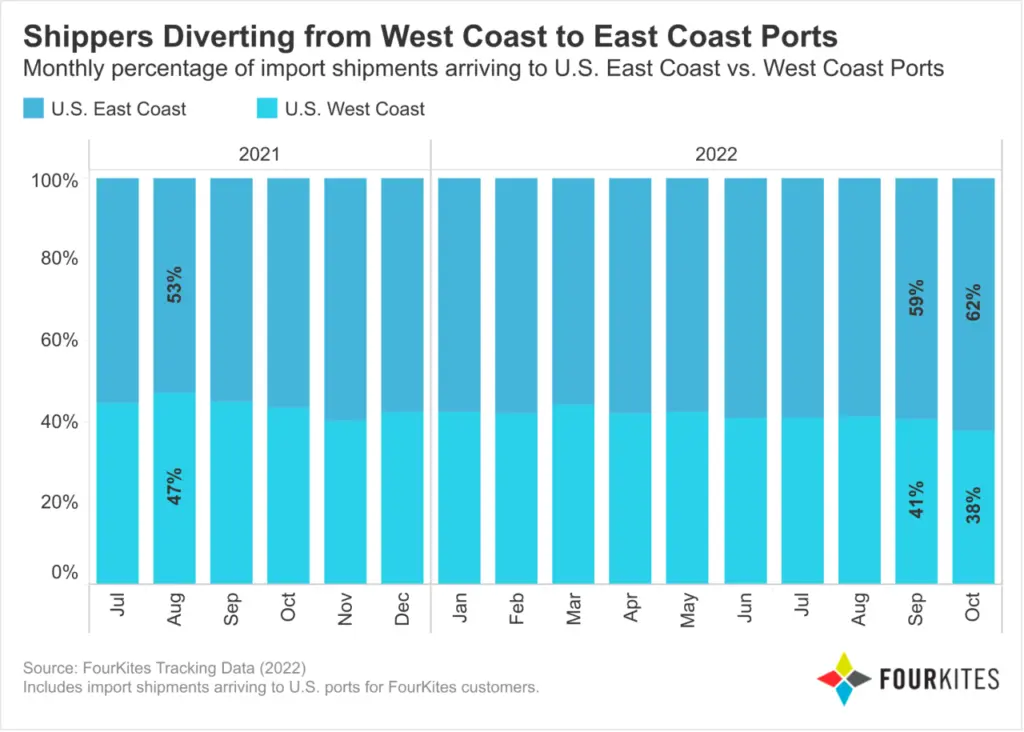
As of August 2021, West Coast ports, such as LA, Long Beach and Oakland, accounted for 47% of import shipments for FourKites customers compared to 53% for the East Coast.
Over the past several months, this proportion has been shifting increasingly towards East Coast ports, with the West Coast only accounting for 38% of imports compared to 62% for the East Coast. This is a 9% point drop in share over the past 14 months, and a 3% point decrease month-over-month.
Glenn Keopke, FourKites’ general manager of Network Collaboration, told Port Strategy that this trend may reverse next year.
“The conversion to more volume to East Coast ports will remain through the peak holiday periods but will re-balance out in 2023 as capacity, delays and shipping rates normalise,” he said.
“There is a trade-off with higher transit days and ocean freight base rates when shipping to the US East Coast ports. The on-carriage transport will have less transit and lower cost so the total transit and total landed cost are very critical factors.”
However, the move to East Coast ports may bring lasting benefits. “We anticipate more volume swinging back to the West Coast ports but many shippers and beneficial cargo owners will keep a diversified lane strategy so overall, this will help the East Coast ports,” said Mr Keopke.
Related Articles
 LEGAL, RISK & INSURANCE
 NEWS
NEWS
 PORT & TERMINAL NEWS