


Port Interface the Concern For New Zealand
It would be overstretching the point to suggest that New Zealand is facing a turning point in its ports and land transport development. But if some of the country’ s leading transportation ” thinkers” had their way, it would be.

The major issues, some would suggest, are the development of inland terminals in order to transfer freight more quickly from pressured marine terminals and congested roads; a rationalisation of major ports to trigger improved use of facilities; and encouraging greater freight volumes on to rail to achieve economies of scale.
In the wings lie somewhat connected but unresolved issues relating to the place that can be given to coastal shipping in the nation’s transport infrastructure, and particularly what level of Government support can be offered to that sector.
The port development issues New Zealand is facing are in themselves similar to those faced by other developed countries. International observers may find it surprising that a country with a population of around four million could be facing port congestion considerations. But New Zealand has several ports close to city centres, surrounded by high-priced residential land, with little scope for expansion without costly and environmentally-sensitive solutions such as reclaiming harbour.
Around the major city, Auckland, there is serious road congestion caused by a lack of investment in the road infrastructure over the last three decades which impacts on the delivery of freight to and from the marine terminal.
This has become more acute over the last decade as the population explosion of northern New Zealand has gathered pace, causing the Government to belatedly regard Auckland’s road congestion problems as a national priority. So much so it has promised a rapid injection of funds for improving roads.
Perhaps, if ship sizes and cargo exchanges had remained static, the lack of free-flowing traffic on port approach roads would not have been a major irritant. But as container ship sizes have indeed increased – the 4,100TEU vessels in the NZ-US-Europe trade being the largest – the future need for the transport infrastructure to handle greater ship exchanges in a narrow timeframe has become more acutely evident.
These issues mean that New Zealand needs to consider how it positions itself for the future, and particularly how it shapes its future logistics network. Greater efficiency and focused investment decisions will be critical.
If one looks at the issues at a micro level, specifically the solution to moving freight more effectively from the Auckland wharves, several critics believe that greater use must be made of inland terminals with short-haul rail feeders being used to affect the exchanges from the wharf.
One such critic, Simon Tapper, md of major wharf road haulage company and inland terminal operator Tapper Transport, believes Auckland must act now to set aside land, appropriate transport corridors and other infrastructure to allow for the establishment of one or more inland intermodal terminals. Failure to do so will have disastrous consequences for the port, region and the country, he says.
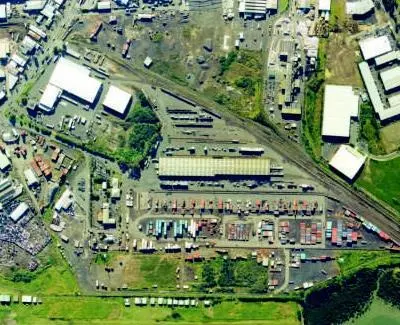
Tapper has a suggestion on how to solve the problem based on the creation of a major intermodal freight hub at Penrose in the southern industrial heartland of the city and adjoining the main trunk railhead that forms the outlet to the all points in the North and South Islands.
This hub, he says would be served by containers railed en masse direct from the marine terminal at the ports of Auckland, and would also act as the fulcrum for distribution to the major consumer demand points of the Auckland region. Penrose has good access to motorways and arterial road routes, excellent proximity to rail and empty container depots, and is distanced from residences (important when handling environmental noise control issues).
Also, it already has the Metroport facility operating from there, juxtaposed to the rail terminal. Metroport is the inland “dry port” established by the Port of Tauranga as a receiving and delivery point enabling it to compete head-on with Auckland for both import and export traffic. The facility is regarded as an extension of the port facility, with the port company controlling and paying for the 200km rail shuttle, and has been an unqualified success. It has reached a throughput of about 100,000 TEUs per year and is due for a third phase of expansion.
Indeed, that expansion is critical because the winning of ship calls from a Southeast Asian service at the start of the year gave Tauranga little time to adjust to the extra box volumes flowing through the facility, and there have been teething troubles handling the sudden rise. Nonetheless, Metroport has proved its point and Tapper is convinced a common-user replicate will help both the Auckland port operator and shipping companies facing an increasing need to move containers off the wharf to facilitate vessel turnaround.
Strategic Planning Vacuum at Government Level
Tapper’s visionary approach is not matched however by the existence of any official planning structure empowered to ring-fence this land so it is used for freight purposes. No body exists to conceptualise the long-term planning needs of the freight industry and pull together the different strands of sectoral interest. Currently, therefore, action being taken is restricted to “company-level” moves by bodies such as the Ports of Auckland itself.
It has created “microports” – receiving facilities in suburbs close to key industries, combating congestion and enhancing truck productivity by moving containers to and from the wharf at night. This also better utilises port-handling equipment. However there is a cost component for the wharf-to-microport move that has so far dissuaded importers and exporters from flocking to the concept en masse.
The real trigger for change may come when the opportunity costs of congestion start to amount to more than the cost of moving containers into the hinterland. What may bring that scenario closer to reality is pressures applied by carriers for port rationalisation. New Zealand reflects a mix of choices between carriers, some choosing to minimise mainline service calls to one or two ports and relying on land or sea feeders, and others choosing to call direct into regional ports because of their proximity to the primary produce that is still the backbone of the export trades.
This has encouraged regional ports to invest in infrastructure such as container cranes and reefer marshalling areas, and in a commercial sense most have attained a reasonable-to-good commercial return on shareholders’ funds. Some industry players however believe that for the national good of “NZ Incorporated”, port consolidation and rationalisation is an essential. Most vocal among these critics is Tony Gibson, managing director of P&O Nedlloyd NZ, who argues forcefully for a streamlining of port hierarchies into premier and secondary tiers in order to maintain the competitiveness of NZ exporters.
He believes port capex on infrastructure is duplicated around the country. Procurement too is duplicated (i. e. contracts with multiequipment suppliers, maintenance contracts, etc). This competition between ports leads to fragmentation of cargo volumes which prevents consolidation of exports into bigger parcels. If that fragmentation ceased we would have more economy of scale, but at fewer ports. Were this to happen consolidation at those fewer hub ports would allow for more focused investment. In return, one could expect better productivity and better service levels.
Gibson says the scene is set for closer relationships between major shippers, shipping lines and logistics suppliers. This will lead to fewer ports being chosen for major service calls, with containers being moved by a more streamlined internal infrastructure to hub ports. However, for Gibson’s argument to play out in full, more than pure carrier pressure will be needed.
A structural barrier to efficiency remains in the fact that dominant shareholdings in New Zealand ports are held by regional Councils, who would be loath to see their local port downsized in any way.
Local authority shareholdings were intended to be a “holding phase” during New Zealand reform in the early 1990s but most councils have held on to their shares because of the healthy dividend streams and also because control over the port operation is seen as having connotations for regional economic development. It is unrealistic to expect a regional Council to take, for example, the ultimate decision to exit a line of business at a port or even close it down or seek a merger, as it sees support for a local port as supporting local business.
Therefore it is up to the Government to enforce the intent of original reform by ensuring regional Councils divest their shareholdings.
Market forces would then allow merger and acquisition, and consolidation in the industry, leading to fewer main container ports and more specialisation. That seems unlikely to happen as Government sees forcing change as being in the “too hard” basket.
In the meantime, port and logistics efficiency improvements are being driven from different areas. One of the most important is the move into the New Zealand market by Australian group Toll Holdings which acquired the rail monopoly last October along with a significant trucking fleet, and has quickly moved to assert that it wants to market a strong integrated logistics policy. Infrastructurally, the policy looks good for the freight mover not just because of the prospect of higher service levels, but because of the imminent investment in improved track, rolling stock and rail container terminals. In a deal with the Crown, Toll is committed to capital expenditure on new locomotives and rolling stock (up to $26m) with the Government investing even more in track work.
At the very least, New Zealand’s land transport infrastructure looks destined for increased efficiency. It is the interface at the ports that remains the worry.
Related Articles
 WORLD
WORLD
 PORT & TERMINAL NEWS
 PORT & TERMINAL NEWS