

Tug Design Goes Hi-Tech in Search of Optimisation
Digitalisation is a driving force as tug manufacturers capture data from the tug’s operating performance to enhance design improvements and modifications.
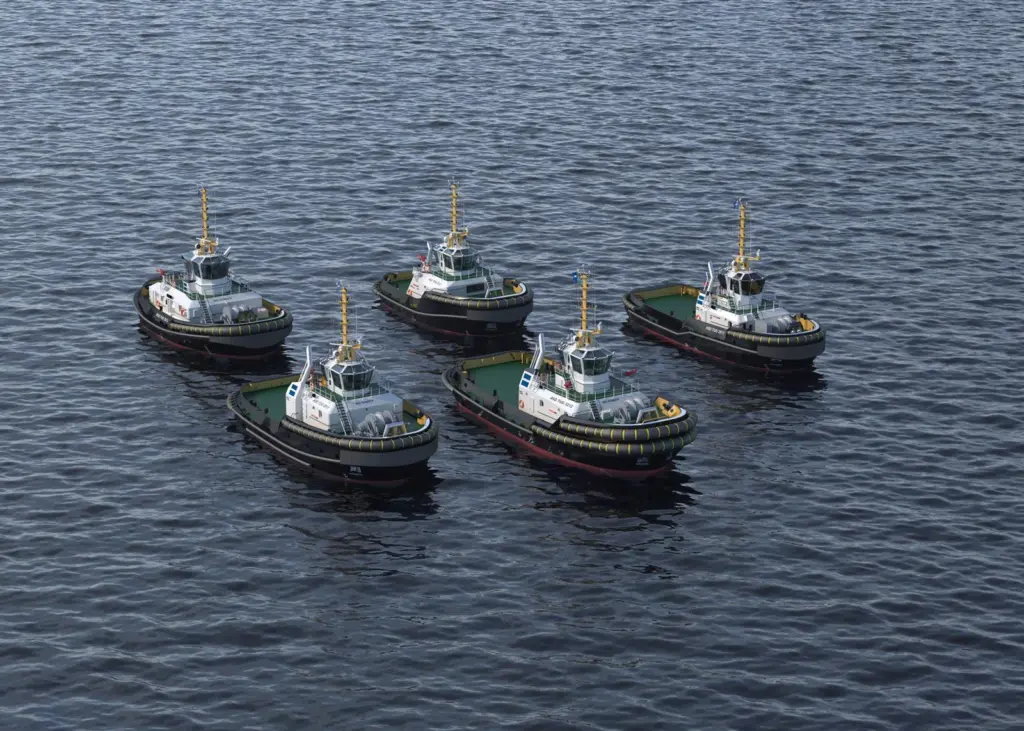
Performance optimisation is a key goal at a time when ships are getting ever larger but port constraints such as berths, turning circles and approaches remain fixed. So, manufacturers are using remote monitoring and other means to retrieve all digital data available on the vessel’s operation.
They make use of existing sources onboard, like the alarm and monitoring system, navigation and communication equipment and any additional systems onboard that generate data. Additional sensors can be placed for specific functionality.
Data is then used to optimise the design and improve the operational uptime for the client, such as a port.
The importance digitalisation has assumed is underlined by Arnout Damen, chief executive officer at Damen Shipyards Group NV, who says it is an ongoing development that is becoming more important to clients and to sustainability.
“We will build our ships cradle-to-cradle – all materials used will be usefully applied to another product after the ship is scrapped – and ensure it sails emission-free. Being able to digitalise is critical,” he confirms, before adding, “You need that constant flow of information about the performance of a ship to determine, for example, the optimally-economic and most-sustainable sailing speed and to plan predictive maintenance.”
Yet Mr Damen adds a word of caution too. “But digitalisation is also an economic law. Onshore operators can monitor multiple ships and solve problems remotely using virtual reality and artificial intelligence.”
For this reason, the group has established a focused digital platform called Damen Triton.
Damen says its goal is to put data to work in the areas of safety, sustainability and efficiency.
Sjoerd de Bruin, sales manager Asia Pacific explains further. “Initial focus is on fuel consumption, but also on the data that assists us to provide better after-sales support to our clients in case of a technical issue…furthermore, design parameters to improve our designs and be able to come with better solutions in the future are important.”
An example of data capture leading to design enhancements relates to the fuel consumption of the generators. For a specific harbour operation, the use of electrical shore power instead of the generator when the vessel is alongside the quay will save a significant amount of fuel, emissions and maintenance.
Predictive Maintenance
Mr De Bruin says predictive maintenance leads to more reliable assets. “This is a development that is ongoing in many different sectors and requires close cooperation with equipment manufacturers, since these are best aware of the characteristics and maintenance profiles of their products.”
In terms of next steps, he is also clear. “Context data is available through Damen Triton. We will slowly move towards new models like predictive maintenance and should carefully coordinate the steps that are needed to get there as feedback and historic data are needed.”
Addressing whether digitalisation can work in with automation, Mr de Bruin says it is important to ask, “Do we need to take care of this remotely, should it be available on board and/or can we automate this?”
In reply to the question, his response is clear about the issues. “It is most effective if you can automate certain aspects, but also most difficult. Directly feeding intelligence to the skilled crew onboard has different requirements and complexity than feeding it to people onshore. This is something that will evolve, where choices will be more and more based on desirability and technical feasibility will be less of an issue. An example is sending alerts to onshore personnel when the vessel is lying unmanned at the quayside, in case of a fire – the existing alarm and monitoring system is then combined with the functionality to send a text.
He adds that fully automated tugs working in major ports is still a long way off, with initial development probably being in remote-controlled tugs.
Voith is also focused on collecting data, detecting anomalies and seeking digital solutions, and has its own hardware on board, a CPU which collects a huge number of sensor data. These are then transferred to the Cloud.
Robin Wankerl, the group’s global market communication manager, trade media & market communication, says Voith has installed numerous CMS systems on tugs (content management software applications).
“This digital data is used to further improve the Voith Schneider Propeller (VSP). The load collectives obtained with the CMS are directly incorporated into the design process of new propellers. As a result, service intervals are extended and costs for the tugboat owner are reduced. The data is also used to further reduce fuel consumption and emissions of tugs with Voith Schneider Propellers. With the aid of the digital CMS data, the VSP operation is further optimised, i.e. the optimum RPM and pitch is recommended to the captain.”
Motion data such as ship speed, rolling and pitching, and line forces are recorded with the CMS. This data is then directly entered into the design process for new tugs. For predictive maintenance, sensors often reveal coming issues far earlier than they can be physically observed.
“If you look on the overall efficiency of tug use, you may not simply focus on one system but on the combination and interaction of all systems leading to certain results (e.g. line forces, turn rates etc.),” says Mr Wankerl.
Looking forward, he says fully automated tugs might be seen working in major ports at some point but adds, “the big question is when.”
World to win if digital data used correctly
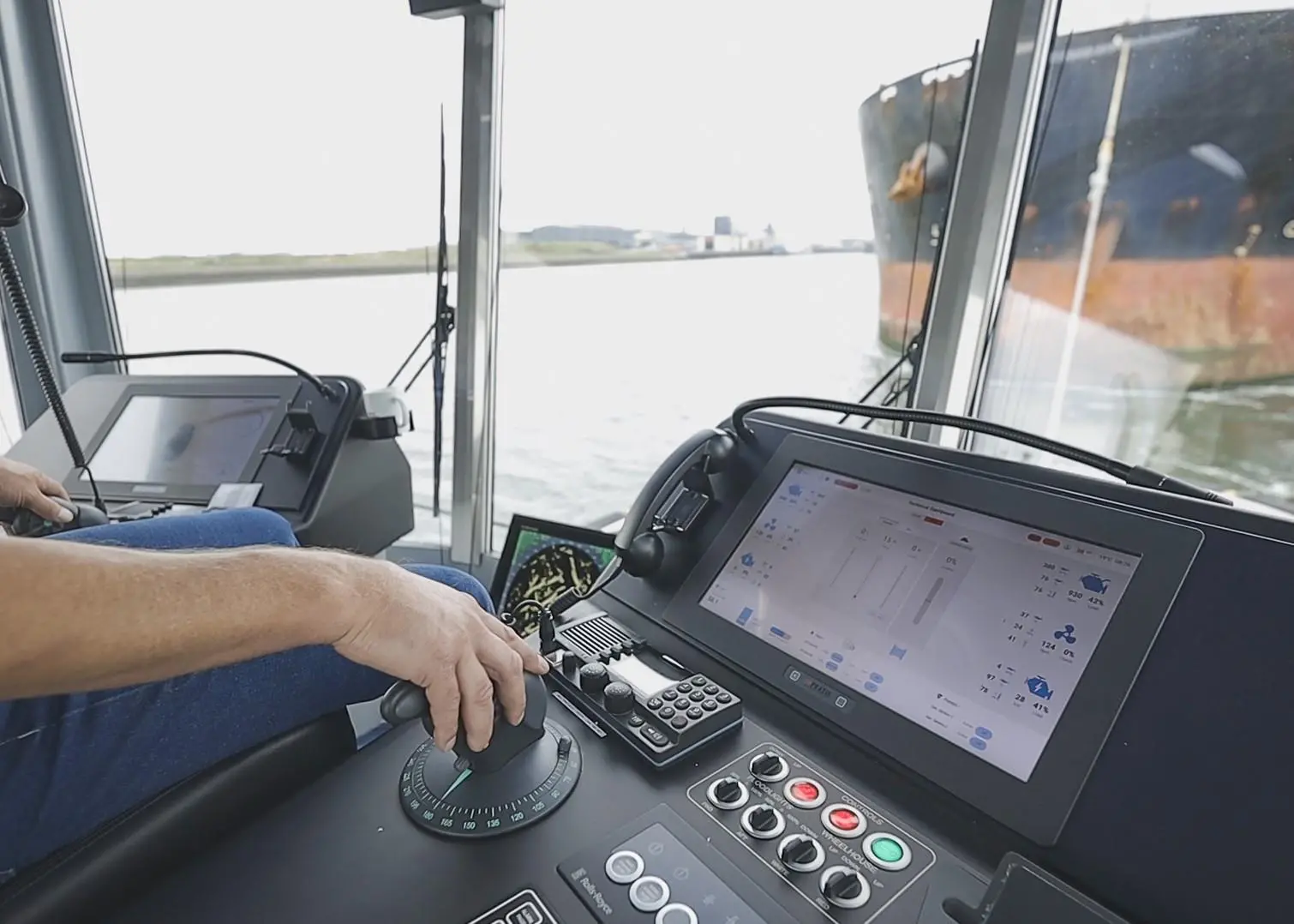
Julian Oggel, managing director of Novatug, says “there is a world to win” if digital data is captured and used correctly, but he believes a lot more could be done.
“Tug design is still a very traditional corner with very little imagination about what could be possible. The tug is basically an extrapolation of the original idea of a tool that could help shift a dead ship once it has stopped in port,” he confirms, but is also clear about the issue.
“The current problem is, however, a lot more dynamic and this calls for a different solution. Not a tool aimed at static pull, but one that can assist at speed and do so in an energy-efficient manner, so it is also clean. ICT (Information and communications technology) can help understand the problem parameters and show possibilities for solving those in an integrated way and this should then filter through to design changes.”
Novatug captures data such as line forces and vectors, fuel flow, propeller thrust, speed through the water, time and vessel heading. These are analysed relative to each other and give a clear indication of tug effectiveness and efficiency.
“We measure a typical ratio of Kw of engine power added per tonne of Kline force generated as a proxy for the tug’s (energy) efficiency. We learned that per tonne of line force generated during an assistance (which is the ultimate aim of a tug) the CRT [Novatug’s Carrousel Rave Tug] can save up to 80% of energy needed to pull compared to traditional tugs,” Mr Oggel confirms.
Digitalisation capture has helped Novatug’s measurement and simulation of different settings, particularly the position of the VSP units relative to hull length and position of the Carrousel ring, and the hull shape which is optimised for resistance.
Mr Oggel explains further. “Since the CRT works on hydrodynamic properties of the hull rather than on engine power to generate its forces, and surprisingly little is known about hydrodynamics, the data collected by the system is also used to train masters and (in the future) give real-time advice to crews about optimal operations.”
He also says that the use of sensors measuring parameters like vibration, acceleration, fuel consumption, load and emissions, all analysed relative to each other, in time helps plan maintenance.
While Novatug does not believe fully autonomous tugs will be possible for the foreseeable future, it firmly believes in “computer-assisted-towing”, with the tug crews getting more and better real-time information and advice about tug performance.
Low-hanging fruit
Mr Oggel is clear about the process from today. “The first step, which is really low-hanging fruit, of tug digitalisation is to provide much more situational awareness to tug crews, pilots and assisted vessels’ crews alike about the actual effect of tugs in port and what resources are being applied to reach that. This is hard as in the chain of maritime logistics everybody (tug operators, pilots, port authorities) traditionally works in a silo. Getting benefits from IT starts with having a full and complete picture.”
He is also certain what needs to occur first. “The ‘C’ for communication in “ICT” is often neglected and we feel that we first need to make sure we have access to the right information before we can complete the system to be optimal.”
Related Articles
 NEWS
NEWS
 CONTAINER & CARGO HANDLING
 OPERATIONS