




Changing course
Denmarks piloting sector has opened its doors.Will this overhaul further improve an already well-performing industry or become a massive cross to bear? Alex Hughes finds out
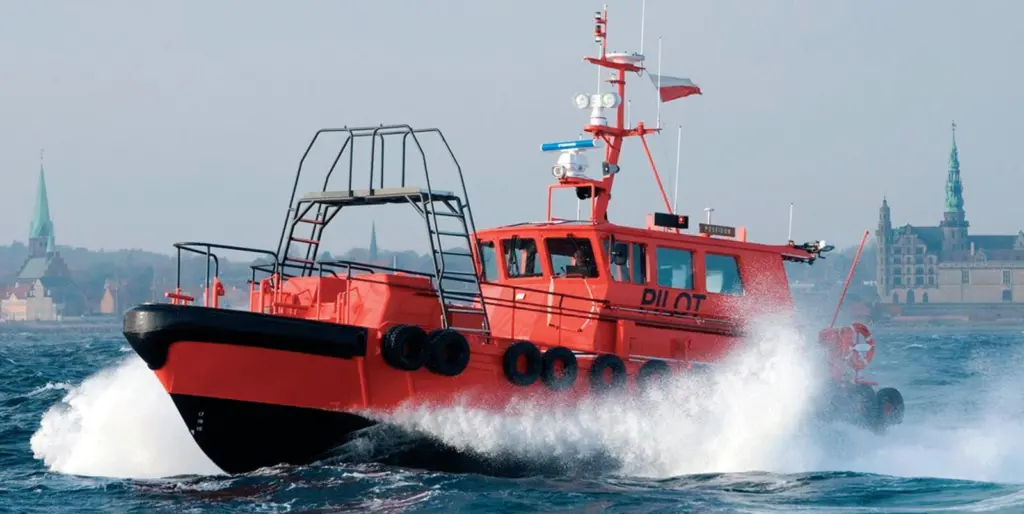
Danish ports are seeing a sea-change in services with the liberalisation of piloting, but opponents believe this could ultimately affect safety.
As from December 1, 2006, the not-for-profit Danish Pilotage Authority (DPA) assumed responsibility for all companies providing pilotage services in Danish waters. As part of new legislation, any company demonstrating the necessary competence can now provide pilot services, although none have so far challenged the former monopolist, the Danish State Pilots Association. Frank Gottlieb, who heads up the DPA, nevertheless expects new arrivals in the not-toodistant future.
“Government strategy is to introduce competition into this sector as a means of further improving pilot services to shipping lines.This should help bring down prices, even though these are not viewed as being particularly expensive,” says Mr Gottlieb, adding that yet cheaper prices might also persuade more vessels to make use of pilots.
Nevertheless, some vessels will be able to apply for Pilot Exemption Certificates (PEC), which will allow them to operate in Danish harbours without pilots. Under the previous law, vessels smaller than 1,500 dwt were exempt from the compulsory use of pilots, as were captains who had entered one port five times within the previous six months.However, as part of the new legislation, captains able to demonstrate the necessary competence will be able to apply for a PEC.
Pilotage services in Denmark have an enviable record. For example, in the eight years prior to 2005,no piloted ship in Danish waters had run aground on the Great Belt. Frank Gottlieb confirms that that record has been maintained up to the present day. Significantly,because these are international waters, ships don’t necessarily have to carry a pilot.”All we can do is to motivate shipping lines to take on a pilot. Last year, the statistic was that 95% of ships with a draught of 11 metres or more did take on pilots,” says Mr Gottlieb.
At the sharp end of these changes in Denmark is Stig Thomsen, head of the Danish Maritime Pilots Association (DMPA). He says that liberalisation of the pilot industry in Denmark does not make sense. “We believe future providers will look first at their bottom line performance, relegating safety into second place. This is because the only way pilot companies will be able to compete is on price.Vessel owners will therefore push pilots to do jobs in more and more uncertain ways. However, the DMPA agues that this is a public service and that economics should not be the main driver,”he says.
Mr Thomsen points out that, when the DMPA compared Danish pilotage costs with those charged in Sweden and Canada (which both use a similar calculating method), Denmark was significantly cheaper.In fact,justification for the liberalisation of pilot services in Denmark has been done purely on the basis of this having been a monopoly.
“I don’t blame shipping companies from wanting cheaper prices,but pilot services have to be provided at a certain level of quality.Nevertheless, the ruling by the competition authority was that these two things were not mutually exclusive, despite the fact that experience in both Australia and Argentina is to the contrary,” says Mr Thomsen.
He notes that several private sector companies are currently assessing the situation in Denmark; they only seem to be interested if they can enter the market as monopoly providers,which would imply swapping one monopoly for another.
“Curiously, those people in favour of pilot liberalisation are not in favour of liberalising police services, although both provide a public service. The obvious difference is that pilots make no recourse to the public purse, since it is the shipping lines, not the taxpayers, that pay our salaries!”
Notwithstanding his opposition to the general introduction of private management into the pilot industry, Stig Thomsen does nevertheless recognise that the separation of operations from regulatory duties has been positive.
“We now have concrete rules governing how pilot services must be provided, which will help minimise any potential damage caused by liberalisation of the industry. Previously, although services were inspected, there were no hard and fast procedures in place to govern these. Anybody, for example, could claim that they had visited a port the required five times within a given six month period and get a pilot exemption certificate; nowadays, you have to prove that and pass an examination for the area.”
Related Articles
 EQUIPMENT
 EQUIPMENT