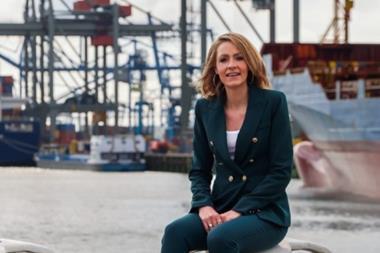
“I don’t think I’ve seen so many headlines related to shipping, if people don’t understand how integral shipping is to our global logistics system then perhaps they never will.”
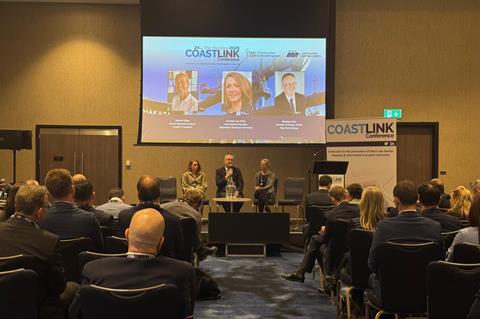
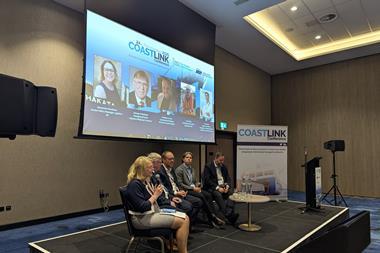
That was the opening comment at Coastlink 2026 by Nick Lambert, Coastlink chairman and co-founder and director, NLA International Ltd.
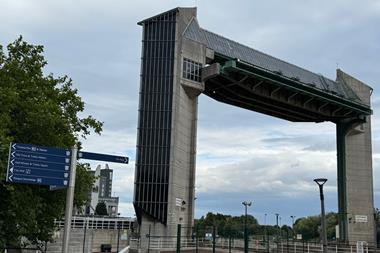
The short sea shipping and sustainable logistics networking event, Coastlink 2026, hosted in Hull by ABP Humber, comes at a critical time for both shipping and ports as they navigate their way through an evermore volatile global trade environment.
Building resilience
Mr Lambert praised the short sea industry for riding through the continued geo-political challenges, which continue to come thick and fast.
“Short sea has ridden through it all pretty well, without shipping, global economies would have gone to bits,” he said.
The aim of Coastlink this year, he said, would be to take the longer-term focus while continuing to manage the repeated trade shocks more strategically.
Paul Litten, head of commercial, ABP Humber, spoke about how Coastlink is helping to address these challenges as practical considerations.
“It is fitting this year the event is being held on the Humber for which short sea shipping is not an abstract proposition, but a commercial reality every day,” he said.
He pointed to the fact that the Humber handles 17% of the UK’s trade and is integral to the country’s short sea market. By nature therefore, it’s also fundamental in supporting the country’s shift towards sustainable shipping.
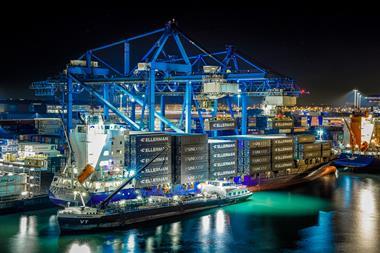
Using the example of the new Stena Line terminal construction at Immingham, he explained that going forward terminals must operate as logistics systems and seize opportunities for new commodities when they arise – carbon capture being one of them.
“Short sea and the energy transition are increasingly aligned,” he said. “The question is how do we align objectives so that decarbonisation accelerates not stalls.”
One of the answers to that he said, will be well shipping operators, ports and logistics providers can get at transporting cargo so it arrives close to its end destination by making road transport less attractive to customers.
Time of arrival is intrinsically balanced against cost, both of transportation and for fuel, that will steer how the short sea and the wider shipping industry operates into the future.
Collaboration is key
It’s certainly not a new topic at Coastlink, but this year the conversation around the urgent need for collaboration across the whole supply chain was king.
It was a central topic for Andima Ormaetxe Bengoa, director - operations, commercial, logistics and strategy, Port of Bilbao, which returned this year to Coastlink as the gold sponsor of the event.
“We need to collaborate because we share the same clients, vessels and logistics. By linking together as businesses we can bring better value to our customers and all reap the rewards,” he said.
The theme was picked up by Annette van Ketel, commercial manager, Rotterdam Shortsea Terminals, who said that turning uncertainty into opportunity is the way forward.
“As a sector short sea needs to find solutions to challenges affecting the whole supply chain because we can’t resolve them on our own.”
She said that at RST, the focus is on the potential for growth but in a different way – the customer comes first, it’s all about building long-term relationships and looking for ways to optimise the whole supply chain.
“The foundation of success is listening to the customer and creating a one-stop-shop at the same location, the focus should be on smarter collaboration both onsite and off.”
RST is delivering multimodal solutions with its inland shipping partners and partnering with local rail services, but says that more work needs to be done on truck turnaround times and the last mile.
Geo-political disruption
The impacts of traffic and trade disruption was as expected, central to the discussion.
Stephen Carr, director of public affairs, Peel Ports said that it’s no surprise volumes have largely been decreasing due to disrupted trade patterns.
He pointed to steel quotas in the UK which has resulted in supply issues driving costs up. This then of course is lead to a knock-on effect in the construction industry.
Environmental measures and regulation, ie the Emissions Trading Scheme (ETS), he said, can drive similar barriers in the market.
“The trouble is these trade barriers are causing serious consequences, but the’re often non-direct and unforeseen,” he said.
He pointed out that the UK government is inadvertently incentivising road transport rather than coastal shipping.
“This should be about making sure the supply chain is fit for purpose and not a substitute for supply, we should be ready and reactionary to change and follow the market more closely.”
Mr Carr’s advice to tackle this is to maintain flexibility across multiple commodities, continue to forge ahead with individual business strategy, including the sustainability agenda and ultimately, to become more energy self-sufficient, despite the market volatility.
Those are clear pathways to success, he said.
Topics
Related Companies
- Previous
- Next